

Mail This Article


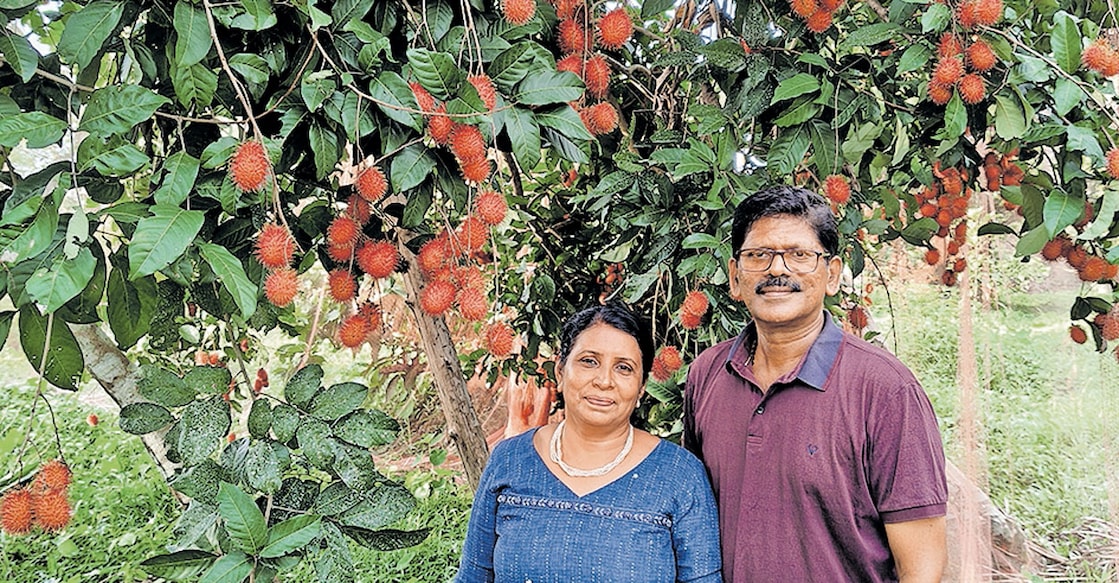
For many, retirement is a time to slow down, but for Wilson, the former HR Head at Angamaly Little Flower Hospital, it was an opportunity to accelerate his agricultural pursuits. Long before stepping down from his corporate desk, Wilson was already actively cultivating his 10-acre family estate. What began as a traditional plantation dominated by rubber and nutmeg has today blossomed into a breathtaking, high-yielding tropical fruit paradise teeming with rambutan, mangosteen, pulasan, and several other exotic species.
The shift to exotic tropical fruits
Wilson’s venture into fruit farming began 17 years ago when he planted 15 saplings of the popular N18 rambutan variety, sourced from Homegrown Nursery in Mannuthy. He fondly recalls taking his first harvest back to the nursery in Kanjirappally three years later just to confirm its authenticity. The outstanding success of those initial trees prompted a gradual but complete transformation of his land. Out went the rubber trees, replaced by a diverse mix of tropical wonders including rambutan, mangosteen, pulasan, abiu, achachairu, and jabuticaba, all while seamlessly integrating his existing nutmeg crops.

High-density planting for maximum yield
Today, rambutan is the cornerstone of the farm's revenue. Some of the mature 17-year-old trees yield up to 400 kg of fruit annually. Wilson's planting strategy has evolved significantly over the years. Rather than allowing trees to grow into unmanageable giants with wide spacing, he now champions a high-density model, spacing trees at 20 to 25 feet to accommodate 80 to 100 trees per acre. Wilson notes that planting one-year-old saplings ensures a yield of 60 to 70 kg per tree by the third year, which increases progressively every year.
Overcoming management hurdles through pruning
Managing large, sprawling trees presents several challenges, particularly when it comes to protective netting and harvesting. To tackle this, Wilson advocates for strict pruning to keep the canopy compact and low. This method not only simplifies pest control and netting against bats but also protects the trees from strong winds. While weed management in open spaces can drive up labour costs, dense planting naturally shades out weeds. If the canopy eventually overlaps, alternating rows can be thinned out, by which time the farmer would have already secured four to five profitable harvests. He highlights that the N18 variety remains the market favourite because it can stay on the tree for up to 20 days after ripening without spoiling, followed by a post-harvest shelf life of about a week.
Goldmine crops: mangosteen and pulasan
Alongside rambutan, mangosteen holds immense commercial promise. Wilson has around 50 fruit-bearing mangosteen trees on his property. While these trees typically take seven to eight years to bear fruit, he advises planting slightly older, mature saplings to advance the first harvest by two to three years. At the start of the season, mangosteen fetches premium rates of ₹250 to ₹300 per kg, tapering slightly as the market supply peaks. The farm also hosts 15 mature pulasan trees, which yield fruit in just two to three years and command early-season prices of up to ₹230 per kg.
A sustainable, integrated model
Wilson’s lush farm is entirely organic, sustained by a herd of nine native cows, including the celebrated Vechur breed. Their waste provides high-quality organic fertiliser, driving healthy yields across the entire orchard, including 120 prolific nutmeg trees. Capitalising on the exceptional quality of his mother trees, Wilson has also established a nursery named "Isidora", generating a steady stream of revenue from high-quality grafted saplings. Looking to the future, he is now gearing up to open his beautiful, well-maintained farm to agri-tourism, offering visitors a firsthand look at a sustainable tropical paradise.
