

Why Muslim League reminds CPI of 'good old days' amid tension with CPM?

Mail This Article


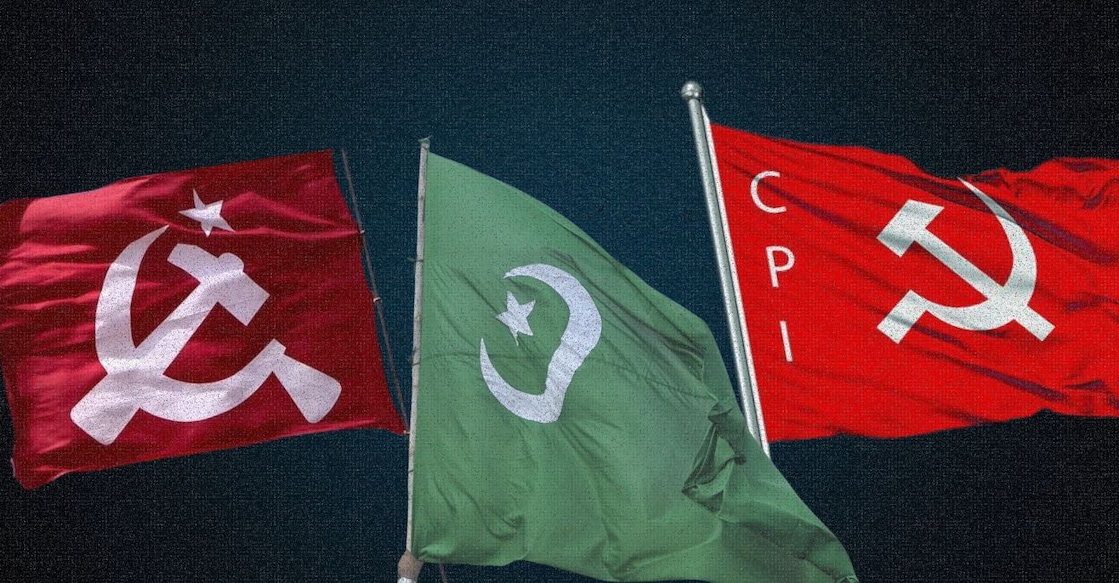
As the rift between the CPI and CPM over the Deputy Leader of the Opposition post deepens in Kerala, the Indian Union Muslim League (IUML) is seeking to exploit the growing strain within the Left, reminding the CPI of its 1970 alliance with Congress and the League.
The outreach has raised questions about what drives IUML to draw the CPI towards the UDF fold, particularly when the League itself remains firmly positioned within the front. With repeated overtures to the CPI, the League appears to be pursuing a twin strategy - bringing the party closer to the UDF while deepening its differences with the CPM and widening the fissures within the Left Democratic Front (LDF).
The recent editorial columns in the party mouthpiece Chandrika by senior IUML leaders K P A Majeed and K N A Khader have struck a notably conciliatory tone towards the CPI, invoking the political history of 1970, when CPI leader C Achutha Menon became Chief Minister with the support of Congress and the Muslim League. The references to that period appear intended not merely as political nostalgia, but as a reminder to the CPI that it has crossed the political divide before and that another realignment is not beyond the realm of possibility.
For the IUML, the attraction is clear. Bringing the CPI closer to the UDF would not only strengthen the front’s political arithmetic but could also weaken the Left’s organisational and electoral base. The League’s repeated outreach, therefore, appears less about political nostalgia and more about exploiting the growing differences within the LDF and weakening the CPI–CPM relationship.
In his article, Majeed, national vice-president of the IUML, argued that the period of the Achutha Menon government, when the Muslim League, CPI and Congress ruled together, laid the strong foundation for Kerala’s development. It was during this period, he said, that the world-renowned Kerala model in education and healthcare began to take shape. There is only one party that turns a blind eye to this reality, he said, referring to the CPM.
“C Achutha Menon, who served as Chief Minister from November 1, 1969, to March 25, 1977, was the one who made land reforms a reality in Kerala. However, the CPM, by turning a blind eye to history, gives the credit for land reforms solely to EMS Namboodiripad and K R Gouri Amma. When the golden jubilee of land reforms was celebrated in 2010, Chief Minister Pinarayi Vijayan did not even mention Achutha Menon’s name in his speech,” he said.
“The CPM will never be able to accept the fact that Kerala achieved its ‘number one’ status when the Muslim League, Congress and CPI ruled together,” the article said.
Majeed also invoked the role of Muslim League leaders in the formation and functioning of the Achutha Menon government. Bafaqi Thangal, who helped make C Achutha Menon Chief Minister within a week of E M S resigning, and C H Mohammed Koya and K Avukadar Kutty Naha, who distinguished themselves as ministers in that government, belong, he said, to the same “golden chapter” of history that records the contributions of the Muslim League and CPI.
Highlighting the cordial relationship that has existed between the IUML and CPI, Majeed pointed out that even after the CPI left the alliance and joined hands with the CPM, the Muslim League and CPI had engaged in healthy criticism and debate without adopting an approach that undermined each other’s dignity. Indirectly inviting the CPI towards the UDF fold, he argued that unless the LDF moves away from authoritarianism towards democracy, it would become difficult for the CPI to continue in the alliance. V D Satheesan’s 'hundred-day rule', he said, is making it clear that the UDF is the real Left in Kerala.
Meanwhile, former MLA and senior IUML leader KNA Khader, in another article, sought to place the CPI’s current predicament in the broader context of political realignments. Defections by elected representatives, floor-crossing and changes in political alliances at the national and state levels are nothing new, he pointed out, citing recent developments from Bengal to Tamil Nadu. Parties that contested elections together subsequently joining another coalition is also not unprecedented, he noted, giving the CPI another reason to consider the possibility of a political realignment.

Khader further pointed out that the CPI joining the UDF could take the UDF’s majority in the Assembly to 110, creating an overwhelmingly favourable situation and potentially splitting the LDF down the middle.
“Even if the CPI cooperates with the UDF, there would be no significant damage to its existing party positions. At the national level, its politics could become more firmly established and much broader. For the CPI, one major relief would be that it would no longer have to carry the burden of the failures of the Kerala CPM,” he said.
“In Kerala, an alliance with Congress is, for the CPI, more appropriate than remaining with the CPM. There is little need to emphasise that this is an unusual period in which parties belonging to the INDIA alliance have the flexibility to change alliances at the state level without changing their broader political objectives,” Khader said, recalling the alliance of the 1970s. “History’s greatest lesson is that it repeats itself at intervals,” he added.
Speaking to Onmanorama, IUML state general secretary P M A Salam said the party and the UDF would discuss the matter if the CPI openly declares any stand regarding its ties with the LDF.
“UDF is yet to invite CPI to its fold formally. But, if CPI wants to join UDF and the party informally declares it, we will hold discussions regarding this,” he said.
Political observers, however, see the CPI’s criticism of the CPM and the IUML’s outreach as part of a larger political game, rather than an immediate possibility of the CPI joining the UDF. Political analyst A Jayashankar said the CPI’s criticism could be a strategy to pressurise the CPM, while the IUML’s outreach could be aimed at creating a divide within the LDF.
“UDF can initiate any discussion regarding the CPI’s joining UDF only after the Congress party takes steps for such an alliance. There are possibilities for CPI, as CPM and CPI have formed alliances with different parties in different regions of the country, such as DMK, TMC and TDP during different periods. But, for CPI, the opposition of CPM to give Deputy Opposition Leader cannot be taken as a serious reason for leaving LDF,” said Jayashankar.
Jayashankar also pointed out that the 1970 alliance was the result of the strong stand taken by the Congress party, which was in power at the Centre at the time, and that there is no such political situation in Kerala today.
“Rather than forming an alliance with CPI, Muslim League may aim at a divide within LDF and redraw political equations in the state,” he said.
It was after the collapse of the CPM-led government in 1969 that the CPI moved away from the CPM and joined hands with the IUML and other parties, with Congress extending support from outside to Achutha Menon’s government. After the 1970 Assembly election, the CPI, Congress and IUML came together in the United Front, with Achutha Menon returning as Chief Minister; Congress formally joined the ministry in 1971. The alliance continued until the end of the Achutha Menon government in 1977.
CPI Secretary Binoy Viswam has, however, played down IUML's enthusiasm, saying that he and his party are clear about the depth of the alliance.
