

Engineers behind fisheries startup who gifted ₹4000/kg worth crab to Kerala CM Satheesan

Mail This Article


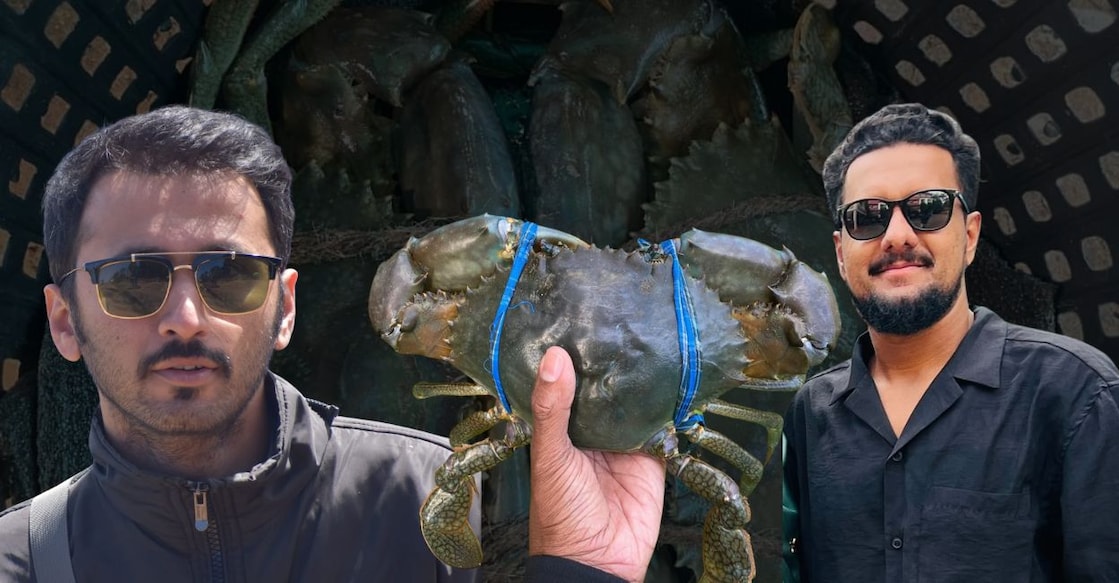
Kerala Chief Minister V D Satheesan, recently opened a gift box at his office in Aluva. Inside was a huge live mud crab. The video has gone viral on social media, garnering over 1.7 million views in less than 24 hours. The unusual gift came from Kochi-based Bluecroft Farming Pvt Ltd, a sustainable fisheries startup founded by two mechanical engineering graduates, Ram Narayan and Liyakath Ali, who are exploring a more resource-efficient approach to crab farming.
After trying their hand at jobs, other businesses and different farming ventures, the duo turned to crab farming two years ago, entering a sector fraught with production and marketing risks. Operating from Kannamali in Kumbalangi, Ernakulam, Bluecroft follows a technology-driven, resource-efficient model that requires limited manpower, space and water. Focusing on exports and retail deliveries, the startup maintains around 200 crabs at a time and sells them for ₹4,000 per kg.
“We started by farming different fish species and later ventured into crab farming using natural ponds. The initial project required four acres of land. Environmental concerns, financial constraints and other challenges eventually pushed us to focus exclusively on crabs through a sustainable model,” said Ram Narayan.
Ram, 32, from Alappuzha, and Liyakath, 33, from Malappuram, were classmates at Ilahia College of Engineering and Technology in Muvattupuzha. After graduation, Liyakath ventured into food production, while Ram worked in food exports. It was Ram who identified an opportunity in seafood exports and proposed the idea.
“I was going through a difficult phase in my business after the pandemic when Ram suggested the idea. Our initial models were not very successful. That pushed us to develop a more organised and sustainable model that could operate in different weather conditions without harming the environment,” Liyakath said.
Bluecroft now operates on a four-cent plot, with a working area of approximately 1,200 sq ft. The founders procure juvenile or partially grown crabs from local fishermen and rear them for around four months before selling them. “When we buy them, the crabs do not have much meat. We nurture them, provide feed and necessary supplements, and allow them to grow for about four months until they develop sufficient meat for sale,” Liyakath explained.

Each crab is kept in an individual container, with close attention paid to its surroundings. According to the founders, crabs are sensitive to stress, which can affect their feeding habits and growth. “They prefer shady, undisturbed places. Even when we feed them, we leave the area immediately because noise can stress them and affect their food intake and growth. Keeping them stress-free is one of the most important aspects of the process,” Liyakath said.
Temperature and water levels must also be carefully monitored to maintain suitable conditions. The model has significantly reduced the farm’s water requirements. “Earlier, maintaining a natural pond required around 40–50 lakh litres of water. Now, we use approximately 7,000 litres,” he said.
The startup currently employs just two staff members - one to care for the crabs and another to handle coordination, packing, deliveries and exports. However, maintaining and cleaning the containers remains time-consuming, prompting the founders to explore automation.
“We are working towards automating 70–80% of the system using AI. The aim is to create a controlled environment in which temperature, lighting, water chemistry, dissolved oxygen and sound levels can be monitored and managed automatically. We also want the system to conduct daily, weekly and monthly checks,” Liyakath said.
The duo has also identified the limited availability of crab hatcheries as a major challenge for the sector. They hope to establish their own hatchery to address the shortage and improve the availability of juvenile crabs.
Designs and prototypes for both the automation system and the hatchery are in development. The founders expect these initiatives to improve productivity and make the business more stable. With support from organisations such as the Kerala Startup Mission, they are also looking to expand their direct sales and live-crab export operations.
“We can also courier live crabs to individual customers in specially packed parcels. They can survive for up to three days in transit without any issues,” Liyakath said.
Building the venture, however, has not been easy. “When we started, we faced several obstacles, including doubts and confusion among our family members. There were no established models for us to learn from. Everything we have achieved and learnt has come through our own experiences and setbacks,” Liyakath said.
