Vesak and the Kerala-Sri Lanka Buddhist Connection

Mail This Article


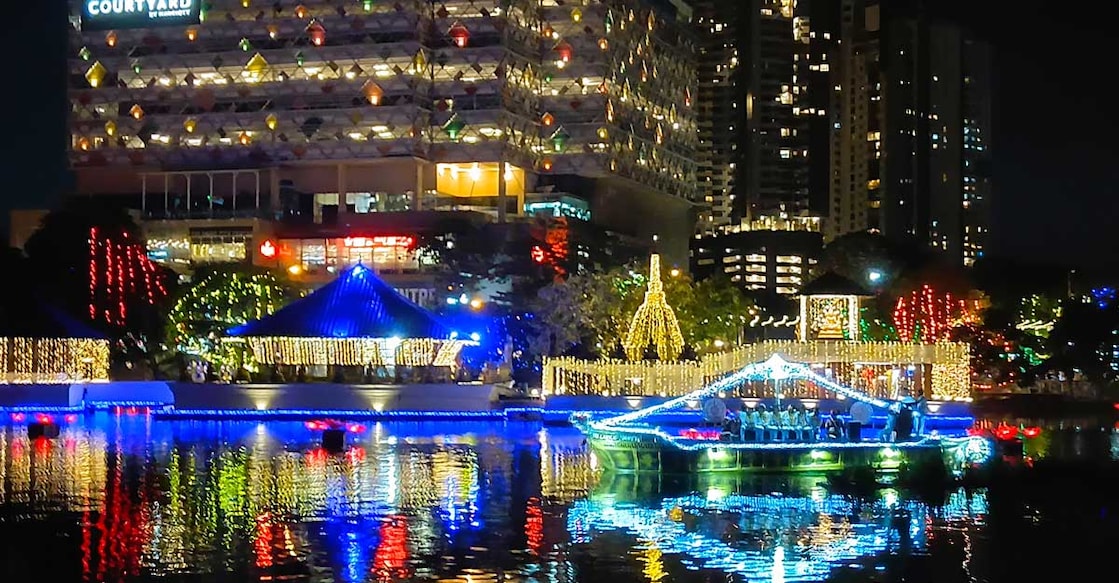
Ever since I read Sybil Wettasinghe’s ‘Vesak Lantern,’ I dreamt of being on the island during Vesak, the festival celebrated on the full moon day in May that marks the birth, enlightenment and death of the Buddha. Over the last two decades something or the other always came up, but this year when I went to Colombo for a family wedding, I had the privilege of witnessing the festival in the city. There were two full moons in May but Vesak was marked on the second one.
Coming from a family that observes religious occasions, I know how important the Vishakam month on the Kerala calendar is. In fact, the sheer importance of the full moon night or purnima as we call it, could have had something to do with Kerala’s Buddhist past.
On the Vesak full moon night, I walked around the town of Nugegoda, which is next to Colombo, to observe the ‘pandals’ and also witness what is called ‘dansala,’ giving food and beverages to the general public. Incidentally, this year, Priyanga Wickramasinghe, the consul-general of Sri Lanka in Mumbai organised a dansala in the crowded fort area of the city, where the consulate is located.
Back in Nugegoda, as I drank a few glasses of lemonade and ate some ice cream on what was an incredibly hot and humid evening I saw a crowd piling up outside a temple that I had passed by many times but never visited. Preparations were on for a perahera, a small elephant parade with musicians dressed in traditional Kandyan costumes leading the way.
This reminded me so much of the utsavams that we have in Hindu temples in Kerala. This is by no means a coincidence. The southwestern Indian state and the Emerald Isle have had exchanges that weren’t properly recorded or erased from memory.

In his book titled A Survey of Kerala History, historian A Sreedhara Menon wrote that even though Buddhism disappeared in Kerala by the 12th century, it left a 'lasting impact' on Kerala society.
“The images, processions, utsavams, etc., associated with popular worship in Hindu temples in Kerala are said to be a legacy of Buddhism,” Menon wrote. “Special mention may be made of the impressive festivity called Kettukazhcha or Kutirakettu associated with temple festivals or utsavams in Quilon and Alleppey districts.” Since I haven’t personally witnessed the festivals in those two districts, I wouldn’t be able to compare them with celebrations in Sri Lanka, but there was definitely a sense of familiarity with what I saw at Vesak.
Many scholars have written about a Buddhist link to Sabarimala, although this has been debated. Menon saw the Buddhist link to the Ayyappa shrine with pilgrims making a vow of non-violence, vegetarianism and abstinence from worldly pleasures, adding that this is a remnant from the Buddhist principle of Ahimsa.
“The sing-song repetition of Saranam Ayyappa by the lakhs of Hindu pilgrims who go to the shrine of the Dharma Shastha of Sabarimala also reminds one of the triple Saranam formula of the Buddha, the Dharma and the Sangha of the Buddhists,” Menon wrote.
The scholar made mention of other areas such as Ayurveda and education. “The extensive popularity of the Ayurvedic system of treatment in Kerala is believed to be a gift of Buddhism,” he wrote. “Many of the Buddhist monasteries had dispensaries where free medical aid was given.”
I remember being a bit sceptical at one time of Ayurvedic spas in Sri Lanka linking the treatment to Buddhism, but I stand corrected.
Menon said Buddhist Viharas (called pallis) in Kerala had schools and colleges and that Buddhist monks were pioneers in the field of education. He added that later on Hindus adopted this method of running educational institutions alongside their temples.
The scholar also pointed out that Buddhism contributed to the development of arts and literature in Kerala.
So, being in Sri Lanka during Vesak was in some ways reconnecting with my deep Kerala roots. There is so much that we observe as children and forget, but the memories are stored deep in the subconscious mind, and reemerge when we see something that resembles an old memory.
It would take a very serious and committed work of scholarship to unveil the true depth of the connections between Kerala and Sri Lanka. In the meantime, there will always be a sense of home and familiarity when Sri Lankans visit Kerala and Malayalis visit the beautiful island nation.