

France find their rhythm after Senegal expose early cracks

Mail This Article


The 2002 World Cup kicked off with a game between defending champions France and debutants Senegal. It was supposed to be a routine outing for the 1998 winners, but when the final whistle blew, Senegal had stunned the champions 1-0. When the groups were announced for the 2026 World Cup, France versus Senegal immediately caught the eye as either an opportunity for Les Bleus to exact revenge or for Senegal to prove that lightning can strike twice.
Looking at France’s starting eleven, it was clear Didier Deschamps was trying to accommodate all his best players. He had an enviable problem: too many attacking options and too few positions. His chosen formation was an awkward 4-3-2-1, with Ousmane Dembele deployed as a No. 10. It quickly became clear that the French players were struggling with their roles.

Counter-attacking has been the blueprint for many underdog teams at this World Cup. We have already seen, particularly in Brazil versus Morocco, that teams such as Senegal and Morocco, unable to match their opponents in pure firepower, are content to sit deep and wait for the slightest mistake before breaking forward. Unfortunately for Senegal, their excellent approach play repeatedly ended in poor finishing or, on one occasion, the woodwork. They were unlucky not to be 2-0 up before half-time.
As the players headed down the tunnel, France looked uninspired. Misplaced passes and awkward attempts to recover lost space made them appear to be chasing the game throughout the opening 45 minutes.
Apart from Michael Olise, the other feared forwards — Mbappe, Doue and Dembele — barely imposed themselves in the first half. Dembele, in particular, struggled to find his place. Having thrived as a striker in Paris Saint-Germain’s fluid front three, he was pushed deeper to accommodate Mbappe as the lone striker.
Yet what makes PSG so dangerous under Luis Enrique is the freedom afforded to the front three to interchange positions. With Dembele operating as a No 10, his movement into advanced areas left large spaces for Adrien Rabiot and Aurelien Tchouameni to cover. Senegal exploited those spaces repeatedly on the counter. Olise, France’s brightest attacking outlet, was also dropping deep to help defensively, which further reduced their creativity in the final third.
However, any hopes of a repeat upset were extinguished in the second half. From the opening whistle, France finally looked awake. Every attack seemed to carry greater purpose as they edged closer to a breakthrough.
A key adjustment by Deschamps was moving Olise into the No 10 role and allowing attacks to flow through him instead of Dembele. Unlike the first half, when France relied heavily on the wings, they began constructing attacks through central areas.
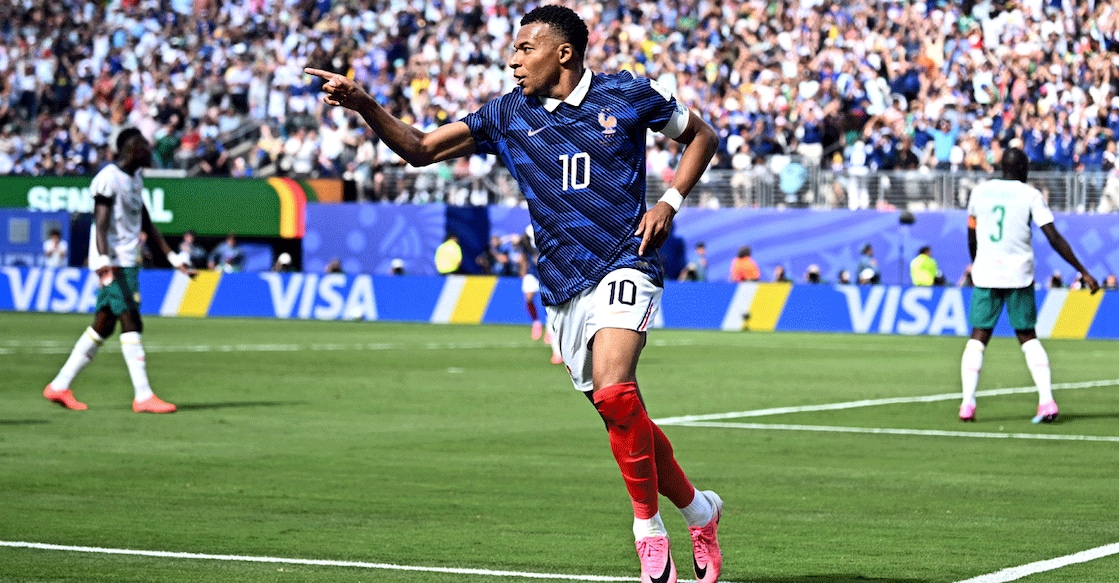
The breakthrough eventually arrived in the 66th minute when Olise threaded a superb pass into the box for Mbappe to finish at the far post. While Mbappe’s finish was top-class, the greater credit belonged to Olise’s vision in spotting the smallest opening.
Senegal refused to fold. For a brief moment, they thought they had equalised straight from the restart, only for Nicolas Jackson to be flagged offside.

France’s pressure only intensified thereafter, and it became a matter of who would score the second goal rather than whether it would arrive. The answer was Bradley Barcola, making his World Cup debut, who scored just two minutes after replacing Dembele in the 80th minute.
After recovering possession in their own half, Senegal were caught out of shape as Rabiot split the defence with a pass for Barcola’s perfectly timed run. The timing of both the pass and the movement left Barcola with a simple finish over Edouard Mendy.
Just when all hope seemed lost for Senegal, Ibrahim Mbaye produced a wonderful run in the 94th minute that left Theo Hernandez sprawled on the ground before drilling the ball past Mike Maignan. With the score at 2-1 and four minutes remaining, a comeback still seemed faintly possible.
However, all doubts were erased a minute later as Mbappe reminded everyone why, at 27, he is already regarded as one of the greatest World Cup players of all time.
Olise was dispossessed outside the Senegalese box, but Mbappe pounced on the loose ball, took a touch and unleashed a strike from 30 yards. The goal made him France’s all-time leading goalscorer with 58 goals, overtaking Olivier Giroud. It also moved him within two goals of a World Cup-record of 16 goals scored by Miroslav Klose and Lionel Messi.
Since his hat-trick in the 2022 final, Mbappe’s public image has undergone something of a rollercoaster. After leaving Paris Saint-Germain in 2024, he completed his dream move to Real Madrid, forming a partnership with Vinicius Jr that seemed destined to dominate European football.
Instead, echoes of the Galacticos era emerged. Two trophyless seasons and multiple managerial changes followed. Although Mbappe finished both campaigns as La Liga’s top scorer, PSG’s back-to-back Champions League triumphs fuelled suggestions that his departure had somehow liberated his former club.
Nevertheless, the World Cup remains Mbappe’s stage and, if today was any indication, he is ready to silence those doubters once again.
France’s dominant second-half display underlined why they remain one of the tournament favourites, particularly given their extraordinary attacking depth. However, Deschamps still faces questions about his preferred starting eleven, as France’s shaky opening was cause for concern.
Senegal, meanwhile, will look back on the first half with regret. Their wasteful finishing proved costly, and coach Pape Thiaw may have to consider giving more opportunities to younger players such as Mbaye ahead of veterans like Ismaila Sarr, who endured a difficult evening in front of goal. They will hope to recover in their second game against Norway.
 Add as a preferred source on Google