

A 146-goal Portugal career and an inglorious last game; Ronaldo deserved a better farewell

Mail This Article


Cristiano Ronaldo, a name synonymous with Portuguese football, has called time on his international career. It was a journey spanning 234 appearances and 146 goals, the most by any player in men's international football.
However, whether such an illustrious career had a glorious ending remains a question. One can argue that not every fairytale, no matter how extraordinary, gets the beautiful ending it deserves.
The 2026 FIFA World Cup was the stage that made the world believe the 41-year-old forward's international career could be nearing its end. Just months later, the inevitable happened.

Under new head coach Jorge Jesus, who had also managed him at Saudi club Al Nassr, Ronaldo hoped to rediscover the form that had eluded him throughout the World Cup.
Then came Portugal's friendlies during the international break in September. The first was against Wales. Ronaldo started in attack, but in the 67th minute, Jesus made a tactical call: the captain was substituted.
No one knew that it would be the last time Ronaldo would take the field for Portugal. A career that deserved a complete farewell, much like that of his peer Lionel Messi with Argentina, appeared to be heading towards an unceremonious end. Ronaldo walked off the pitch visibly furious.
He was frustrated at being substituted. After the match, a heated argument reportedly broke out between Ronaldo and Jesus.
The next friendly was against Norway. Ronaldo was not named in the starting line-up and was benched by Jesus. But the trouble was only beginning.
Before the game, Jesus told Ronaldo that he would not be featured because of fitness concerns and assured him that he would get opportunities in the coming matches.
However, Jesus went back on his word and asked Ronaldo to warm up at half-time. Despite that, the forward was not brought on. After the final whistle, Ronaldo simply walked out of the tunnel, a gesture reminiscent of his fallout during his second stint at Manchester United.
By the time Portugal faced Denmark, tensions between the star and his coach had intensified. Ronaldo, believing that he would not be given a chance, left the training camp. He later revealed that Jesus had broken an understanding to give him playing time, prompting his decision to walk away.
The episode did not end there. The Portuguese Football Federation handed Ronaldo a 30-day suspension for disciplinary violations.
Meanwhile, fans around the world hoped the superstar would return to the national team before calling time on his international career. But that was not to be. Just days after his suspension ended, Ronaldo announced his retirement.
"To the Portuguese people, the day has come for me to hand back the No. 7 shirt of our national team," said the boy from Madeira, who made his international debut in August 2003.
A career that won everything but the World Cup
Ronaldo was the face of Portuguese football for more than two decades. Before him, Portugal had produced several great footballers, including Eusebio, Rui Costa and Luis Figo. Their individual brilliance, however, did not translate into sustained success on the international stage.
Portugal's biggest achievement at the World Cup had been reaching the semi-finals in 1966, led by the legendary Eusebio.
In 2003, Ronaldo took the baton from these legends to become the great of the game. Built on hard work and determination, his career saw him carry the national team on numerous occasions.
Some may argue that Portuguese football can be divided into two eras: before Ronaldo and after him. Trophies alone do not define the difference. His greatness extends far beyond the silverware he helped the country win.
Take the 2016 European Championship final against France. Portugal's first major international trophy was within reach, but Ronaldo was forced off on a stretcher after picking up an injury. What followed remains one of the most memorable moments in the country's football history.
From the sidelines, Ronaldo continued to urge his teammates on. In the 109th minute, Eder scored the winner, securing Portugal's first major international title.
The team went on to win two UEFA Nations League titles. Yet the World Cup remained Ronaldo's biggest dream.
He represented Portugal at every World Cup from 2006 onwards, having also featured in the tournament that year. His only appearance in a World Cup semi-final came in 2006.
One of his finest World Cup moments came in the 2018 edition in Russia, when he scored a hat-trick against arch-rivals Spain in the group stage. Ronaldo opened the scoring and shot another before Spain levelled at 2-2. Spain then moved ahead, leaving Portugal staring at defeat.
But Ronaldo had one more moment of magic. Standing over a free-kick outside the box in the 88th minute, he struck a stunning effort into the net to complete his hat-trick and rescue a 3-3 draw. It remains one of the most iconic goals of his international career.
Portugal, however, were knocked out in the round of 16. In 2014, they failed to progress beyond the group stage, while their 2022 campaign ended in the quarter-finals. That was also the year Messi reached the pinnacle of his career by lifting the World Cup.
After Messi's triumph, the world hoped Ronaldo would have his moment too. With a strong national team heading into the 2026 tournament, many believed he could sign off with a memorable campaign.
But fate had other plans. Portugal's game appeared to move away from Ronaldo, with teammates often choosing to play the ball back rather than find him as he waited up front.
In the round of 32 against Croatia, Portugal won a free-kick, and Ronaldo stepped up to take it.
It was a familiar sight, one that had defined his 23-year international career. He struck the ball into the net, sending the crowd and fans around the world into celebration. No one knew they were witnessing the final goal of his Portugal career.
Portugal advanced after defeating Luka Modric's Croatia, his former Real Madrid teammate. Portugal were eliminated in the next round, bringing his World Cup campaign to an end.
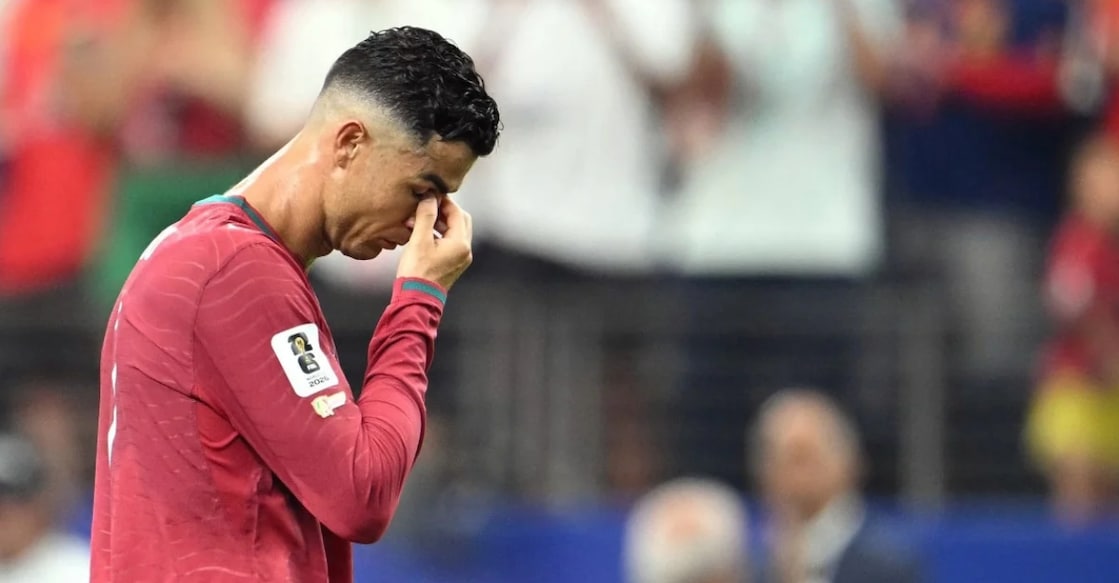
Ronaldo was in tears, and the world shared his disappointment. Some believed age would prevent him from featuring in another World Cup, and he himself had hinted at the possibility. But he remained committed to representing Portugal until the inevitable finally arrived.
"Today the time has come to pass it (the No. 7 shirt) on to the future. A journey that began in August 2003 and changed my life forever has come to an end," Ronaldo said.
He may have wanted a different ending, but the memories of his goals, his celebrations and the moments he gave Portuguese football will endure long after he has handed back the shirt.
