

Sanju's 'selfless' act reopens old debate about relevance of personal milestones in team game
Mail This Article


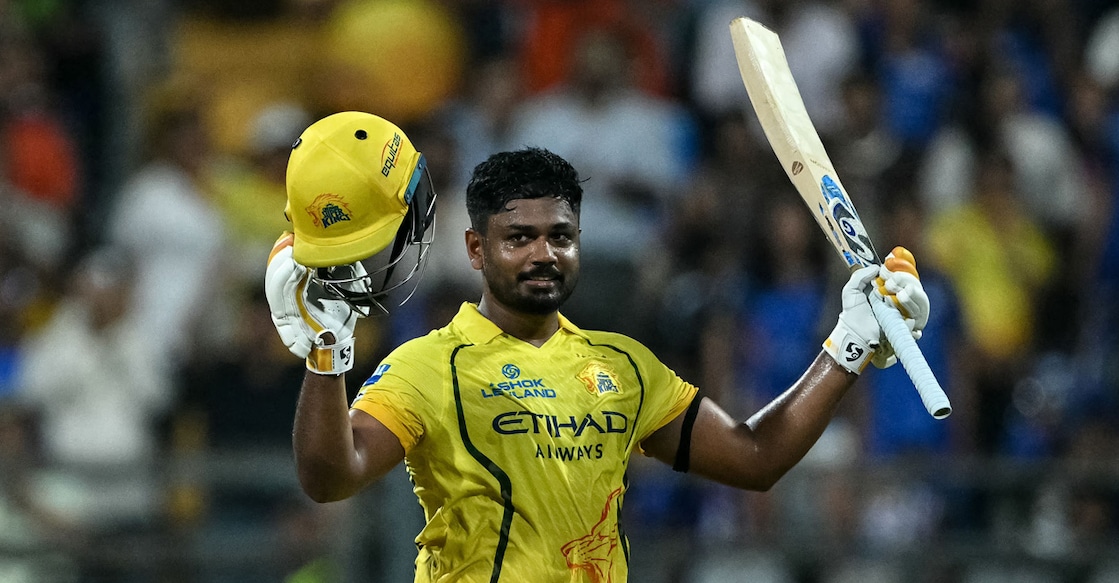
Sanju Samson played a brilliant innings of 87 off 52 balls to guide Chennai Super Kings (CSK) to a facile eight-wicket victory over Delhi Capitals (DC) in the 48th match of the ongoing edition of Indian Premier League (IPL) to keep his side in the reckoning for a place in the knockout phase of the championship.
Samson’s knock, where he not only anchored the response to CSK to a target of 156 runs but also stepped up the pressure on the pedal when required, came in for high praise from observers. He guided the run chase after the loss of two early wickets, displaying a calm and serene demeanour, and stayed at the wicket till the end to seal the win. This superlative performance underlined that fact that he is presently the best batsman in the country in white-ball cricket.
One of the questions posed to Samson after this match was about missing out on a century. Since the match was won with 15 balls to spare, Samson could have easily farmed the strike during the last phase of the innings and reached this personal landmark. Had Karthik Tyagi not finished off the match with a flurry of boundaries, Samson might have reached this landmark.
But Samson did not show any disappointment when he was asked this question. Replying to Harsha Bhogle, who posed this query, he said: “A hundred is always special. But for that I would have had to be a bit selfish. I did not say ‘take a single, let me get my hundred.’ I thought it was better to win the match for the team.”

This statement of Samson, which was widely reported in print and social media, won the player rich compliments from followers of the sport all over, cutting across loyalties to the franchisees. Two former players who applauded Samson for this innings and his approach were Sunil Gavaskar and Virender Sehwag. While Gavaskar praised his patience saying that this trait will bring him big rewards, Sehwag chose to highlight Samson’s improved game awareness. For the record, Samson has two centuries to his credit in IPL this year and is one of the front-runners for the Orange Cap award.
The use of the word “selfish” by Samson opened up an old debate about relevance of personal achievements in a team sport. The followers of any team sport want their side to do well and win; any personal landmarks achieved in the process becomes an added cause for celebration. However, there is no denying the fact that there still exists a deep admiration in India about personal achievements in team sports. This can be seen from the celebration that followed when Sachin Tendulkar became the first batsman in the world to score 100 centuries in international cricket. This took place during the One Day International (ODI) against Bangladesh at Mirpur on March 16, 2012. After Tendulkar scored his 99th century in March 2011, he had to wait for a year to reach this peak made the achievement appear all the more significant. The fact that India lost this match by a margin of five wickets was overlooked during the celebrations that followed Tendulkar reaching this landmark.
Till the mid 1980s when limited overs’ cricket emerged as the more popular version of the game, more often than not, the prime intention of the national side was not to lose a Test, rather than winning it. This strategy invariably led to batsmen trying to spend as much time at the crease as possible, as part of their attempt to save Test matches. In this situation, batsmen who played long innings’ won accolades despite the fact that the cricket on display was seldom entertaining and invariably boring. Amongst the few exceptions to this rule were Farokh Engineer, the dashing wicket-keeper batsman, Kapil Dev, the brilliant all-rounder, and Sandeep Patil, an outstanding strokeplayer. All of them were extremely popular with the crowds, though the flip side was that they were often blamed for throwing their wickets away and batting in an irresponsible manner.
Indian batsmen refused to shed their Test match approach while playing limited overs’ cricket during the initial phase after this version became part of the international calendar. Gavaskar’s unbeaten innings of 36 in the first match of the inaugural World Cup in 1975 against England, which came off 174 balls, stands as the best example to this phenomenon. But a closer look shows that, with the exception of Kapil Dev, other Indian batsmen continued with their safety first approach till around the mid 1980s.
A study of the first four centuries scored by the Indian batsmen in the first 100 ODIs played by the country highlights this fact. The first amongst these was the unbeaten 175 scored by Kapil Dev at Turnbridge Wells against Zimbabwe during the 1983 World Cup, which not only won the match for the side but also acted as the turning point that catapulted India’s campaign into an irresistible force. Amongst the other three, two were by Ravi Shastri (102 off 144 balls against Australia at Indore in 1984 and 102 off 142 balls against England at Cuttack) and Dilip Vengsarkar (105 off 125 balls against England at Pune). India lost all these three matches and the main reason was the tendency of the above batsmen to slow down the pace of run-getting when getting closer to their century and a tendency to throw their wickets once they reached this landmark. Even when Shastri won the “Champion of Champions”, following India’s win in the World Championship of Cricket held in Australia in 1985, there were murmurs that he batted more with an eye on his individual score in the last two matches to ensure that he did not miss this award!
This fascination towards attaining personal landmarks started diminishing only after Sachin Tendulkar entered the fray and India started winning matches more regularly from the 1990s onwards. However, this was not a quick process as it was not easy to shed the old habits that had become ingrained in the approach of players. The fact also remained that making tall scores in domestic cricket was the only way through which young players could capture the attention of national selectors and the media. The inherent insecurity of losing a place in the national side and being condemned to go back to first class circuit may also have played a role in shaping the mindset of the players on the fringes of the national side into adopting a “safety for self” approach.
This transformation of approach gained pace after the turn of the century, with skippers Saurav Ganguly and Mahendra Singh Dhoni playing yeomen roles in speeding up the process. This led to the team management and the selectors placing less reliance on the scorecard and looking more at the contributions of players towards the team’s effort. This trend was carried forward by Virat Kohli and Rohit Sharma with the result that players today place the team above self and results of the match matter more than personal achievements of the individual players. The advent of IPL with its focus on results, where the franchisees look only at the bottom-line has helped to make the up and coming players also to adopt this approach. This is also the prime reason behind the national side winning more titles in limited overs’ cricket during the last two decades.
Thus, the response of Sanju Samson to the question posed regarding missing out a century highlights a basic attitudinal change that has taken place in the mindset of the present generation of players. It is not coincidental that this was articulated by a player from Kerala, a state that does not have a rich history or tradition of producing great cricketers. This is a pointer towards the future of the game in India, where focus on contributions from players towards the team effort will hold the key and individual milestones fade into the background.
 Add as a preferred source on Google