

Kerala's Wayanad coffee plantations turn into a sea of white flowers

Mail This Article


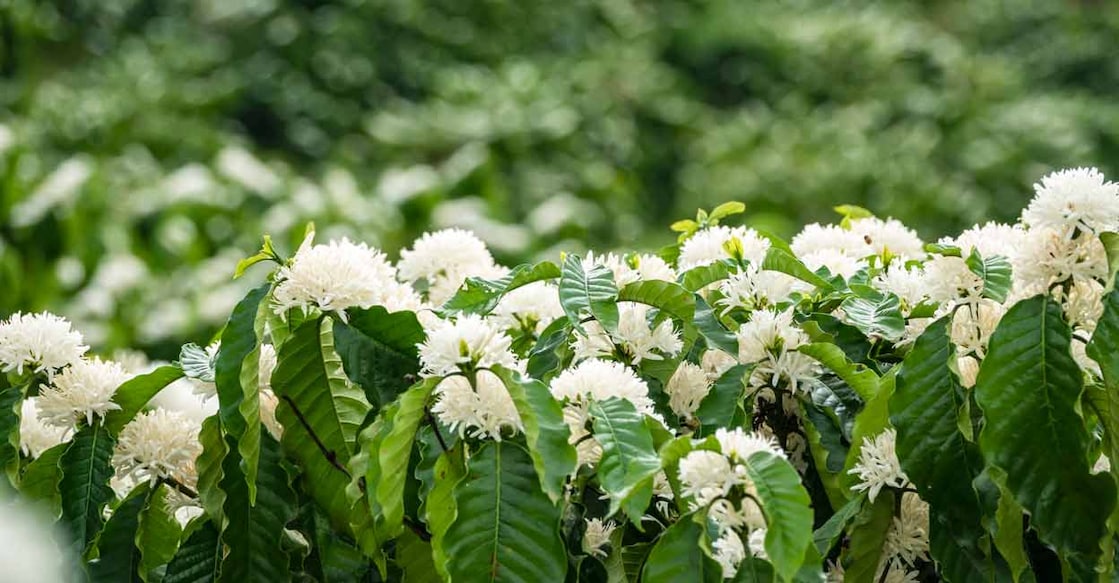
Blessed with early summer showers, the vast coffee plantations of Wayanad are offering a visual treat to visitors as coffee plants blossom into a carpet of white flowers — a phenomenon that occurs every summer after the harvest season. After the harvest, the plants enter a dormant phase, preparing themselves for the next blooming cycle. When the first copious summer rains arrive, the plants burst into bloom within a week.
In large plantations with abundant water sources, the blooming process often begins earlier. Farmers in such areas use artificial irrigation with water sprinklers soon after the harvest. Some begin irrigating their farms as early as January, enabling them to trigger blooming in a phased manner.

Rain is the trigger
Whether artificial or natural, rain is the key trigger for widespread coffee blossoming. If rainfall is abundant and widespread, the blooming will also be extensive. Without rain, the plants will not bloom. While farmers without reliable water sources wait for nature’s blessing in the form of rain, those with access to ample water use artificial irrigation to stimulate the blooming process.
Travelling along highways and interior roads alike, visitors can witness the beautiful flowers with their unique aroma blooming everywhere, said Coffee Board Regional Joint Director (Kerala and Tamil Nadu) Dr M Karuthamani. He told Onmanorama that with widespread summer showers, the blossom is good this year. “If we receive copious backup rains, the crop will also be good as healthy fruiting will take place,” he said. “For a good crop, we need at least half an inch of follow-up rain within ten days to convert the flowers into fruits”, he added.
Don't touch the flowers
Visitors are advised not to touch the flowers. They are extremely sensitive, and any disturbance can disrupt fruit formation. In plantations open to visitors, photographs can be taken, but here too, touching the plants should be avoided, farmers say. In closed plantations, photographs and videos can be taken from outside the fences.
The flowers would exist only for a few days, but the process of flowering would continue. At this point, pollination is crucial for fruit formation. Flies, honeybees, and other insects act as pollinators. After pollination, it takes almost nine months for the flowers to develop into mature coffee beans, ready for harvest.
Farmers are particularly concerned about disturbances to honeybees. Columns of bees move from flower to flower, facilitating pollination. Any disturbance may scare them away, resulting in flowers dropping without being pollinated. While traveling one can see groups of tourists taking photographs and videos of the farms.
Best routes to enjoy the blossoms
According to officials of the Coffee Board of India, although blossoms have appeared across the district, they are particularly dense along the Meppadi–Vaduvanchal–Choladi stretch of the Kozhikode–Ooty Road, extending up to the Kerala–Tamil Nadu border.
On both sides of the road, the endless expanse of blooming coffee plants resembles a vast white sea, attracting nature lovers. However, visitors are urged to admire the flowers from a distance, as physical contact can disturb the delicate blooming process.
Coffee plantations are also in bloom in Ripon, Thomattuchal, along the route to the tourist spot Sunrise Valley, and on the road leading from the Ooty Road to Karapuzha Dam.
Don't disturb the bees
Many experienced farmers also caution that camera flashes may disturb the humming bees. To enhance pollination, some farmers even practice beekeeping by installing bee boxes across their farms. The blossoms are best enjoyed quietly, without disturbing the fragile ecosystem.
Best time to take pictures
For close photography, the ideal time is between 7 am and 10 am, and again between 4 pm and 6 pm, according to farmers. Visitors should obtain permission from farmers before entering fenced plantations. However, there are several open plantations where visitors can enjoy close-range photography.
 Add as a preferred source on Google