

The 1963 Vagamon property you can’t book with money
Mail This Article


No matter how much money you are willing to spend, you cannot book a room at this vintage property in Kerala's Vagamon.
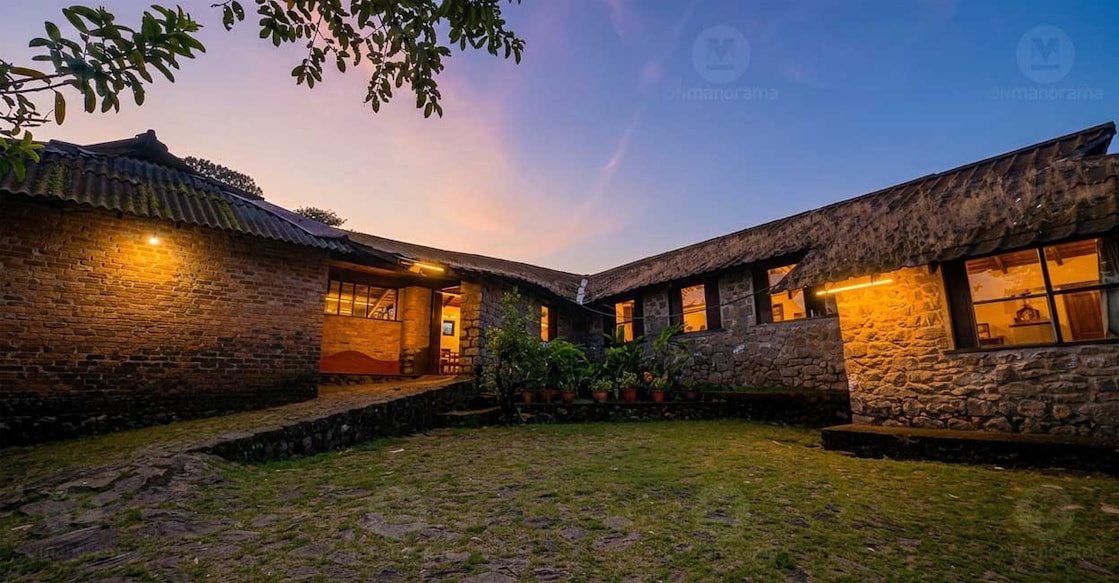
Tucked into the hills of Vagamon Kurisumala, Mitraniketan is not a hotel, a homestay, or a luxury resort. Built in 1963, this stone structure is one of the very first buildings that the legendary architect Laurie Baker constructed in Kerala. For decades, it served a purpose far removed from tourism. Today, it stands as an understated architectural masterpiece, a repository of history, and a quiet sanctuary for those looking to learn from its past.
An architectural experiment in the hills
Before coming to Vagamon, Laurie Baker and his wife, Elizabeth, spent 16 years living and working in the Himalayas. That experience heavily influenced Mitraniketan.
Architect Gayathri S points out that the building reflects construction techniques borrowed from the hills and indigenous tribal communities. "When Baker initially started construction in the hills, he referred to the tribal people, the Ooralis, who constructed using mud and thatched roofs," she explains. Baker adopted these methods but adapted them over time to withstand Vagamon’s fierce winds and heavy rains, replacing thatch to eliminate the risk of fire.
If you are familiar with Baker’s later work in Kerala, Mitraniketan might surprise you. His signature filler-slab roofs are absent here. Instead, roof rafters support asbestos sheets, and concrete is used minimally. Baker relied almost entirely on locally available stone and the skills of local masons to create a structure that could survive the unforgiving hill-station climate.
For years, the people living and working inside these stone walls were so focused on their daily mission that they hardly thought about the building's architectural significance. It was only around 2018 or 2019 that it became widely known that this was Baker's very first project in the state. "It was an experimental project," says Joseph Michael Jose, a trustee of Mitraniketan, "because it has no similarity with any other Laurie Baker project in any other part of Kerala."
Decades of empowerment and service
Long before it became a point of interest for architecture students, Mitraniketan was a lifeline for the region. It was a hospital run entirely by women.

"When we talk about women empowerment, it was practised here since 1963," says Joseph. Founded by Elizabeth Baker, the hospital’s leadership and staff remained exclusively female for over four decades, passed down through administrators and medical professionals including Alina Cattani, Dr. Hildegard Sina, Mariyamma Ninan, and Andamma Mani.
Andamma Mani, known affectionately to everyone as Kunjechi, arrived at Mitraniketan in 1969 as a 19-year-old girl with a dream of becoming a nurse. By then, the Bakers had moved to Thiruvananthapuram, leaving the hospital in the hands of Dr. Hildegard Sina, a German doctor, and Alina Cattani, an Italian nurse.
"The Vagamon during those days was nothing like what you see today," Andamma recalls. "The weather was unbearable with thick fogs and mist." There was only one bus in the entire region, and many patients walked more than 20 kilometers to get medical help. Even Laurie Baker used to walk to the site all the way from Erattupetta - a gruelling 25-kilometer journey up the hills - due to the lack of transportation.
The hospital prioritized the health of local estate workers, tribal communities, women, and children. In an era before electricity reached the hills, the facility was remarkably advanced, complete with an operation theatre, a labour room, an X-ray room, and a surgical table brought from Germany.
Because estate labourers could not afford to lose a day's wages, the hospital operated on Sundays and took Saturdays off. "We had dedicated our Sundays for the patients," Andamma says. "Serving the poor was much more meaningful than visiting the church regularly." More than a hundred patients would line up on Sundays, not just for treatment, but to learn about nutrition and preventive healthcare. Children suffering from malnutrition were kept at the hospital, fed, and cared for until they were completely healthy.
The changing tides of Vagamon
As tourism grew, Vagamon changed. The region became more developed, roads improved, and local residents acquired their own vehicles and found financial stability. They no longer relied on the small charity hospital.
At the same time, the influx of outsiders altered the quiet hills. Without overnight in-patients, the small female staff faced safety concerns from late-night disruptions and intoxicated visitors. The inpatient wing was eventually closed, and in 2016, the clinic shut its doors for good.
How to visit Mitraniketan: The Baker Walk
Since the closure of the medical clinic, Mitraniketan has transformed into a community space focused on ecology, the environment, women’s empowerment, and sustainable architecture. Through a partnership with COSTFORD, the space is maintained to teach students and visitors about climate-resilient building practices.
It functions as a true "home of friends," meaning you cannot simply hop onto a booking platform and reserve a room. Stays are restricted to those who have a personal reference from a board member, or those who participate in the community's public programs.
The most immersive way to experience this space is through the 'Laurie Baker Heritage Walk'. Initiated in the summer of 2023, this gathering is a gentle way of keeping the spirit of Mitraniketan alive, allowing visitors to stay at the residence, share communal meals, listen to the stories within the walls, and study the architecture.
The community hosts these events for small circles of about fifteen people. If you wish to join a future walk or request permission for a normal day visit, you can reach out directly to the community via email or social media messaging.
As the founders envisioned, it is not about architecture alone. It is a chance to step away from consumer tourism and experience the quiet beauty of usefulness, simplicity, and community.
 Add as a preferred source on Google