

'Aadu 3', 'Vaazha 2', 'Mohiniyattam': How sequels are driving Malayalam cinema in 2026

Mail This Article


Malayalam cinema did not ease into 2026 with confidence. The early months felt uncertain, with few films making a strong theatrical impact. What followed, however, was not a gradual recovery but a clear shift in pattern. Sequels, once approached with caution, began to drive the box office, bringing audiences back with a sense of familiarity and trust.
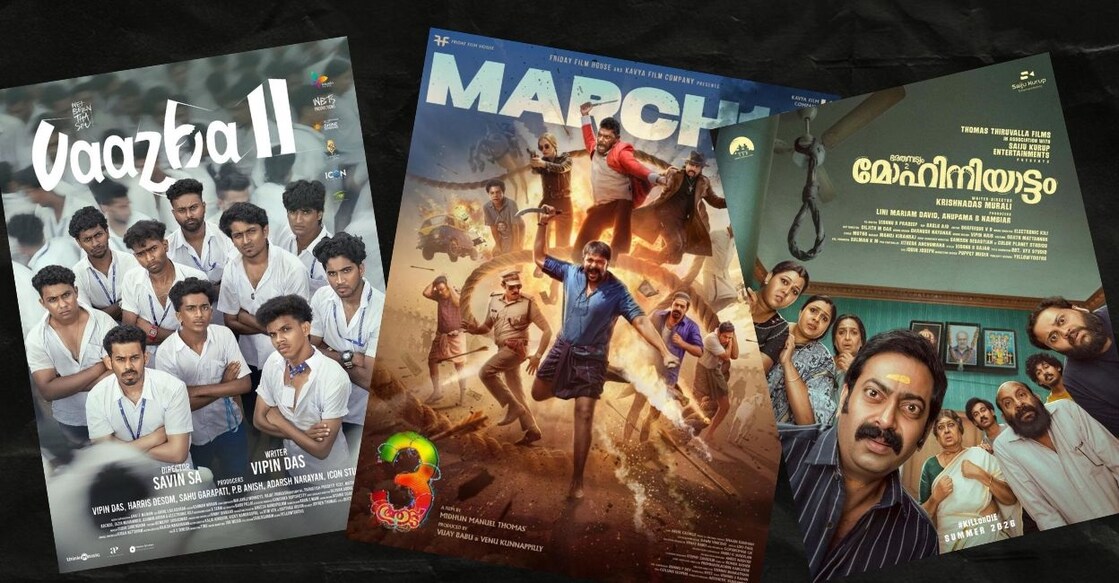
The shift became visible with 'Aadu 3'. Positioned as the next chapter in a popular franchise, the film opened strong and quickly established itself as one of the year’s early successes. Producer Venu Kunnappilly had earlier acknowledged the risk of sticking to its release plan, but said the team relied on the strength of the franchise’s connection with audiences.
“For a regular film, it usually takes around two weeks to reach 50,000 viewers. 'Aadu 3' managed to bring in close to three lakh viewers within just three days. That clearly shows the level of trust audiences have in the franchise,” he said.
That momentum carried forward with 'Vaazha 2', which stood out for succeeding without the backing of major stars. Produced by Harris Desom, the film leaned on a cast of newcomers and a growing belief in its story world.
“We were always confident that 'Vaazha 2' could be better than the first film. After seeing the response to the original, we were sure about the possibilities,” Desom said.
He added that the film’s success felt particularly significant because it did not rely on established stars. “Most successful sequels have big names attached to them. 'Vaazha 2' had newcomers, and still went on to become a hit. That makes it even more special for us,” he said.
Despite competition and a budget that exceeded initial plans, the film managed to recover quickly. “We did go over our planned budget, but we were able to recover that within the first two weeks of release,” he noted.
A more uncertain journey played out with 'Mohiniyattam', the sequel to 'Bharathanatyam'. The original had underperformed in theatres before finding a following on OTT, leaving director Krishnadas Murali cautious about returning to the story.
“There is definitely some tension. 'Bharathanatyam' did not work in theatres, so this is not a sequel built on proven box office success. People might question why a sequel is needed at all. But we are confident about the film we have made,” Murali said ahead of release.
Once released, the film found steady acceptance, particularly among family audiences. “It is a very happy moment to see the film being accepted across Kerala. Usually, a film connects with a specific section of viewers, but reaching family audiences is always difficult. With 'Mohiniyattam', we are seeing that change. The response and bookings are growing day by day,” he said.

For Murali, the success of these films also signals a broader shift in perception. “All these films have brought goodwill to Malayalam cinema. There was always a belief that sequels were just a way to cash in, but now people can see the amount of effort that goes into making them,” he added.
This marks a notable change in how Malayalam cinema views sequels. For years, there was scepticism among audiences, driven by the fear that follow-ups might dilute the legacy of beloved originals. That concern was not unfounded. Films like 'Kilukkam Kilukilukkam', 'Balram vs. Tharadas' and 'The King and the Commissioner' struggled to meet expectations, reinforcing the idea that sequels were often unnecessary extensions.
At the same time, there have always been examples that worked. The continuation of 'Nadodikkattu' through 'Pattanapravesham' and 'Akkare Akkare Akkare' sustained audience interest, while 'Devasuram' evolved successfully into 'Ravanaprabhu'. Similarly, 'Kireedam' found a natural continuation in 'Chenkol', where the story progressed organically rather than feeling extended.
The idea of sequels itself is not new to Malayalam cinema. Films like 'Aavanazhi and 'Inspector Balaram', or 'Ramji Rao Speaking' and 'Mannar Mathai Speaking', showed an early tendency to revisit familiar characters. But these were isolated instances rather than a sustained trend. Even commercially viable follow-ups, including those in the 'In Harihar Nagar' series, often struggled to match the cultural resonance of the originals.
What makes 2026 different is the consistency of this shift. Recent years had already hinted at it, with franchises like Drishyam and Aadu building sustained audience engagement. Even large-scale projects such as L2: Empuraan demonstrated the commercial pull of continuing established narratives.
The current wave suggests that Malayalam cinema is recalibrating its approach. Sequels are no longer treated as shortcuts, but as extensions that demand the same level of care as original films. Audiences appear willing to return to familiar worlds, but only when the storytelling justifies it.
 Add as a preferred source on Google