

'Pennum Porattum': Rajesh Madhavan's directorial debut is a biting social satire that doesn’t always sustain its edge | Movie Review

Mail This Article


You walk into 'Pennum Porattum' expecting the well-worn template of the quirky village satire that Malayalam cinema has revisited time and again. The film seems aware of that expectation and plays along, at least initially. It is set in a Palakkad village, the characters are eccentric, and the humour is rooted in everyday situations. But it doesn’t take long to realise that the film is not interested in being merely quirky. There is a sharper, more acidic edge beneath the surface.
The village of Pattada runs on suspicion. Its residents watch one another closely, passing judgment, interfering, and amplifying every minor moral slip into a collective spectacle. This constant surveillance becomes the film’s driving force. The narrative is less about what happens and more about how a community reacts when it believes it has the right to police private lives.
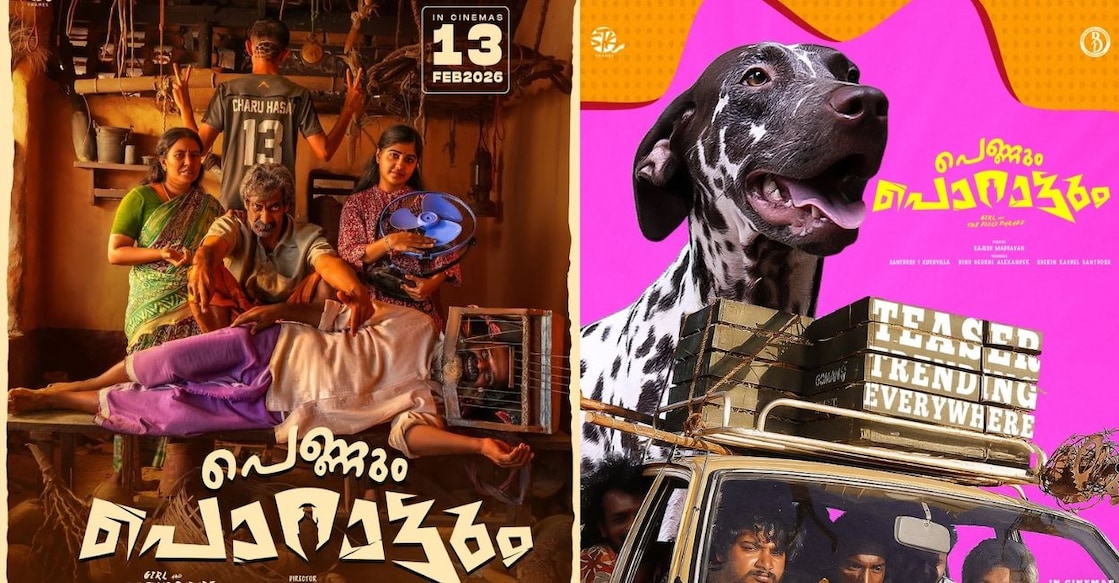
The story pivots around two triggers. One is Suttu, a dog the villagers assume is rabid. The other is Charu, played by Raina Radhakrishnan, who is propositioned by Kumar for a one-time, no-strings sexual encounter. The proposition is private and almost mundane, but in Pattada it sparks a moral wildfire. The village does not simply respond. It erupts, turning a personal moment into public theatre.
Rajesh Madhavan leans into the chaos rather than softening it. The film is deliberately loud, occasionally violent, and often darkly funny. Its humour emerges from absurd situations that still feel rooted in recognisable social behaviour. It plays like exaggerated social theatre where the logic may seem warped, but the hypocrisy behind it feels uncomfortably real.
Yet, the film does not feel entirely new. Its thematic core recalls earlier Malayalam films that have explored collective malice and moral policing. While the treatment is sharp, the central idea carries a sense of familiarity. The second half, in particular, seems to rely heavily on the novelty established earlier. Suttu the dog, who has a striking voice presence in the first half, fades away later, which slightly weakens the narrative’s tonal consistency.
The film also shifts dramatically in portions, taking on the flavour of a porattu nadakam, the traditional folk theatre form. While this theatrical exaggeration adds energy, it occasionally reduces characters to caricatures. In several stretches, the exaggeration feels excessive, and by the end, the messaging becomes somewhat spoon-fed and mildly preachy.
Written by Ravi Sankar, who previously co-wrote Rani Padmini and Bheeshma Parvam, the film works effectively in parts. However, its tonal and thematic echoes of films like 'Kanakam Kaamini Kalaham' and 'Avihitham' are hard to miss. On paper, the premise is a winner, packed with all the ingredients for a sharp, quirky satire, but in execution, it sometimes struggles to hold sustained engagement.
One of the standout performances comes from Shanooj Alanallur as Sujathan, a key presence in the village’s moral machinery. His character reflects the quiet hostility that runs through the village, revealing how easily ordinary people can turn harsh and vindictive when they feel morally justified.
Technically, the film scores well. The cinematography stands out, especially given the demanding staging involving chases, crowd movements, and high-energy sequences. It captures the chaos of Pattada without losing visual coherence.
Ultimately, 'Pennum Porattum' is a strong, biting satire that effectively skewers society’s obsession with moral policing. But its familiarity and occasional overstatement slightly dilute the impact of what is otherwise a sharply observed social commentary.
