

Land prices go up, residents return as sea-ravaged Kerala village Chellanam turns sought-after realty spot

Mail This Article


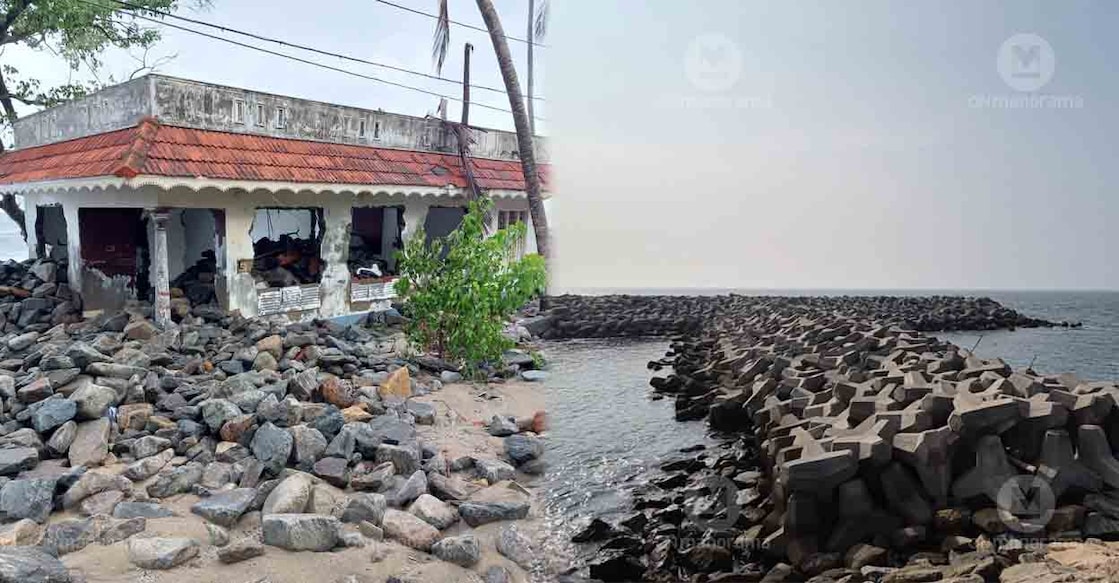
Smitha Kaliparambil, a resident of Chellanam, sits on the polished sit-out of her new house, admiring the front door. Her story beats at the heart of a revived Chellanam, a coastal hamlet sandwiched between the Arabian Sea and backwaters, on the outskirts of Kochi that spent nearly fifteen years as a shadow of itself. After close to two decades of relentless erosion by the Arabian Sea, the completion of a 7.35-km tetrapod seawall, reinforced by a network of groynes, has triggered something close to a miracle. Nearly 120 families who once moved away after losing everything have returned home. They have thrown away the “For Sale” boards and reclaimed the land they once thought was lost to the sea.
For years, the sound of the Arabian Sea was a death knell for the residents of Kochi’s Chellanam. Smitha remembers the exact moment she gave up.
“We were living in a shed, saving every rupee to build a home, but the sea was faster than us,” she recalled how she watched the sea swallow the bricks and cement she had painstakingly saved for her dream home.

“It swallowed our construction materials and battered the foundation until we just gave up and fled to a relief camp. We were ready to take the government’s offer under the Punargeham rehabilitation scheme and just run. We thought the sea had finally evicted us for good,” Smitha added.
The years when fear ruled
Chellanam’s tragedy was never just about rising water. It was about people’s dignity slowly eroding along with the land. Roban Kuttappasheri, a resident of Chellanam Bazaar, remembered a childhood when the waves were nearly 100 metres away. “Over time, the sea took it all. The old stone wall crumbled, and suddenly, there was no separation between land and water,” he said.
The village soon earned the grim label of a “forsaken” land. With a grim smile, Roban added that even marriage proposals dried up. “No one wanted to marry their daughters to men from here. Who would want to move into a house that was being devoured by the sea?” he asked.
The final blow came in 2017, when Cyclone Ockhi tore through the coast. Jinson Veluthamannungal, former secretary of Care Chellanam, still shudders at the memory. “Once the seawall was fully gone, the sea came in full force. It wasn’t just an inconvenience; it was horrific,” he said.
Bedrooms filled with black silt, children woke to rushing water, and the trauma ran so deep that counselling became necessary. Schools shut, work stalled, and daily life turned into a series of frantic escapes.
As the sea advanced, people retreated. KK Krishnakumar, the local ward member, watched Chellanam fracture as over 150 families abandoned their homes for rented rooms, relief camps, or relatives’ houses in neighbouring districts. “It was impossible to live here and people ran away,” he said.
For women, the crisis carried a particular humiliation. Smitha remembers the tides choking their toilets. “When the mud and sand clogged the pipes and septage lines, we couldn't use the bathrooms for days. We had to hold our urges or travel miles to a relative’s house just to use a toilet. The cleaning afterwards was soul-crushing,” she said.
Jessy Thomas, who arrived in Chellanam as a bride 27 years ago, remembers the ritual of “night watches.” “One member of each family would stay awake at night to alert others when the waves rushed in the middle of night. Then only we could flee for our lives,” Jessy said.
To stop walls from collapsing, families slept with doors flung open, allowing waves to rush through their homes. “My husband’s brother’s house was swept away entirely. We lived in a state of constant, breathless fear. We can sleep without fear now,” she said.
When the tide finally turned
Change came in 2021. After years of sustained protests under the Janakeeya Vedi and Care Chellanam’s banner, the government’s coastal protection plan finally materialised. Massive four-legged concrete tetrapods were laid like armour along the 7.35 km, stretching from the fishing harbour to Puthenthodu beach.
The impact was immediate. Last monsoon, Chellanam experienced a calm it hadn’t known in two decades. Xavier Machingal, who has lived on this coast for sixty years, admits he had lost hope after witnessing neighbours die in waterlogged pits during earlier floods. “But with the new wall, we finally saw a ray of hope. The entire region has revived,” he said.
Security brought the exiles back. Families returned from rented houses, pooling savings to repair walls scarred by salt and time. “The erosion and flooding has stopped completely in the region where the seawall has come up. So people have come back to their homes,“ ward member Krishnakumar said.
Lysa Jinson, a homemaker, finally feels she can breathe. “The sea took my garden every single time I planted it. I eventually just surrendered to fate. “Now, I can grow whatever I want and my plants are safe. I am happy just to see them bloom,” Lysa said as she pointed at her new garden at her house.
From disaster zone to destination
Chellanam’s revival is not just emotional, it is economic. Land once offered up for a ₹10 lakh relocation grant is now surging in value.
The long walkway atop the seawall has become one of Kochi’s newest sunset spots, drawing locals and tourists each evening and transforming a former disaster zone into a lively promenade.
“People are dividing land into plots now. Investors are looking for spots for homestays and beach resorts. New buildings are coming up everywhere because we no longer fear the sea,” Roban said.
Local residents admitted that without the new seawall, they would have been forced to accept the Punargeham rehabilitation project, which offered a flat payout of ₹10 lakh, regardless of their actual land size. "Before the wall, our land was seen as worthless, and nobody wanted it," said VT Sebastian of Chellanam Janakeeya Vedhi. "Now that the coast is secure, prices have surged to ₹5 lakh per cent, and some residents are even transforming their homes into sea-facing homestays," he added.
Most importantly, children are back in classrooms. The days of missed lessons and soggy textbooks are fading into memory.
 Add as a preferred source on Google