

'Do you still support Sabarimala women's entry?' Pinarayi govt refuses to say 'yes or no'
Mail This Article


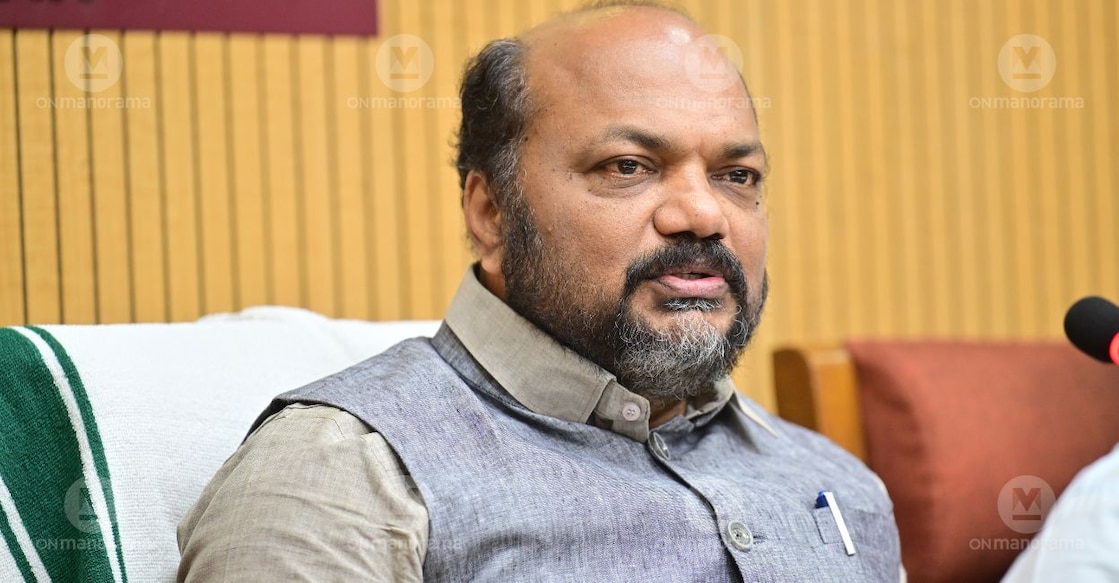
Law minister P Rajeev on Monday said that the state government would take a stand on the entry of menstruating women into Sabarimala only after "carefully resolving" its opinion on the seven fundamental questions framed by the Supreme Court for a larger 9-judge bench to consider.
None of these seven issues, the minister reminded reporters on Monday, is an "objective type yes or no question" on whether the government supported women's entry. "The Supreme Court will first determine these Constitutionally relevant questions before moving to other issues (like women's entry)," the minister said.
Despite incessant prodding, Rajeev refused to directly say whether the government has changed its stand on women's entry. Nonetheless, the law minister called attention to the fourth paragraph of the affidavit filed by the V S Achuthanandan government in the Supreme Court on the Sabarimala issue in 2007.
"In this, we (the LDF government) had said that this (non-entry of menstruating women) was a long-held tradition and had proposed the constitution of a commission made up of Hindu scholars and social reformers with impeccable integrity to study the issue," Rajeev said.
He said the government wanted the Supreme Court to go with what the proposed Commission recommended. "Instead, the SC appointed an amicus curiae and eventually issued an order allowing the entry of women. Any right thinking person knows that a Supreme Court order is binding," Rajeev said, explaining why the government tried to implement the verdict.
"Later, the court decided to subject the order to a judicial review. Did we go ahead with implementing the law, saying that the original order has not been stayed?" Rajeev said.
Noticeable in Rajeev's arguments was a gradual but subtle attempt to dissociate from the idea of Sabarimala women's entry. "Can you point out one instance in the Sabarimala judgment where it is said that the LDF government had backed women's entry?" the minister said.
In fact, there is. The 2018 Sabarimala verdict mentions how the Kerala government had changed its opinion over time.
In the first affidavit submitted in 2007, the Kerala government said "it was not in favour of discrimination towards any woman or any section of the society". On February 2, 2016, during Oommen Chandy's tenure, the 2018 order says that the affidavit was revised to convey that the government was against the entry of menstruating women into Sabarimala.
However, on November 13, 2016, after the first Pinarayi Ministry came to power, it restored the original affidavit that stated that no laws stood against the entry of women into Sabarimala. "On a query being made by the Court, the learned counsel for the State submitted that it wanted to place reliance on the original affidavit dated November 13, 2007," the 2018 order says.
During the argument in Supreme Court, Kerala's senior counsel Jaideep Gupta said that the state "was going by the original affidavit of November 2007". Chief Justice Dipak Mishra then pointedly asked: "So that means the State government supports women of any age entering the temple?" Kerala counsel's reply: "Our stand is that women of all ages should, and I say should, be allowed to enter the temple and worship. There should be no bar."
Much later, during the time of the Global Ayyappa Sangamam in September 2025, it looked like the LDF government had virtually dumped the 2007 affidavit.
"Has the first Pinarayi Ministry revised the affidavit submitted by the 2011-16 government on women's entry into Sabarimala," was a question posed by Congress MLA Uma Thomas in the Assembly in September. Here's Devaswom Minister V N Vasavan's reply. "The first Pinarayi Ministry has not revised the affidavit submitted by the 2011-16 government."
This was technically correct because the Pinarayi government did not formally submit a revised affidavit but only orally said that it was in agreement with the 2007 affidavit.
SEVEN QUESTIONS FRAMED FOR CONSIDERATION OF NINE-JUDGE BENCH
1. What is the scope and ambit of right to freedom of religion under Article 25 of the Constitution of India?
2. What is the interplay between the rights of persons under Article 25 of the Constitution of India and rights of religious denomination under Article 26 of the Constitution of India?
3. Whether the rights of a religious denomination under Article 26 of the Constitution of India are subject to other provisions of Part III of the Constitution of India apart from public order, morality and health?
4. What is the scope and extent of the word 'morality' under Articles 25 and 26 of the Constitution of India and whether it is meant to include Constitutional morality?
5. What is the scope and extent of judicial review with regard to a religious practice as referred to in Article 25 of the Constitution of India?
6. What is the meaning of expression "Sections of Hindus" occurring in Article 25 (2) (b) of the Constitution of India?
7. Whether a person not belonging to a religious denomination or religious group can question a practice of that religious denomination or religious group by filing a PIL?
 Add as a preferred source on Google