

Extreme drought in major wildlife reserves of Nilgiri Biosphere Reserve triggers animal migration

Mail This Article


Kalpetta: Extreme drought has affected major wildlife reserves in the Nilgiri Biosphere Reserve (NBR), causing widespread migration of wild animals due to a lack of rain, drying water sources, and vanishing greenery.
Hundreds of acres of dry grass and bushy undergrowth, along with waterless rivers, streams and ponds, have turned vast forest stretches into potential fire hazards. With summer rain becoming increasingly erratic, the jungle zones adjacent to the Deccan Plateau in the NBR — particularly the Mudumalai Tiger Reserve (MTR) and Bandipur Tiger Reserve (BTR) — have become fire-prone areas, experts point out.
The Forest Department officials said they have intensified vigil to prevent any forest fires in these stretches.
Experts have raised concerns that the arid conditions of the Deccan Plateau are gradually encroaching on the Nilgiri Biosphere Reserve. The forest stretch, which begins after Gundlupet, along the Mysuru-Kozhikode National Highway (NH 766), presents a grim picture with almost no greenery in sight. Regular travellers say that even deer, which are commonly seen along the route, are now rarely spotted.
Scant rain
Though the Forest Department has created extensive fire lines along the roadside, trained fire trackers have been deployed to monitor the forests round the clock. According to data from the Regional Agricultural Research Station (RARS) at Ambalavayal, the region received no rainfall in March, whereas it received 67.2 mm of rain at the same time last year. Though there were widespread summer showers by the end of February, which led to coffee flowering across the district, there has been no follow-up rain since then.
RARS expert Sajeesh Jan P told Onmanorama that last year, the region did not face a drought-like situation because of the copious summer rain it received. "However, the current situation is not entirely new as similar climatic conditions were experienced in 2024 as well," he added.
Artificial ponds in Mudumalai
Experts point out that the Sigur region of Mudumalai Tiger Reserve in the Nilgiris has been the worst affected by the drought-like situation. Two elephant deaths have already been reported from the region at the onset of summer.
Forest department staff in the Bandipur Wildlife Sanctuary in Karnataka and the Mudumalai Tiger Reserve in Tamil Nadu — especially in the Sigur region — have begun supplying water to artificial concrete ponds inside the forests for the wild animals.
The river Moyar, which originates from the Moyar Hills near Masinagudi in Mudumalai, has now been reduced to a thin stream. Wildlife safari activities at Mudumalai have also been suspended due to the extreme drought.
Unlike animals in Masinagudi, which often migrate to the forests of Wayanad in search of water and food, animals in the Sigur plateau rarely migrate due to geographical constraints.
Resumption of the wildlife safaris in Bandipur, suspended following recurring human casualties in tiger attacks, has been put on hold after villagers opposed it. They argued that a restart could trigger fresh human–animal conflicts, particularly when animals are already stressed by extreme heat and water scarcity.
Wayanad facing the heat
Although water sources in the forests of Wayanad remain adequate, officials warn that the situation could worsen if temperatures remain high. The Forest department data shows that the Sanctuary currently has 209 water sources, including ponds, check dams and other water bodies.
The Wayanad Wildlife Sanctuary and adjacent forest zones — the South Wayanad and North Wayanad divisions — are currently the only relatively green stretches in the biosphere landscape. These forests serve as a refuge for many migratory animals crossing state borders in search of water and food. But that poses the threat of intensified human–animal conflicts in the region, experts point out.
South Wayanad Divisional Forest Officer Ajit K Raman told Onmanorama that the forests of Wayanad are already experiencing drought-like conditions. “The temperature is high and the forest regions have received only light rain in March, much less than last year,” he said. He said that the possibility of forest fires cannot be ruled out, though the department has taken extensive precautionary measures to prevent such incidents.
Last year, the Muthanga region received good summer showers, which reduced the migration of long-range animals. However, this year's migration has increased significantly as animals sensed the drought conditions much earlier.
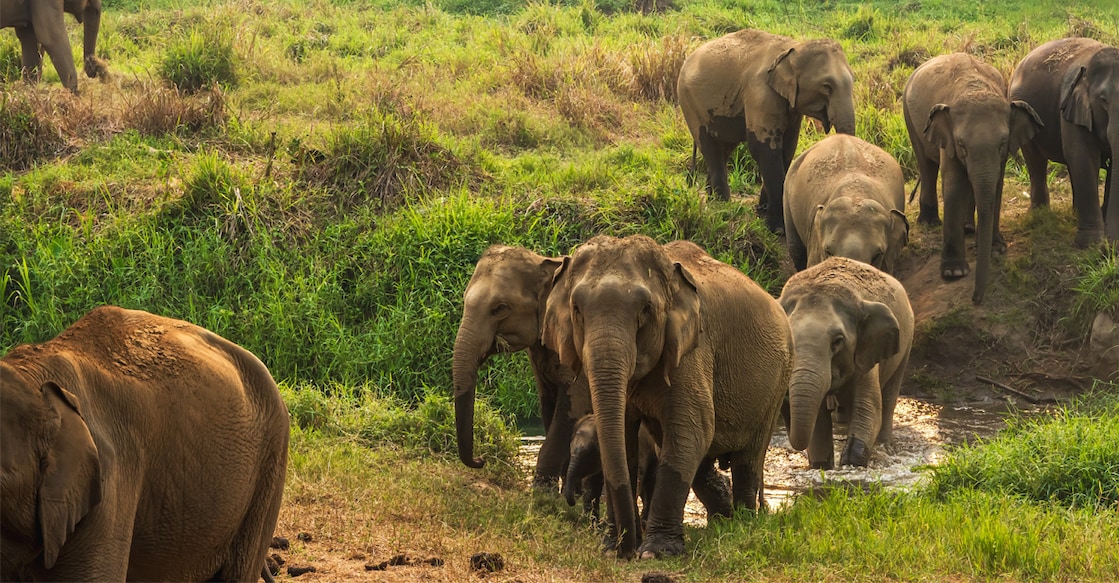
Ajit said elephants, being long-range animals, migrate early as they cannot survive without water. “Jumbos do not have sweat glands. They cool their bodies by staying in water during the hot seasons. (So) every year, they migrate to greener and cooler areas,” he said.
“We have utilised every allotted fund under the Wayanad Package and KIIFB projects to conserve water and reduce human–animal conflict,” he added.
