

The Kochi homemaker who turns everything she touches into gold
Mail This Article


From farmer to dairy and poultry entrepreneur, farm shop owner, food processor and yoga trainer, Shiji David Mekkamalil leads a life that rarely slows down. But what truly sets this homemaker, a native of Asamannoor in Ernakulam disrict, apart is her uncanny ability to turn every venture into a success.
Once a volleyball player who represented Kerala and won a bronze medal at the national level, Shiji could not secure a job through sports. Undeterred, she turned to farming and discovered not just financial success, but deep personal fulfillment. Today, she earns more than many salaried professionals, yet she insists the real reward lies in the joy and satisfaction that farming brings.
At a time when many dairy farmers speak of losses, Shiji has grown her herd from just two cows to 24. But her success, she says, comes not merely from production but rooted in smart marketing too. By connecting directly with customers in her locality and nearby towns, she has cultivated a steady clientele.
Shiji notes that while dairy farmers who rely solely on cooperatives often face challenges, those who sell directly enjoy far greater opportunities in local markets. Moving beyond milk alone, she now offers a wide range of value-added products, including curd, ghee, organic vegetables, and traditional farm produce. To reach more customers, she recently opened a farm outlet along the Aluva–Munnar national highway, further expanding her enterprise.
By building a loyal customer base for her farm products, Shiji has created a sustainable venture through a diversified approach to farming and livestock, earning over ₹1 lakh a month within just five to six years.
Until about six years ago, broiler chicken integration was her primary source of income, while rubber and coconut grown on her three-and-a-half-acre farm brought in little return. The Covid period, however, awakened the entrepreneur in her. It was the decision to rear a single goat that became a turning point.
During a visit to her relative Peter’s farm in Cherukunnu to buy a goat, Peter suggested a bold idea: why not start her own goat farm? Taking his advice to heart, Shiji began rearing goats and soon gained the confidence to add two cows, marking the beginning of her journey into dairy farming. In the early days, she supplied milk only to the local dairy cooperative. But as demand for high-quality milk grew in her area, she gradually shifted to retail sales. With a steady income flowing in, Shiji expanded her operations and hired two workers to help run the farm.
Her connections through various farmer groups soon enabled her to extend direct marketing to Perumbavoor town. Today, her farm produces around 200 litres of milk daily. ``The morning supply goes to households in Perumbavoor, with my husband, Saju Paul, helping with distribution. He also assists in delivering the afternoon supply to nearby homes'', Shiji says. Beyond milk, value-added products like curd and ghee provide a significant boost to her income and their consistent quality keeps customers coming back for more.
The cow shed on her farm houses HF and Jersey breeds. Along with regular cattle feed, the cows are given fodder grass and pineapple leaves. While Shiji cultivates fodder grass on five acres of leased land, she admits it still falls short during the summer months.

“After each harvest, cow dung slurry needs to be applied and the area properly covered to ensure weed-free regrowth. But managing this alongside daily animal care is time-consuming,” she explains. To maintain efficiency, she has scaled down fodder cultivation and now sources feed from nearby growers and plantations—a practical solution that keeps her farm running smoothly without compromising quality.

Goat farming adds to a steady income
Goat rearing has also emerged as a steady source of income. With kids born every six months, it offers a viable option for homemakers seeking an additional source of earnings, she points out. The farm mainly breeds crossbred goats, including Boer and Malabari varieties, along with a few Bulabi goats.
With a stock of 55 female goats, Shiji sells around 40 kids annually, priced at ₹350 per kg (live weight). She notes that Boer crossbred kids tend to gain weight faster than Malabari goats. Goat milk is sold at ₹120 per litre, while a sack of goat manure fetches ₹350. Together, the sale of goat milk and kids brings in an additional monthly income of around ₹10,000.
Her first venture, broiler chicken farming, is still going strong. Each batch consists of around 5,000 chicks, with earnings fixed at ₹7.5 per kg based on growth, ensuring an average monthly income of about ₹20,000.
With a stock of 100 layer hens, egg production serves as another steady source of daily income. The eggs are sold at retail rates through milk outlets and the farm shop, while additional earnings from cow dung and goat manure further strengthen the overall returns.
On a land taken on lease close by her goat farm, Shiji cultivates bananas, vegetables and tuber crops and balances crop cultivation with her expanding livestock ventures. Her excellence in agriculture earned her the Karshaka Thilakam award, instituted by the State Government, in 2021.
As she follows organic farming practices, her produce fetches fairly good prices. Shiji also stresses the importance of setting aside time to grow chemical-free vegetables for one’s family. For those who cannot, she advises choosing locally grown produce over cheaper alternatives from outside the State.
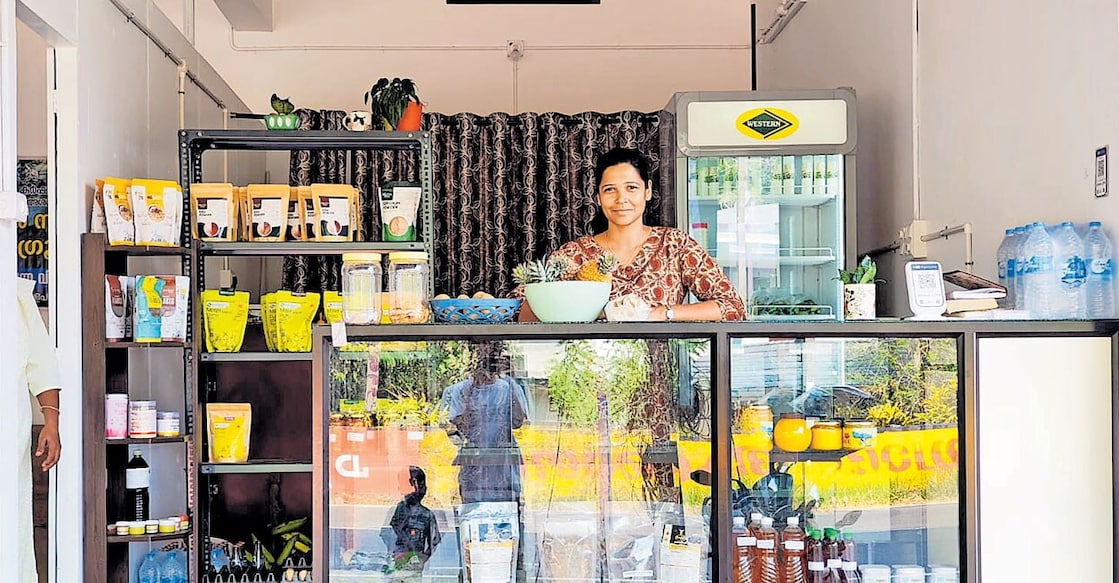
Her farm shop offers a diverse range of value added products, including milk from her own farm, curd, buttermilk, ghee, milkshakes, peda, vegetable saplings, millet products and jackfruit etc, in addition to banana chips, pickles and a variety of homemade snacks. It also showcases chemical free vegetables sourced from other farmers in the neighbourhood.Plans are also underway to launch online sales of these products soon.
Looking ahead, Shiji plans to focus on value addition while also bringing her farm closer to the public through a farm tourism project. As part of this vision, she has already set up a new goat farm on the forest-fringed lands of Inchathotty, near Neriyamangalam, nurturing indigenous breeds like Kuttampuzha Kullam and Attappady Black
Her husband, Saju, who had earlier worked in a private firm in Kakkanad, has left his job to become an active partner in her ventures. Shiji attributes her success to the strong support of her family and gratefully acknowledges the guidance of her relative Peter and Smitha, a former agriculture officer from Asamannoor. She says the values instilled by her farmer parents, combined with the discipline and resilience gained from sports, keep her energetic and optimistic. She is also passing on the richness of farming culture and its lessons to her children too.
Shiji can be contacted at 9495257153
 Add as a preferred source on Google