

From curious onlookers to drone pilots: Kudumbashree women take control of farming and cash in big
Mail This Article


When tractors and power tillers first rolled into the fields, followed later by brush cutters and tree climbing machines, control of these tools remained firmly in the hands of men. From the bunds, women would stand watching, curious and amused, as the “big brothers” handled the machines below. Over time, they gradually began to operate these machines, but even then, only a handful among them dared to step forward.
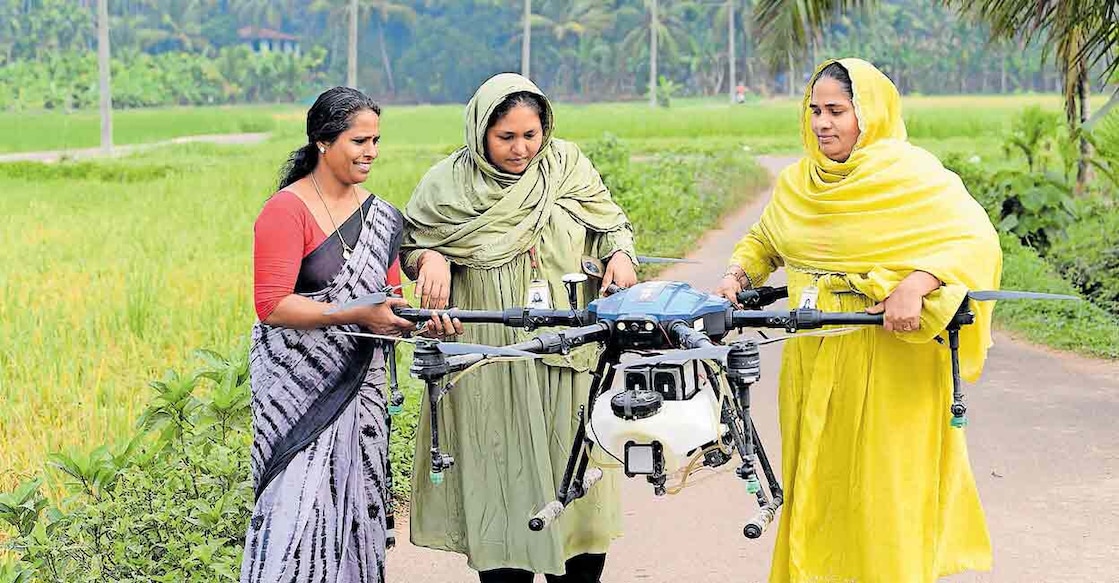
Now, with drones taking to the skies over paddy fields, old roles are being rewritten. Those who once watched from the bunds are no longer just spectators. There is a new confidence in the air, almost as if the women are saying, let the men stay in the fields and watch, while we take control from the bunds.
Under the Centre’s Namo Drone Didi scheme, implemented in Kerala through Kudumbashree, 49 women have already earned drone pilot licences, with more on the way. It may not carry the glamour of flying an aircraft, but drone piloting is opening up a strong new income stream. While a tractor operator earns an average of about Rs.1,200 an hour and a brush cutter operator around Rs.400, a drone pilot can earn at least Rs.3,000 an hour. In favourable conditions, this can even rise up to Rs.20,000 a day, says Dilshad Mundasheri, one of Kerala’s first `drone didis.'

If one owns a drone worth around Rs.10 lakh, it is possible to launch an independent venture. But for those entering through the Drone Didi scheme, the entry barrier is brought down completely. The drone is provided free of cost, along with free training and a pilot licence.
Beyond the basic licence training, Kudumbashree has also arranged specialised sessions focused on practical agricultural application to ensure the women are field-ready. More advanced training programmes and new work opportunities will be rolled out in the coming months, said Kudumbashree Programme Officer (Agriculture Livelihood Division) Dr S Shanavas.A technical support team has also been put in place to stand behind the Drone Didis as they take to the fields and skies.
About half of those who completed the training have already taken to the field and are actively at work. The rest are expected to receive additional support soon, paving the way for more active operations.The initiative is also set to widen its reach, moving beyond paddy fields into banana, tapioca and pineapple cultivation. Even financial assistance for purchasing batteries is under active consideration.
In a more ambitious step, Kudumbashree plans to bring together the Drone Didis with others trained in agricultural machinery and precision farming to form a `Smart Agriculture Team'. A digital platform is also on the cards, aimed at making their services accessible to all. At the same time, discussions are underway with M G University on advanced training modules that will enable drones to deliver a wider range of services, added Dr. Shanavas.
When a homemaker took control of the skies
Educated up to undergraduate level, Dilshath Mundasseri from Morayur in Malappuram once carried the weight of unrealised expectations. in her life Having been unable to complete studies, a stable job remained out of reach. As time passed, so did mount her concern about how to support her children’s education and manage household needs without a steady income.
It was at this point that opportunity arrived in an unexpected form through Kudumbashree as a drone pilot. For Dilshath, excitement knew no bounds. A pilot, yes, but one who never had to leave the ground. It offered her a chance to work with cutting edge technology while staying rooted in her own community and supporting farmers in the fields around her. The very idea opened up a world of possibilities and was enough to spark her enthusiasm.
Dilshath says with pride that it was her association with Kudumbashree that opened the door to a career built on new age skills. Beyond the job itself, there was also the thrill of being part of something that was beginning to bring change at the local level. That sense of purpose, she adds, made even the demanding training phase feel lighter and easier to push through.
The training took place at Garuda Aerospace in Agni College, Chennai. Women from various parts of India had come for the programme. Although many faced language barriers, everyone successfully completed the course and obtained their licences within two weeks. Dilshath was among the first Kudumbashree members in Kerala to receive a drone licence. Although the drone was delivered to her home in January 2023, technical hurdles meant that spraying operations only began in October 2024.
She also had to wait for the paddy cultivation season in her locality, which further delayed the start of work. Most of her assignments have been in paddy fields, though she has also carried out spraying in mango, cashew, and banana plantations. Water soluble fertilisers, especially micronutrients, are most commonly applied using drones. However, with certification from the agriculture officer, low toxicity green label pesticides can also be sprayed.
According to her, farmers are generally satisfied with drone-based pesticide spraying as it helps reduce the quantity of chemicals used while also saving time. A task that once took two days can now be completed in just two hours, she points out.
Dilshath has so far provided drone services across more than a thousand acres of farmland. Although the earning potential is high, around RS.750 per hour, she says she has earned only up to Rs.2 lakh so far due to various constraints. Even so, the income has helped her meet part of her son’s education expenses, as he is pursuing MBBS in Russia. Her husband, Hanifa, a former expatriate now working at the airport, also takes pride in his wife becoming a drone pilot.
With only one battery of her own, Dilshatth often has to borrow batteries from other “drone didis” to carry on her work without interruption. This, however, also means she has to share her earnings with them and bear the additional cost of hiring taxis to transport the drone to different fields. Together, these factors significantly reduce her overall income.
She explains that this arrangement is followed mainly because drone didis in different locations do not always get work at the same time. When more opportunities open up elsewhere, she says, owning an additional battery becomes essential.
Dilshath remains hopeful that Kudumbashree will soon extend a helping hand in this regard. With sufficient batteries, she points out, up to 40 acres a day can be covered for spraying. At present, she manages an average of about 30 acres a day.
She adds that her earnings have been possible largely because she operates in a paddy-growing region and due to the Agriculture Department’s subsidy-based spraying schemes in the area. However, a key limitation is that wages under government schemes are lower than the rates offered directly by farmers.
She also notes that due to the absence of local Agriculture Department schemes, Bindu from Mukkom in Kozhikode, another `drone didi',is not receiving enough orders. As a result, she is now working with Dilshad as a co pilot.
The `Lakhapathi didi'
When Sudha Devadas, who had been leasing paddy fields for cultivation, was asked by Kavitha, a Kudumbashree District Mission Coordinator, if she would be willing to train as a drone pilot, she was initially surprised.. But as she learned more about drones and the opportunities the field offered, she agreed. That decision soon took her to Chennai, along with 48 other Kudumbashree women selected from across the state under the Drone Didi scheme.
For the programme, preference was given to members of Kudumbashree Joint Liability Groups engaged in agriculture. Sudha recalls that the training at the Garuda Aerospace Academy was rigorous. There were several unfamiliar technical terms to grasp before the lessons began to make sense. Yet, she remained undeterred. With the determination that Kudumbashree members are known for, she mastered each aspect of the course and earned her licence.
Her journey has also brought her recognition as a `Lakhapathi didi,' a distinction that took her to Jalgaon in Maharashtra, where she had the opportunity to meet and interact with the Prime Minister. The title is awarded to women in self help groups who achieve an annual income of one lakh rupees or more.

Sudha now takes her drone services beyond her own fields and those of fellow Kudumbashree farmers, reaching even neighbouring districts. She has no doubt that this is a promising livelihood, especially for women. If women can operate tractors, tillers, sprayers and even tree climbing machines, why not drones, she asks. At the same time, she points out that there are limitations to turning drone work into a full time source of income.
At present, opportunities for drone based spraying are largely confined to the paddy cultivation season, which lasts only about four months. Once the season ends, there is a need to find work in plantation areas in the high ranges. For that, proper and safe camping facilities must be arranged for drone didis in such regions.
Battery life is another major challenge. A fully charged battery allows the drone to fly for only about 15 minutes. In practical terms, at least three to four sets of batteries are needed to ensure uninterrupted work through the day. “We have the drone, but not enough batteries to keep it going,” she says.
In contrast, drone pilots working with IFFCO are equipped with multiple battery sets and even vehicles to transport them, allowing them to operate more efficiently and at lower cost. For Sudha, buying additional batteries on her own would mean an investment of nearly Rs.1 lakh per unit. She is now exploring ways to make that possible.
