

AI grading for coconuts by Kerala BTech students wins big at OpenAI hackathon

Mail This Article


Kochi: A coconut drops onto a sensor-based metal plate at high speed. For a fraction of a second, its hard shell strikes first while the water trapped inside momentarily lags behind due to inertia before settling. That tiny delay – invisible to the human eye and lasting barely a microsecond – is enough for a group of Kerala engineering students to determine how much water the coconut contains without ever cracking it open.
Using that simple principle of physics, combined with artificial intelligence and a low-cost sensor worth barely ₹250, the students have built an automated coconut grading system capable of analysing coconuts in just three seconds, identifying defects, estimating quality and sorting them into eight categories with nearly 90 per cent accuracy.
What began as a hackathon idea to help local farmers has now propelled the young innovators from engineering classrooms in Kerala to one of the country’s most elite AI competitions, including the OpenAI Codex Hackathon held in Bengaluru in April, where they competed alongside professionals from global technology giants and secured international recognition.

According to Mohsin Bin Althaf, a second-year Electrical and Electronics Engineering student from the Federal Institute of Science and Technology (FISAT), Angamaly, one of the innovators across India’s massive coconut industry, grading and sorting are still carried out largely by human workers. In farms and export units, labourers manually inspect thousands of coconuts every day, judging ripeness, cracks, mold, texture and quality based purely on experience. The process is slow, labour-intensive and often inconsistent.
The student team believed automation could change that. The AI-powered system they developed evaluates coconuts across 15 physical parameters, including colour, texture, density, surface defects, weight and volume, before classifying each coconut into specific quality tiers.
But the project’s biggest breakthrough came while solving what many considered one of the industry’s hardest problems – measuring internal water content cheaply and accurately without damaging the shell.
“In industries, when people tried to develop this, everyone tried to develop it using a mic. We can place a machine, shake the coconut, and if we place a high-frequency mic near it, we can understand the sound of the water shaking inside. But that is never practical because there will be a lot of noise pollution that prevents getting accurate readings. Moreover, it is time-consuming. Finding the water level by dropping it on a metal plate using automated conveyor belts, which is very simple physics, was our biggest key to innovation,” explained Mohsin.
Instead of expensive ultrasound systems or specialised industrial equipment, the team engineered a low-cost workaround using an ordinary load cell sensor.
“When the coconut hits the bottom first, I get the weight of the shell alone. Then, once the water settles, I get its total weight. When we subtract these two, we get the water content inside. We make the load cell work at a high frequency, and that’s how we do it. We cannot give the water quantity in exact millilitres. But in the industry, classifying the coconut as low, medium, high water content is enough,” Mohsin said.
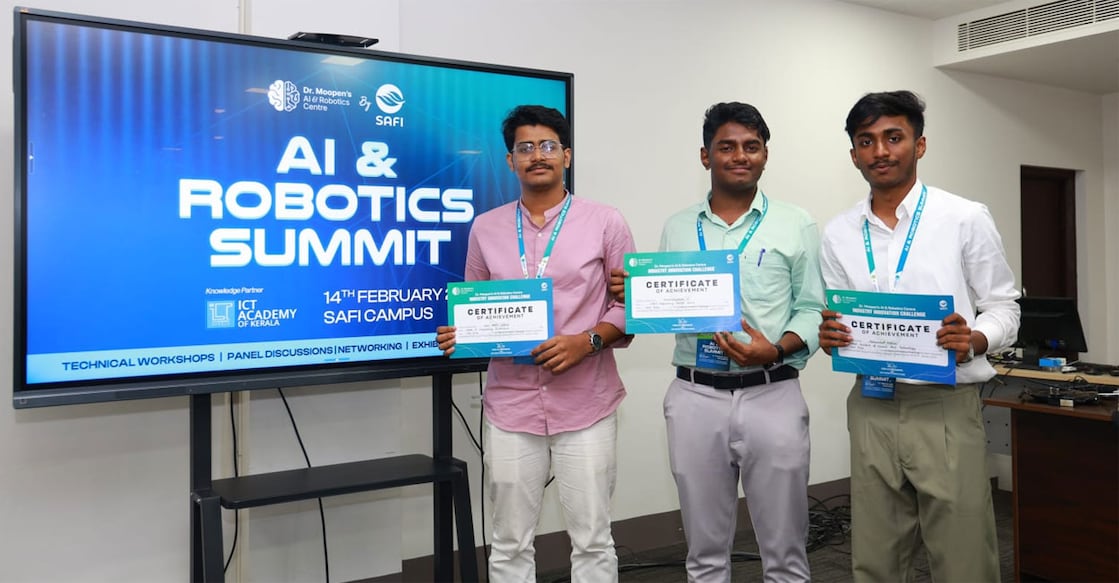
The project, titled “AI Coconut Classifier,” first emerged at Dr Moopen’s AI and Robotics Centre State Level Industrial Hackathon held earlier in January this year. For the competition, Mohsin collaborated with students from different colleges – Saad Abdul Latheef, a second-year Electronics and Communication Engineering student from CET Thiruvananthapuram, and Devanarayanan A, a second-year Robotics and Automation Engineering student from KMEA Aluva.
Competing against nearly 200 applications from institutions across Kerala, the inter-college team won the overall championship and secured the first prize along with ₹50,000 in prize money.
But the students were far from finished. Determined to scale the technology further, Mohsin later upgraded the project’s backend infrastructure to align with global AI development platforms.
“We made a few upgrades for the OpenAI hackathon in the tech stack. Because they have a regulation that we must use ChatGPT’s tools, we completely shifted the backend,” he said.
The upgraded version earned the team an invitation to the prestigious OpenAI Codex Hackathon held in Bengaluru on April 16. Out of more than 2,500 applicants nationwide, only 35 teams were selected.
For the national-level competition, Mohsin teamed up with Riza Mohammed T, a Class 12 pass-out student. The duo competed against professionals from companies including GitHub, Microsoft, Amazon Web Services and Apple, as well as students from premier institutes including BITS Pilani and the IITs.
They secured third place in the competition, winning $5,000 in OpenAI developer credits and a one-year subscription to ChatGPT Pro.
Following the consecutive victories, the project has now begun attracting attention as a commercially viable agritech solution. Mohsin has since been selected for the YC Startup School India programme hosted by Y Combinator.
According to the students, the financial implications for the coconut export industry could be substantial.
“I spoke to a coconut industry based in Bangalore that exports 100 tons a day. They have almost 15 to 20 people to manually classify this, paying roughly ₹1–2 lakh as salary monthly. If they implement a system like this, it will cost a maximum of ₹2–3 lakh because the expenses only come from the mechanical parts like conveyor belts and rollers. The technology itself is completely developed,” Mohsin said.
 Add as a preferred source on Google