
Gulf Malayalis catch up with buddies, flag bad roads at Kerala panchayat’s online Grama Sabha

Mail This Article


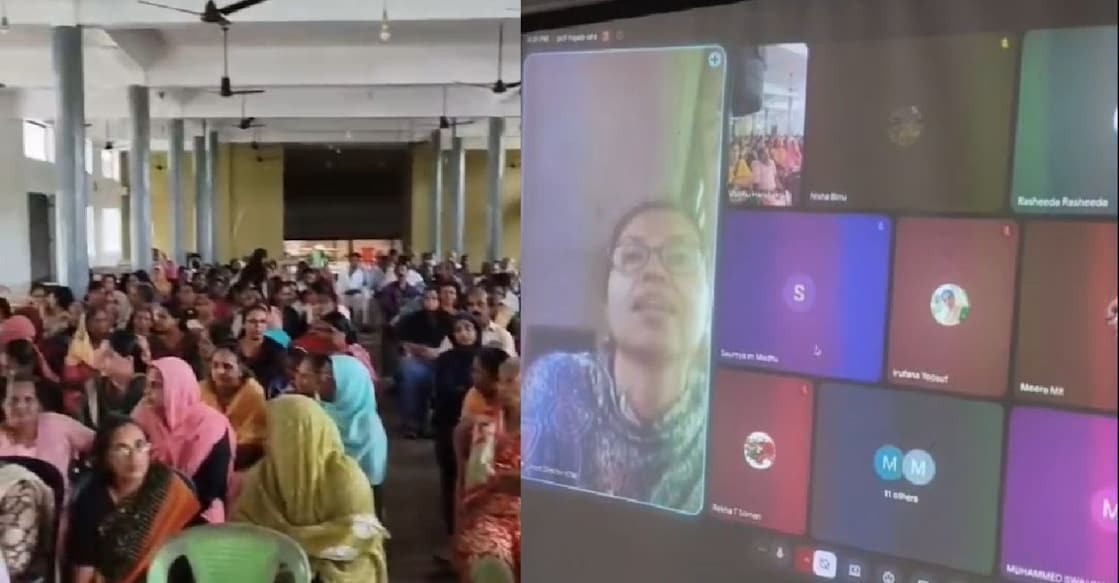
During his lunch break at work, Shan Valiplakkal Thazhe Abdul Kareem, a Qatar-based Malayali, logged into a Google Meet from his office. On the other side was a digital Grama Sabha meeting happening over 3,000 kilometres away in his hometown in Kottayam's T P Puram — a first-of-its-kind initiative in Kerala.
The meeting, held recently, was organised by Ramshad, the ward member of the T P Puram ward in Kottayam's Vazhoor panchayat, as part of a broader plan to digitalise local governance across the ward.
"The meeting was scheduled for 3 pm IST. So over here it was around 1 pm, the time of my lunch break. So I looked forward to participating," Shan told Onmanorama.
Having left India 18 years ago, Shan had found ways to remain connected with his locality. "Whenever I can, I try to participate in regional matters. But it is difficult to intervene in governance while sitting here. We only come to know of political decisions after they have already been made," Shan told Onmanorama.
However, the digital Grama Sabha initiative became the bridge Shan had hoped for. "Sitting here, I was able to raise concerns regarding a road that was in a treacherous condition," he said. "But more than just the road, it is the sense of community it brings to those who have been separated from our hometowns that I value," he added.
Several people had joined the meeting with their cameras on. Shan spotted familiar faces from his locality, which added a layer of homeliness that was missing in NRI life. "It felt as though I was actually there," Shan said.
"Even when I was back in Kerala, I would never attend these meetings. I wouldn't even know what to do in them. It's something that usually gets settled with a notice sent to our homes," Shan said.
"But this initiative is worth applauding. It brought together a platform for us NRIs to address our issues while retaining a sense of community," he added.
The digital platform had not just helped those living outside the village. Even those within the village who were temporarily unable to attend could use the platform to make themselves heard.
For Irufana, the meeting came at an unfortunate time as she was taking her daughter to the hospital. "I was planning to attend the meeting, but I had to take my daughter to the hospital," she told Onmanorama.

She then recalled a message sent to the ward's WhatsApp group informing residents of the option to participate in the meeting online. "I remembered that I could attend it digitally, so I logged in from my phone while I was travelling back in the car," she added.
The experiment quickly turned into a major success, garnering appreciation from the ward's residents as well as government representatives.
"This is the first time such an initiative has been conducted anywhere in Kerala," Ramshad said, expressing his pride in the venture's success.
"The UDF government is pushing to digitalise various aspects of governance. That's what gave us the idea," Ramshad told Onmanorama. "There are a lot of people in our ward who live abroad or outside the village. So we thought this would be a good start," he added.
According to Ramshad, the ward has 1,147 voters, of whom 250 attended in person, while 109 people joined online at some point during the meeting.
The choice of a digital platform also broadened the scope of the meeting's participants. Among those in attendance was Kanjirapally MLA Rony K Baby, who inaugurated the digital initiative by joining online while on official travel. "Everyone is switching to online and digital platforms. We should embrace this digital revolution," he told Onmanorama, applauding the initiative.
He also pointed out its significant role in bringing "democracy to the people" by improving accessibility for a broader section of society. "Such platforms bring more people into the practice of democracy by allowing them to actively participate in decision-making and governance," he said.
He also said the initiative had been brought to the attention of the Local Self-Government Minister. "He was extremely happy to hear about its success," Rony added.
Grama Sabhas are integral to local self-governance under the 73rd constitutional amendment. It provides a platform for village panchayats to gauge public opinion and disseminate information on key schemes and projects to be implemented in village panchayats.
The Kottayam district Local Self-Government Department Joint-Director, Treesa Jose, who also participated digitally, shared similar views. According to Treesa, the grama sabha is a fundamental unit of governance, and active participation will positively impact overall development. "The grama sabha is the most basic yet fundamental unit of decision-making. It is the ideas that originate here that form the foundation for decisions taken at higher levels of government," she told Onmanorama.
While the initiative acts as a blueprint for broader implementation, Treesa ruled out the need for blanket implementation. "Each village is unique and has its own characteristics. Therefore, any initiative must carefully study these attributes and implement policies that complement them," she said.
The local self-government department had earlier announced a plan to use K-SMART app to convene online Gram Sabha meetings. As part of the initiative, each local body member would be given a user ID to convene online meetings.
 Add as a preferred source on Google