

Mail This Article


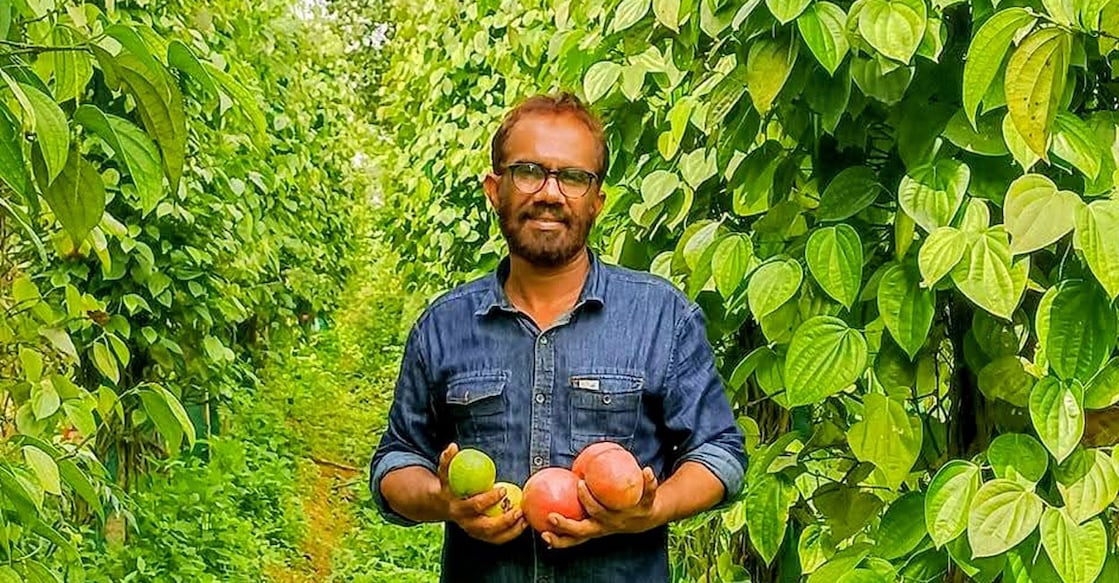
At a time when debt and crop failures were driving farmers in Kerala’s Wayanad to despair, Ayub Thottoli and his wife Sabira decided to take a leap of faith. Ayub resigned from his job and returned to the soil, seeking the peace and satisfaction that his father, a passionate conservationist, had always derived from farming. Realising that traditional, single-crop systems were failing, Ayub chose to innovate. Today, his pioneering efforts have not only put his farm on the global agricultural map but also earned him a place in the state's agricultural budget discussions, supported closely by his daughters Sithara, Ani, and Isabel.
Ayub became one of the first in Wayanad to experiment with diverse cash crops, introducing Vietnam-style black pepper cultivation and commercial guava farming. Today, his lush estate in Vellamunda is a thriving ecosystem featuring avocados, rambutans, passion fruit, dragon fruit, Vietnamese jackfruits, dwarf coconut palms, freshwater aquaculture, and a poultry unit.

The shift from seasonal harvests to monthly income
Traditionally, Ayub’s family relied on seasonal cash crops such as coffee, pepper, arecanut, and paddy. However, waiting for annual harvests created financial instability. Ayub realised that to make farming viable, he needed to secure a steady monthly cash flow. He began planting short-duration crops like vegetables and bananas, systematically planting 100 banana saplings every month. Within a year, this small change started yielding a reliable monthly income of ₹3,000 to ₹5,000, boosting his confidence to scale up and experiment with newer, highly structured agricultural methods.
How 'Lunch with a Farmer' changed the tourism landscape
Recognising that crop cultivation alone was vulnerable to market volatility, Ayub turned to agro-tourism. His meticulously managed two-acre vegetable plot, brimming with unusual crop varieties, initially drew local curiosity. As visitors started arriving to buy fresh produce straight from the farm, Ayub realised the massive potential of experiential tourism. This sparked his self-developed initiative, 'Lunch with a Farmer', which he presented to the Edavaka Panchayat. Under this programme, visitors tour the farm and are treated to a traditional lunch prepared entirely with ingredients harvested on-site, alongside value-added treats like homemade squashes and fruit jams.
A global hub for responsible tourism
Agro-tourism, in Ayub’s view, is not designed for casual sightseers. It is an integral part of responsible tourism aimed at those who genuinely want to learn about conservation and the journey of food from seed to table. Ayub’s farm found a prominent partner in the MS Swaminathan Research Foundation, which regularly routes its international delegates, researchers, and travellers to his property to study sustainable techniques. Visitors from various countries now pay a set fee to experience his farm, converting agriculture into a highly profitable educational service.
Spread across seven acres in Edavaka and managed by just three people, the farm hosted over 1,000 visitors in 2024. Among its prime attractions is a high-density fruit orchard modelled on South African farming techniques. While traditional methods accommodate only 40 to 45 mango trees per acre, Ayub’s high-density model utilizes a 2 x 3 metre spacing to comfortably grow 666 trees per acre. The trees are regularly pruned to a manageable height, allowing for easy, damage-free hand-harvesting. Additionally, the estate showcases 24 different varieties of bamboo—a plant rarely grown systematically as a commercial crop in the region.
Challenging traditional mindsets and mentoring the next generation
The journey was not without resistance. When Ayub first proposed integrating tourism with agriculture at a local farmers' forum, he faced severe backlash. Many feared that tourists would merely leave behind plastic waste and disrupt their peaceful lifestyle. However, Ayub demonstrated that curated, responsible tourism could directly empower farmers by eliminating middlemen, allowing growers to sell premium produce directly to consumers. He advises aspiring agro-tourists to develop a deep, intimate knowledge of their own land, as the ability to share authentic insights is what truly builds buyer trust.
Ayub’s farm has also been recognised by the State Biodiversity Board for its role in preserving native flora and maintaining a comprehensive regional biodiversity register. This document monitors newly introduced species while charting lost indigenous varieties. Furthermore, the Department of Agriculture has formally designated his estate as a 'Farm School'. Through this initiative, Ayub hosts local school children for hands-on activities, including traditional paddy transplanting, fostering a vital and long-lost connection between the younger generation and the soil.
