

Varanasi: The rhythm of life and death
Mail This Article


Mark Twain, in his travelogue ‘Following the Equator: A Journey Around the World’ published in 1897, wrote, “Benaras is older than history, older than tradition, older even than legend, and looks twice as old as all of them put together.”
Only a handful of cities worldwide have witnessed continuous human habitation for over three millennia. Among the few such Indian cities, one has acquired three names over the course of history: Varanasi, Benaras, and Kashi.
A trip to India’s holy ‘City of Death’ had long been on the bucket list, inspired by its unique past and by reading MT Vasudevan Nair’s novel 'Varanasi'.
City of commonness
While booking flight tickets, the face of a former Indian Prime Minister suddenly came to mind: Lal Bahadur Shastri.
Varanasi Airport is named after him, a native of the city. He was educated at Kashi Vidyapith, where he earned the title ‘Shastri’ (scholar), which subsequently became his surname.
In one of his rare interviews with the BBC, Lal Bahadur Shastri unequivocally declares, "I belong to the category of the common man." Notably, a constructed ‘commoner’ image also forms an integral component of the public persona of the present MP from Varanasi and the Prime Minister of India, Narendra Modi.
Despite its association with two Prime Ministers, Varanasi remains what it has always been: an unapologetic celebration of the ordinary, where faith binds the rhythms of everyday life to the eternal.
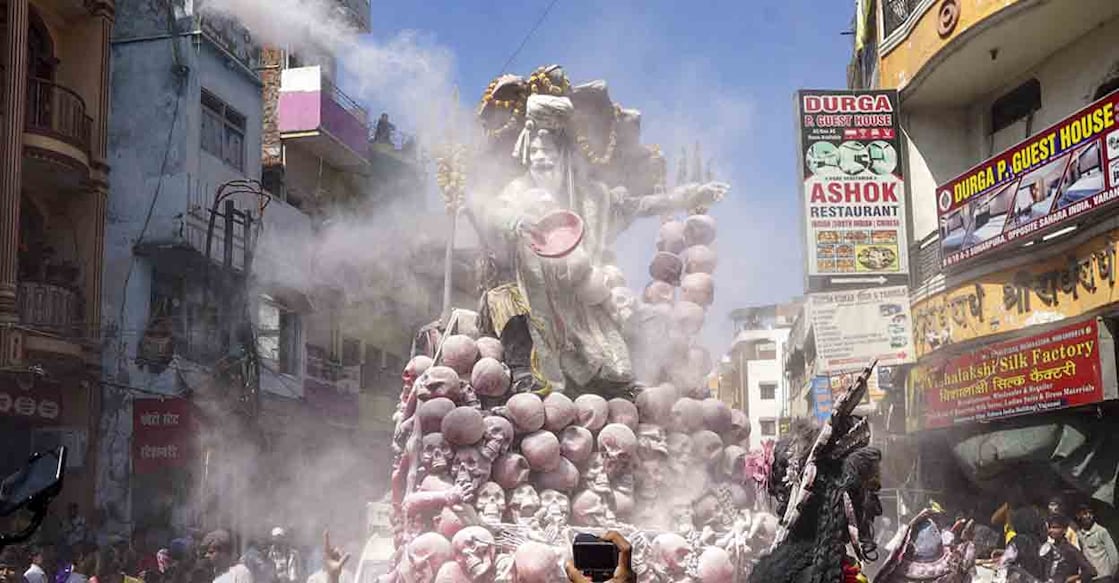
Once you step into Varanasi’s city centre and walk towards the ghats, the relentless pulse of a North Indian ‘religious’ city engulfs you instantly. Pilgrims from every walk of life, small shopkeepers selling ritual items, boatmen along the ghats, street vendors, and artisans fill the scene.
The moment you enter its centuries-old narrow streets, locally known as gallis, you are instantly engulfed. These commercially and religiously dynamic lanes are interconnected and extend across much of the city. Walking through them amid the ceaseless honking of motorbikes is indeed a humbling experience; in these gallis, distinctions fade and everyone must move as one among many.
Pan-Indian ghats
What is the most exciting thing to do in Varanasi for a history enthusiast? A sunrise boat ride along the Ganga.

A dawn boat ride along the roughly 7 km stretch of the Ganga, passing more than 80 ghats, offers an extraordinary experience -- one that reveals monumental structures embodying India’s architectural richness and diversity.
Ghats are essentially stone stairways descending to the riverbank, serving as focal points of religious and cultural life in Varanasi.

Many of the ghats in Varanasi were constructed by native rulers from across India, each reflecting the architectural traditions of their respective princely states.
A prominent example is Dashashwamedh Ghat, renowned for its evening Ganga Aarti. The ghat was constructed and later renovated by Maratha rulers, especially Ahilyabai Holkar of Indore, in the 18th century.
Rana Mahal Ghat, Bhonsale Ghat, Scindia Ghat, Raja Ghat, Rewa Ghat, Darbhanga Ghat and Chet Singh Ghat are among the numerous ghats in Varanasi built by native rulers.
Vijayanagaram Ghat and Karnataka Ghat, established by the Mysore State, were constructed by South Indian kings.
Are there any contributions from the rulers of Kerala? While the rulers of Travancore and Cochin did not establish any ghats, their royal families established two satrams in Varanasi around 250 years ago.
These satrams are now managed by the Travancore and Cochin Devaswom Boards, catering to pilgrims from the state. A few years ago, the Travancore Devaswom Board initiated the renovation of its satrams in Varanasi, located near Kedar Ghat.
Although the phrase ‘Going to Kashi’ has long been popular in Kerala, very few Malayalis are aware that a state-run accommodation facility in Varanasi dates back to the royal era.
Fascinating are the ways in which mighty, opulent kings and queens from across India built those establishments long before Independence.
Death, rituals, and beyond
Varanasi reminds every pilgrim of life’s most fundamental truth: Death. It is a place where believers desire to die, and perhaps the only city in the world where cremations have taken place around the clock for centuries.
Ghats built by different – and often rival – kingdoms across India proclaim how this fundamental truth of life compelled them to cooperate. Death achieved what politics could not: It united them along the banks of the Ganga.
What is most striking of all is that everyone’s last rites – regardless of status or wealth – unfold on the ghats in full public view. Equality in death is Varanasi’s ultimate message: rulers and commoners alike stand before the same great equaliser.
In his 2024 book 'Why we die' Nobel laureate Venki Ramakrishnan explains how humans have developed cultural and religious practices to cope with the eternal fear of death. These coping mechanisms range from building of personal or social legacies for a posthumous existence, belief in resurrection and the immortality of the soul, and, in the Indian tradition, the enduring belief in reincarnation.
The life of Sudhakaran, the main protagonist in MT's 'Varanasi', reminds us how Kashi fulfilled this role in a poignant yet meaningful way.
Sudhakaran reached the ‘City of Death’ in deteriorating health after facing a series of losses in his life. He leaves the scene after performing self-rites for his own soul.
Was Varanasi built and sustained merely to confront the question of death? Do not be mistaken.
Varanasi is not just about death or rituals related to it. It is one of India’s most vibrant cities – a truly happening place. The ghats along the Ganga are not merely places for religious rituals; they are also thriving cultural spaces.
For instance, Assi Ghat draws many foreign tourists for its sunrise yoga sessions, laid-back cafés and pizzerias, and nearby shopping options. Similar morning yoga gatherings can be seen at several other ghats as well.
Tulsi Ghat, named after the Hindu poet Tulsidas who lived in Varanasi, is best known for its wrestling tradition that spans nearly 500 years.
Tulsi Akhada is a mud wrestling pit where daily training and competitive sessions in the indigenous sport of ‘kushti’ (also known as pehlwani) are conducted. After centuries of male dominance, the wrestling pit at Tulsi Ghat finally witnessed women competing in 2017, partly inspired by the Dangal starring Aamir Khan.
Varanasi also hosts a lot of music and dance performances (especially at Panchganga Ghat) featuring both local and invited artists.
A final memory
On the last day of the trip, a cycle rickshaw was hired for the return to the hotel after visiting a Kerala restaurant. As the middle-aged rickshaw puller pedalled through narrow alleys and onto the main road, he moved back and forth, zealously describing how they make the “world’s best mangoes,” the Banarasi Langra aam, and Banarasi paan – all while singing for me “Khaike paan Banaraswala” from the famous Amitabh Bachchan movie Don.
Varanasi is no longer a distant destination imagined as the final journey of ‘going to Kasi,’ but a living presence – where exhaustion, hope, and reflection flow together in the rhythm of life and death.
(Social anthropologist and novelist Thomas Sajan and US-trained neurologist Titto Idicula, based in Norway, write on politics, culture, economy, and medicine)
 Add as a preferred source on Google