

Dubai's calm disrupted as Iran's retaliatory strikes bring missiles over Gulf sky
Mail This Article


As Iran unleashed a barrage of drones and missiles across the Gulf in retaliation for US and Israeli strikes, scenes of disbelief unfolded in Dubai, a city long seen as insulated from regional turmoil.
Some residents rushed for cover. Others stood frozen at their windows, staring at streaks of light across the night sky, struggling to comprehend what was unfolding.
"Oh my God … this is the view from my balcony," influencer Hofit Golan said, her voice trembling as she filmed smoke rising near the Palm Jumeirah- the man-made island emblematic of Dubai's luxury and serenity. "This is in front of my home. Oh my God," she repeated to her millions of followers.
For decades, Dubai has been regarded as a safe haven in a volatile region- a refuge for Arabs fleeing conflict and for Western expatriates drawn by low taxes, security and a predictable lifestyle.
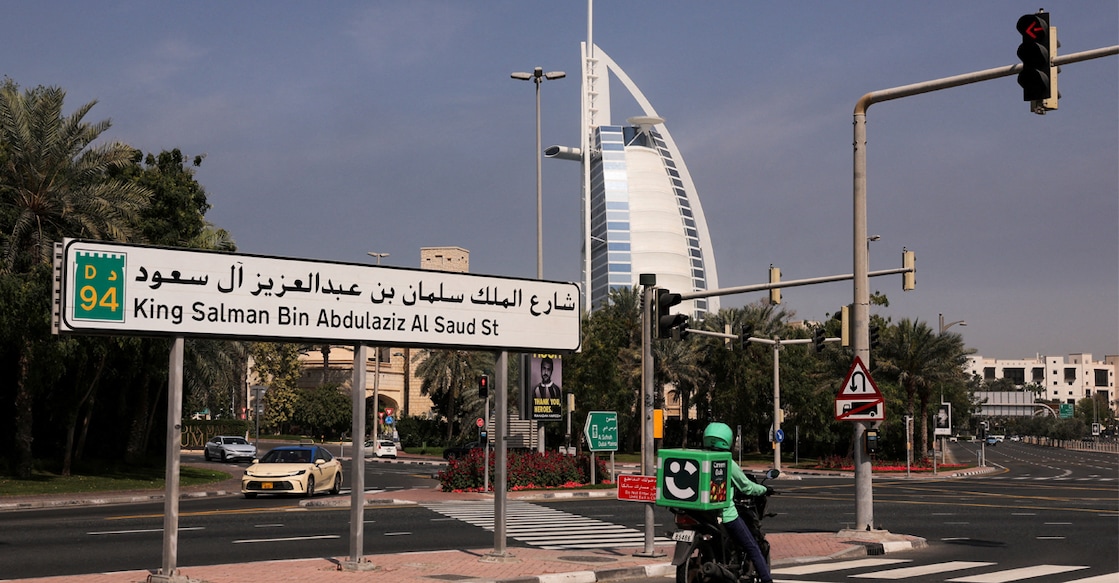
That sense of distance from regional conflict was abruptly shaken as Iranian drones and missiles targeted Gulf states. While air defence systems intercepted most of the projectiles, falling debris caused damage at several prominent locations in Dubai, bringing the reality of regional tensions to the doorstep of one of the Middle East's most carefully curated symbols of stability.
Those sites include the luxury Burj Al Arab hotel, and the Palm- home to luxury hotels, high-end apartments and influencers' panoramic views- where residents described being jolted by blasts as missiles and interceptors streaked overhead.
'Panic and Fear'
Daniel Holmes, a trader based in Dubai with a large Instagram following, said he was woken by a missile interception and could see it from his balcony. "All the locals are like 'nah bro you've got nothing to worry about, it's all good,'" he said in a social-media post. "I'm like ... there is genuine war around where you live here in Dubai. I've never dealt with that before."
That sentiment echoed in conversations across the city, the Middle East's biggest trade and tourism hub: some talked openly about leaving- at least temporarily- while others insisted Dubai and the UAE could still ensure security and continuity.
Expatriates make up around 90 per cent of the UAE's population. A Western expatriate mother of two primary-school children, reacting after hearing a quick succession of explosions, said the experience was unnerving. "They are really keeping us on our toes," she told Reuters via text message. "It's almost as if their only purpose is to maintain the panic and fear."
One Dubai resident who had lived through previous Middle Eastern conflicts said he never expected to hear drone interceptions in the UAE. "I was not mentally prepared. I was terrified, I was actually (hiding) in the bathroom", he said, asking not to be named out of concern for Dubai's strict censorship.

Yamen Fadel, a 36-year-old Dubai resident from Syria, said he saw no reason for alarm, crediting the state's ability to protect people and communicate with residents. "I am seeing that there's nothing much, just a few minor things," he said. "Nothing scary ... because the government here, thank God, is protecting everyone."
Dubai's media office said on Saturday that footage of past fire incidents in Dubai were circulating on social media and that legal action would be taken against those publishing such content. Some influencers appeared to have taken down their initial posts.
'Each one for himself'
On Sunday, as Iran's retaliation widened across the Gulf region, Dubai residents described a city that appeared unusually subdued, with roads- typically crowded even on weekends- strikingly quiet in some areas. The UAE Ministry of Human Resources recommended remote work for the private sector until Tuesday.
A number of small businesses in residential neighbourhoods- barbers, corner shops and other local services- remained shut. Some reported long supermarket queues, delays in grocery deliveries and shelves more thinly stocked than usual.
On social media, residents quarrelled and complained over panic buying. "STOP! You are leaving no essentials for others," one user said on a forum for Dubai residents on Facebook.
"My husband was in the queue at are (sic) local shop and the person in front of him had 15 baguettes in their trolley, and there was absolutely no meat left," another said. A third user retorted: "During the war there are no rules. Each one for himself."
Dubai's leadership signalled continuity. On Saturday evening, the emirate's ruler was pictured at Dubai's marquee horse-racing event, Emirates Super Saturday, which Dubai's state media office described as "a special evening marked by thrilling races and strong competition".
But Robyn, a UK national holidaying in Dubai who stayed at the Fairmont Hotel earlier in the week- before it was struck on Saturday- said the attacks were a reality check. "I always thought in the back of my mind that something will kick off someday and spread to the UAE and surrounding areas," she said. "But the fact that it happened is definitely very grounding, and you realise that not all that glitters is gold," she added.
 Add as a preferred source on Google