

Tehran demands Lebanon ceasefire before Iran-US talks, JD Vance heads to Islamabad
Mail This Article


Iran said on Friday that blocked Iranian assets must be released and that a ceasefire must take hold in Lebanon before peace talks can proceed, throwing last-minute doubt over negotiations scheduled for Saturday in Pakistan.
Iran's parliament speaker Mohammad Baqer Qalibaf said on X that the two measures had been previously agreed with the US and warned that negotiations would not start until they are fulfilled.
His post was echoed by Foreign Minister Abbas Araqchi, who also called for the Israeli airstrikes on Lebanon to stop. Both Qalibaf and Araqchi are expected to be at the talks, Pakistani sources said. There was no immediate comment from the White House.
The Strait of Hormuz remained shut on Friday as Israel traded fire with Hezbollah in Lebanon, disputes that both the United States and Iran described as violations of their ceasefire deal on the eve of their first peace talks of the war.
The two-day-old ceasefire has halted US and Israeli air strikes on Iran. However, it has done little to end the blockade of the strait, which has caused the biggest-ever disruption to global energy supplies, or to calm the parallel conflict between Israel and Iran’s Hezbollah allies in Lebanon.
Iran was doing a “very poor job” of allowing oil to pass through the strait, US President Donald Trump said in a social media post overnight. “That is not the agreement we have!”
Vice President JD Vance said on Friday he was looking forward to positive negotiations with Iran as he left for talks in Pakistan, while warning Tehran not to ‘play us’.
“We’re looking forward to the negotiation. I think it’s going to be positive,” Vance told reporters before leaving Washington.
“As the president of the United States said, if the Iranians are willing to negotiate in good faith, we’re certainly willing to extend the open hand,” he said. “If they’re going to try to play us, then they’re going to find the negotiating team is not that receptive.”
Pakistani capital locked down for talks
Iran, for its part, described the ongoing Israeli attacks on Lebanon as a violation of the truce. Israeli forces launched one of the biggest attacks of the war hours after the ceasefire was announced, killing more than 250 people in strikes on densely populated areas.
Iran maintains that the truce was meant to apply to Lebanon, a position initially supported by Pakistan, which mediated it. Israel and the United States say Lebanon is not covered by the US-Iran ceasefire. However, in a shift on Thursday, Israel said it would open separate talks with the Lebanese government aimed at ending the conflict and disarming Hezbollah.
Despite the accusations of violations, the first planned US-Iran peace talks, set to begin in Islamabad on Saturday, appear to be on track.
“Everything is on track,” said a Pakistani source aware of the discussions, adding that a reduction in violence in Lebanon was a positive sign. “It has de-escalated. Good sign.”
The source said advance teams from both countries were already in place at the Serena Hotel in central Islamabad, where both delegations will stay. While no face-to-face meetings were scheduled for Friday, Pakistan was relaying messages between them.
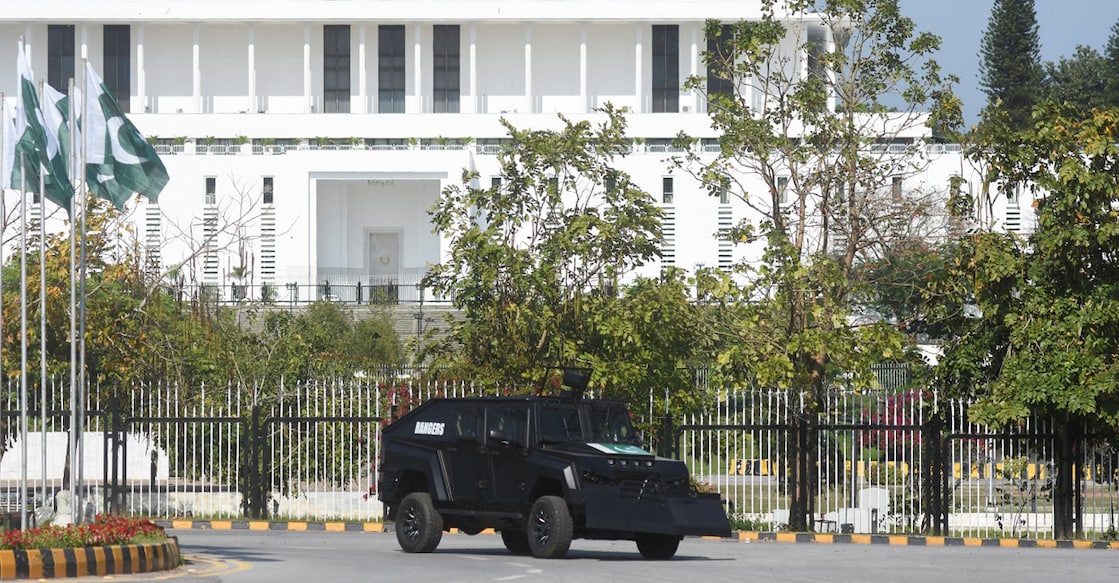
Central Islamabad was placed under a complete lockdown for a hastily announced public holiday, with a 3-km “red zone” security perimeter set up around the hotel.
Pakistani officials were tight-lipped about the arrival of the Iranian delegation led by Parliament Speaker Mohammad Baqer Qalibaf. The US delegation, led by Vance, is expected to arrive in time for Saturday’s talks.
US inflation data to reflect early impact
As throughout the war, Iranian ships continued to pass through the strait, while vessels from other countries remained stranded.
Among the few ships to cross on Friday was an Iranian supertanker capable of carrying 2 million barrels of crude. Before the war, around 140 ships would pass daily, including tankers carrying up to 20 million barrels.
March US consumer price data, due later on Friday, is expected to reflect the war’s early impact on inflation.
Although Trump has declared victory, the conflict has not achieved key objectives he outlined at the outset, including curbing Iran’s military capabilities and dismantling its nuclear programme.
Iran still possesses missiles and drones capable of striking neighbouring countries and holds more than 400 kg of uranium enriched close to weapons-grade levels. Its clerical leadership has also remained intact despite internal unrest.
Iran’s demands at the talks include lifting sanctions and recognition of its authority over the Strait of Hormuz, including the ability to control access and levy transit fees.
Its Supreme Leader, Ayatollah Mojtaba Khamenei, who has not appeared in public since assuming office after his father’s death on the first day of the war, issued a defiant statement on Thursday.
“We will certainly not leave unpunished the criminal aggressors who attacked our country,” he said.
The United States, meanwhile, is expected to push for Iran to give up its enriched uranium, halt further enrichment, abandon its missile programme and end support for regional allies.
Fresh attacks in Lebanon
Israeli Prime Minister Benjamin Netanyahu’s announcement on Thursday that he had instructed officials to begin peace talks with Lebanon marked a shift in stance.
“The negotiations will focus on disarming Hezbollah and establishing peaceful relations between Israel and Lebanon,” Netanyahu said. A US State Department official confirmed that Washington would host an Israeli-Lebanese meeting next week.
Israel invaded Lebanon last month after Hezbollah launched attacks in support of Iran. The conflict has displaced around a fifth of Lebanon’s population.
Israel’s military said early on Friday that it had struck 10 rocket launchers in Lebanon, while Hezbollah launched a missile towards Israel, triggering air raid sirens.
Hezbollah said it had targeted Israeli military infrastructure in the northern city of Haifa. The group had initially indicated it would pause attacks under the ceasefire, but resumed fighting following Israeli strikes earlier this week.
