

Everyone knew Spain's plan. No one could stop it

Mail This Article


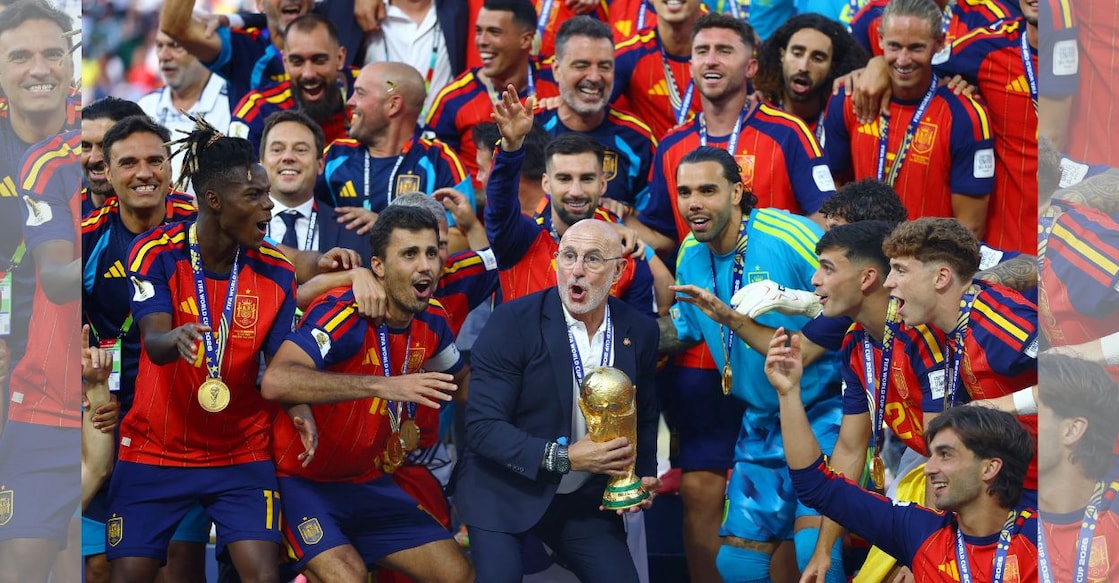
Spain came into the FIFA World Cup with no secret weapon. Every opponent knew exactly what La Roja were going to do—keep the ball, dictate the tempo and patiently pass their way through matches. Yet knowing the plan proved far easier than stopping it. Spain stayed true to their philosophy throughout the tournament and capped it by defeating Argentina in the final to lift their second World Cup title.
Every team prepared for Spain's possession-heavy approach, but none found an answer. In the semi-final, they disarmed France's ruthless attack. In the final, they repeated the feat against Lionel Messi's Argentina, denying them a shot for over 100 minutes. Spain defended not by sitting deep, but by making sure their opponents rarely had the ball.
Spain's passing statistics tell the story better. La Roja completed a tournament-high 5,470 passes, controlling the rhythm of matches from midfield. Their love to monopolise possession denied opponents attacking abilities, reducing goalkeeper Unai Simon's workload to just 14 saves throughout the tournament. By comparison, England's Jordan Pickford made 19 saves, while Argentina's Emiliano Martinez was forced into 20, including 11 in the final alone.

At the heart of Spain's success was captain Rodri, the metronome who kept the entire team ticking. His influence extended to almost every corner of the pitch. A look at his tournament heatmap shows his presence virtually everywhere, except inside the opposition penalty area. He constantly dropped deep to receive possession, shielded the back four, linked defence with midfield and dictated the tempo whenever Spain had the ball.
-
Also Read
Spain's system eclipsed Argentina's Sun
His impact was reflected in the numbers. Rodri completed a tournament-high 799 passes, including 328 accurate passes in his own half and 428 in the opposition half, highlighting both his responsibility in building attacks and his willingness to push Spain forward. His contribution was not limited to possession. He also attempted 26 tackles and won 18 of them, underlining his defensive importance whenever Spain lost the ball.
Rodri's composure gave Spain's back four—Pedro Porro, Pau Cubarsi, Aymeric Laporte and Marc Cucurella—the confidence to play out from defence instead of resorting to long clearances. The approach worked to perfection, with the world champions conceding just once throughout the tournament.
If there was one area where Spain left room for improvement, it was in front of the goal. Their dominance in midfield did not always translate into clinical finishing. The World Cup final against Argentina was a perfect example. Spain attempted 20 shots, 12 of them on target, before Ferran Torres finally broke the deadlock.
Throughout the match, Spain carved out several clear-cut chances. Dani Olmo, Mikel Oyarzabal and Lamine Yamal all tested Emiliano Martinez, but many of their efforts lacked the conviction to beat the Argentine goalkeeper. Had Spain possessed a clinical number nine or a player like David Villa, they could have turned the fortunes by regular time.
The tournament numbers tell a similar story. Spain attempted 140 shots, with 54 on target, but scored only 15 goals. Oyarzabal finished as their leading scorer with five goals from 12 shots on target, while Yamal, despite matching him with 12 efforts on target, managed only one goal. The statistics underline Spain's biggest shortcoming—not creating chances, but converting them.
That lack of a prolific finisher meant Spain were often forced to grind out victories despite controlling matches. Substitute Mikel Merino came off the bench to rescue La Roja against both Portugal and Belgium, while their only comfortable victories came in the 4-0 group-stage win over Saudi Arabia and the 3-0 Round of 32 triumph over Austria. The rest demanded patience, discipline and complete control rather than ruthless finishing.

Rodri himself perhaps summed up Spain's identity best. "I think we're the team that handles the most game situations. Pressing, possession, counter-attacks, set pieces... I think that, in every aspect of football, Spain are the team that can control the game the best."
And that, ultimately, was Spain's greatest strength. They did not overwhelm opponents with goals. They overwhelmed them by controlling every phase of the game.
 Add as a preferred source on Google