

NASA launches astronauts on historic Artemis Moon mission

Mail This Article


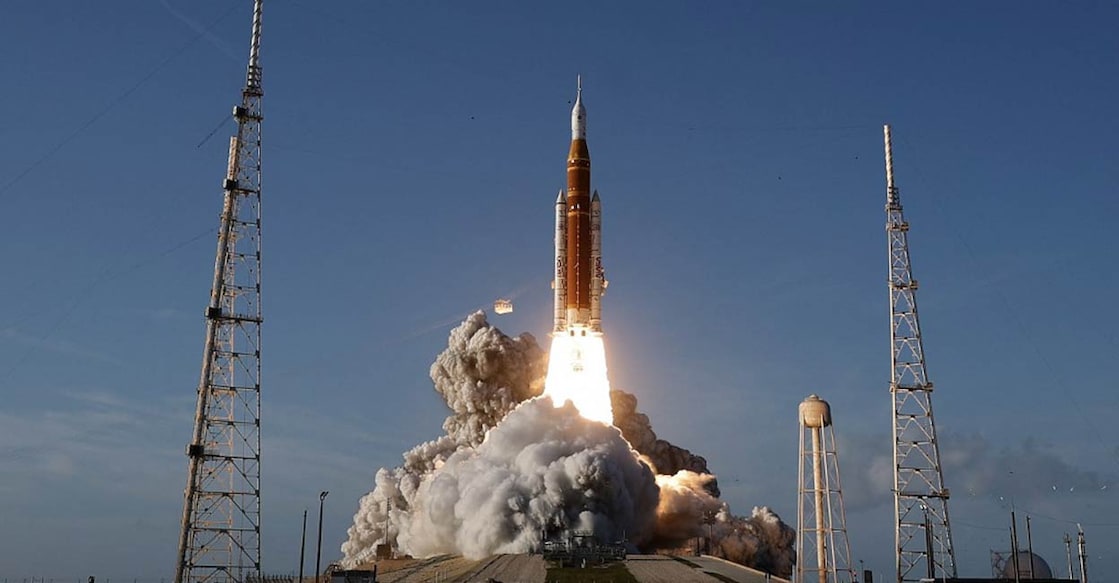
• NASA’s SLS (Space Launch System) rocket lifted off from Launch Pad 39B at the Kennedy Space Center in Florida, sending four astronauts aboard the Orion spacecraft on a planned test flight around the Moon and back.
• The successful launch is the beginning of an approximately 10-day mission for NASA astronauts Reid Wiseman, Victor Glover, Christina Koch, and CSA (Canadian Space Agency) astronaut Jeremy Hansen.
• As the first crewed mission of NASA’s Artemis program, the flight will demonstrate life support systems for the first time with crew and lay the foundation for an enduring presence on the Moon ahead of future missions to Mars.
• About 49 minutes into the test flight, the SLS rocket’s upper stage fired to put Orion into an elliptical orbit around Earth.
• A second planned burn by the stage will propel Orion, which the crew named ‘Integrity’, into a high Earth orbit extending about 46,000 miles beyond Earth. After the burn, Orion will separate from the stage, flying free on its own.
• The spacecraft will remain in high Earth orbit for about a day, where the crew will conduct a manual pilot demonstration to test Orion’s handling capabilities.
• The astronauts, with Mission Control Center teams at NASA’s Johnson Space Center in Houston, will continue checking spacecraft systems.
• If all systems remain healthy, mission controllers will give Orion’s European-built service module a command to conduct the translunar injection burn.
• This move is an approximately six-minute firing to send the spacecraft on a trajectory that will simultaneously carry crew around the Moon, while also harnessing lunar gravity to slingshot them back to Earth.
• During a planned multi-hour lunar flyby on April 6, the astronauts will take photographs and provide observations of the Moon’s surface as the first people to lay eyes on some areas of the far side.
• Following a successful lunar flyby, the astronauts will return to Earth and splash down in the Pacific Ocean.
Why is this programme called Artemis?
• The first missions to take astronauts to the Moon were called the Apollo Programme.
• The first astronauts landed on the Moon in 1969.
• Artemis is Apollo’s twin sister and the Goddess of the Moon in Greek mythology.
Artemis 1
• Artemis 1 was launched on November 16, 2022.
• The 32-story Space Launch System (SLS) rocket surged off the launch pad to send its Orion capsule on a three-week test journey around the Moon and back without astronauts aboard.
• The mission marked the first flight of the SLS rocket and the Orion capsule together.
Artemis 2
• For the first time since Apollo 17 mission in 1972, NASA is sending humans back on a path toward the Moon with the Artemis 2 mission.
• Artemis 2 is NASA’s first crewed test flight in the Artemis campaign.
• Four astronauts will fly aboard NASA’s Orion spacecraft and confirm the spacecraft’s systems operate as designed in the deep space environment.
• The Artemis 2 mission follows the uncrewed Artemis 1 flight test by demonstrating a broad range of SLS and Orion capabilities for deep space.
• The astronauts will evaluate the spacecraft’s systems, including practicing emergency procedures, testing the radiation shelter, taking part in science experiments, and making observations of the Moon from a closer vantage point than human eyes have had in more than 50 years.
• The Artemis 2 crew will travel approximately 4,600 miles beyond the far side of the Moon.
• They will see the Earth and the Moon from Orion’s windows, with the Moon close in the foreground and the Earth nearly 250,000 miles in the background.
• From the crew’s location, the Moon will look about the size of a basketball held at arm’s length.
• Once Orion and the crew come around the far side of the Moon, they will begin the return leg of their journey home.
• This mission will prove Orion’s life support systems are ready to sustain crew on future missions and allow the crew to practice operations essential to the success of Artemis 3 and beyond.
• The Artemis missions will allow astronauts to explore the Moon for scientific discovery, economic benefits, and help build momentum for the first crewed missions to Mars.
• Through Artemis missions, NASA will land the first woman on the surface of the Moon.
 Add as a preferred source on Google