

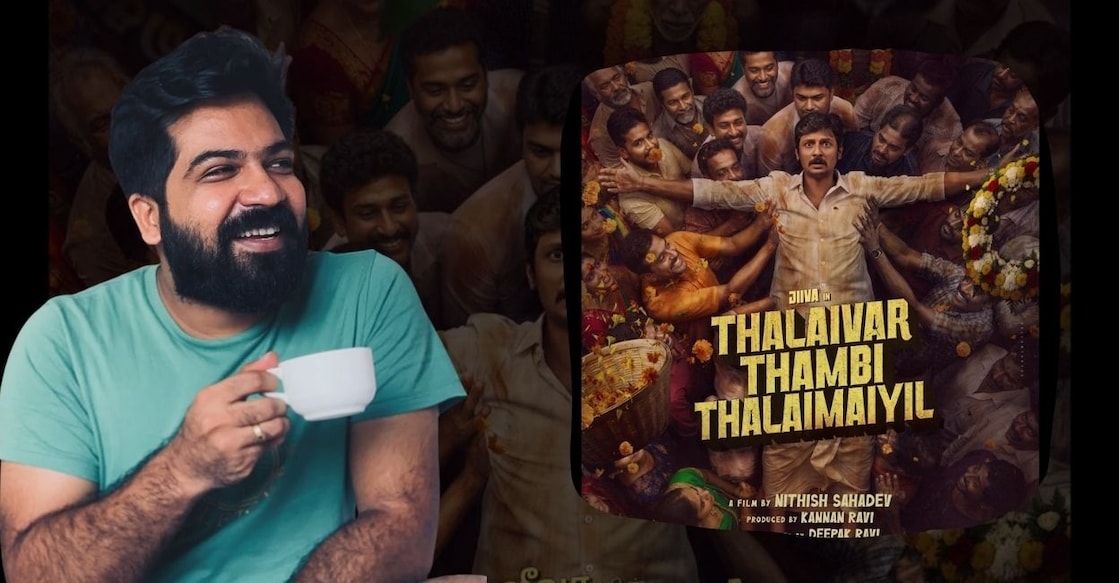
Faced many hurdles releasing ‘Thalaivar Thambi Thalaimaiyil’, but Jiiva is like Nivin Pauly: Director Nithish Sahadev

Mail This Article


About a month before Thalaivar Thambi Thalaimaiyil hit theatres, director Nithish Sahadev was not sleeping easy.
The anxiety had little to do with the film itself. It had everything to do with perception. Actor Jiiva, who headlined the project, had gone through a string of films that didn’t quite land at the box office. Industry chatter was loud. Trade conversations were louder. And Nithish admits it affected him deeply.
“It was a very bad phase mentally,” he says. The role, in fact, was initially meant for Manikandan, but date issues forced a change. When Jiiva came on board, the director was confident in the actor but wary of the noise surrounding him.
“People love Jiiva. He has fans. Jiiva is like Nivin Pauly in that sense. There is a lot of goodwill. The films just have to release properly. Once they release, people will watch.”
That faith eventually paid off. But the journey of Thalaivar Thambi Thalaimaiyil was far from straightforward.
Interestingly, this Tamil film was never meant to be Tamil in the first place.
After delivering the sleeper hit Falimy starring Basil Joseph, Nithish had originally planned Thalaivar Thambi Thalaimaiyil as a Malayalam project. But at that time, several films were emerging in a similar genre space.
“There were too many projects coming up in that zone. I completely dropped it,” he says. That decision led him to make Falimy instead.
Post Falimy, another big opportunity knocked. Nithish was supposed to collaborate with Mammootty. However, the project faced delays. Before it could begin, Mammootty announced a one-month break from films. That pause made Nithish revisit the script he had once shelved.
But by then, he was convinced it would not work in Malayalam anymore.
He believes the audience dynamic in Kerala has shifted. “Malayali audiences are already used to heavy, content-oriented films. Now they want more of a theatrical experience,” he explains. In his view, content-driven films in Malayalam are increasingly flourishing on OTT rather than in theatres. He points out that several such films, despite strong appreciation, had comparatively modest theatrical runs before finding wider reach digitally.
Tamil cinema, on the other hand, felt like fertile ground for this story.
“Content-oriented films are working there in theatres,” he says. That’s when he made the call to rework the project in Tamil.
The casting happened organically. Jiiva had actually approached Nithish for a remake of Falimy. Instead, the director pitched him this different subject. Jiiva agreed immediately.
Despite his earlier anxieties, Nithish says working with Jiiva was smooth. Reflecting on working with both his leads, Nithish points out how different their approaches are. Basil thrives on improvisation and enjoys playing around with scenes, while Jiiva prefers precision, often getting it right in a single take. Yet despite their contrasting styles, both actors brought a relaxed, easy energy to the set.
If casting was one layer of pressure, timing was another. The film’s theatrical reception benefited from circumstances beyond the team’s control. Jana Nayagan starring Vijay was expected to release around the same time but did not. That absence created space in the market.
“Maybe that gave us a push,” Nithish says candidly.
Shifting industries also meant navigating cultural nuance. As a Malayali filmmaker working in Tamil, he was unsure whether he would fully grasp the local pulse. “Being Malayali, there will always be a Malayali touch. I don’t think I can change that even if I try,” he says.
Interestingly, that subtle tonal difference worked.
He observes that in many recent Tamil films, humour often arrives through clearly designed comedy tracks, sometimes driven by actors like Yogi Babu delivering standalone bits. Thalaivar Thambi Thalaimaiyil functioned differently. The humour was not written as forced punchlines. Situations naturally turned funny.
“I honestly did not think that subtle humour would work so much there. But the audience accepted it and loved it,” he says.
To truly understand the reception, Nithish travelled across Tamil Nadu, observing how audiences responded in different cities. “Tamil Nadu is huge. The way Chennai receives a film is different from Salem or Madurai,” he explains. Watching those reactions up close has given him insights he plans to carry into his next Tamil project.
The goodwill from Falimy also travelled across state borders. Nithish laughs as he recalls how several cast members told him they had watched Falimy at least ten times before signing on. That recognition gave him unexpected confidence.
Now, as Thalaivar Thambi Thalaimaiyil gains wider attention following its OTT release, the director finds himself reflecting on the strange arc of the project. A script that was dropped. A language shift that was uncertain. Pre-release anxiety around its leading man. A release window that unexpectedly opened up.
It could have gone very differently.
For Nithish, the experience has reinforced something simple but crucial. Audience love does not disappear overnight. Sometimes it only needs the right timing, the right positioning and the right faith.
He does plan to do more projects in Tamil. But first, he says, he wants to complete the long-pending film with Mammootty.
 Add as a preferred source on Google