

Don't believe in cosmic malarkey; cook, eat all you want during blood moon
Mail This Article


Every time a lunar eclipse rolls around, social media fills up with warnings. Close the kitchen. Do not eat. Fast until it passes. Some posts even advise avoiding intimacy, as though the Moon has suddenly taken charge of daily life.
If this sounds familiar, you are not alone. But before you push aside your dosa batter or cancel dinner, it helps to pause and look at what a lunar eclipse actually is.
What is a blood moon?
A blood moon is the popular name for a total lunar eclipse.
A lunar eclipse happens when the Earth moves directly between the Sun and the Moon and casts its shadow on the Moon. During a total lunar eclipse, the Moon does not vanish. It turns coppery red. That colour comes from sunlight passing through Earth’s atmosphere. The atmosphere scatters shorter blue wavelengths and bends red and orange light toward the Moon, giving it that deep glow.
Not all lunar eclipses are blood moons. Only total lunar eclipses produce the full red effect. Partial and penumbral eclipses may darken the Moon slightly, but they do not create the same dramatic colour.
According to NASA, a lunar eclipse is simply an alignment of celestial bodies. It is safe to watch with the naked eye and poses no health risk. The physics involved concerns light, shadow and atmospheric scattering, not food contamination or digestion.
The Indian Space Research Organisation explains eclipses in the same way. They are predictable and measurable events. Scientists can calculate their timing years in advance. Nothing about that precision suggests danger to the sambar simmering on your stove.

So where did the food restrictions come from?
Historically, eclipses were unsettling because they were rare and not fully understood. In many cultures, including in India, they were viewed as omens. Ritual fasting and other practices grew out of that uncertainty. Traditions often carry emotional weight long after the original fear has faded.
What has not emerged is scientific evidence that food cooked during an eclipse becomes unsafe. There is no mechanism by which Earth’s shadow falling on the Moon can alter the chemical composition of rice, fish curry or chai. Digestion does not slow down because of celestial alignment. Bacteria do not multiply because the Moon appears red.
Astronomy vs astrology
Many of the warnings about avoiding food during an eclipse are rooted in astrology and tradition. Astronomy, which studies the physical universe through observation and evidence, offers a different view. Eclipses are well documented natural events. Treating them as hazardous to everyday life is a cultural belief, not a scientific conclusion.
Cooking, eating and everyday life
Let’s clear the air on common concerns:
- Food safety
Cooking and eating during a lunar eclipse does not make your food unsafe. There is no physical or chemical change in food because of an eclipse. Your idli stays as soft and delicious as ever. - Health and digestion
There is no scientific evidence that eating during a lunar eclipse affects digestion or health. Your stomach does not recognise cosmic events.
A lunar eclipse is a natural and observable event. It does not interfere with how food cooks or how bodies function.
So what should you do?
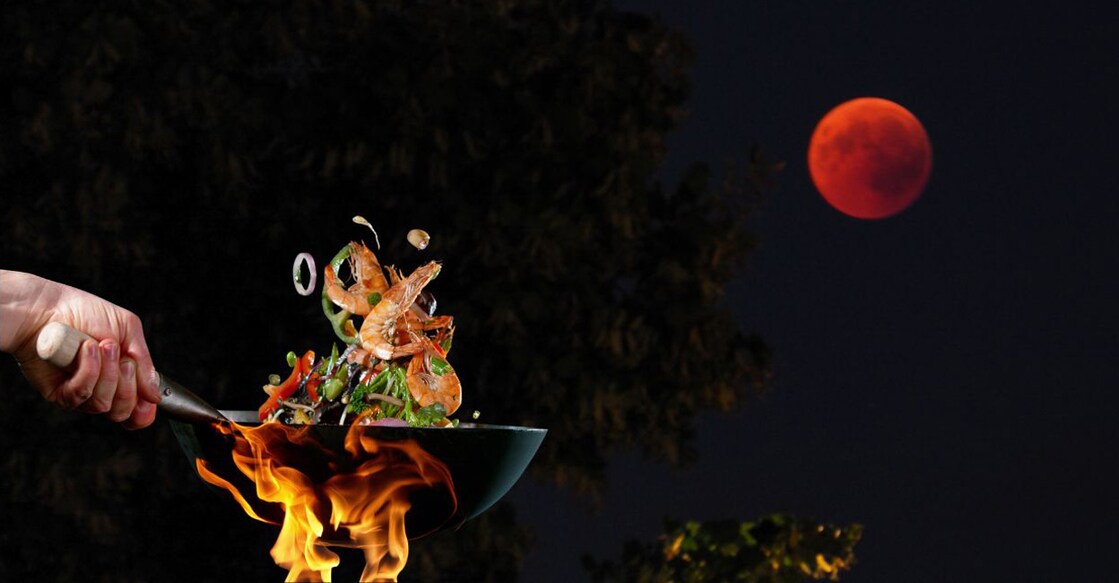
Carry on as usual. Cook dinner. Sit down and eat. If you are curious, step outside and look at the Moon as it changes colour. It is a striking sight.
Traditions add texture to culture, and people are free to follow the practices they value. But from a scientific standpoint, there is no reason to treat a lunar eclipse as inauspicious for your kitchen.
The Moon will pass through Earth’s shadow and move on. Your meal will be just fine.
 Add as a preferred source on Google