Analysis | Kerala Budget: Welfare now, questions later!

Mail This Article


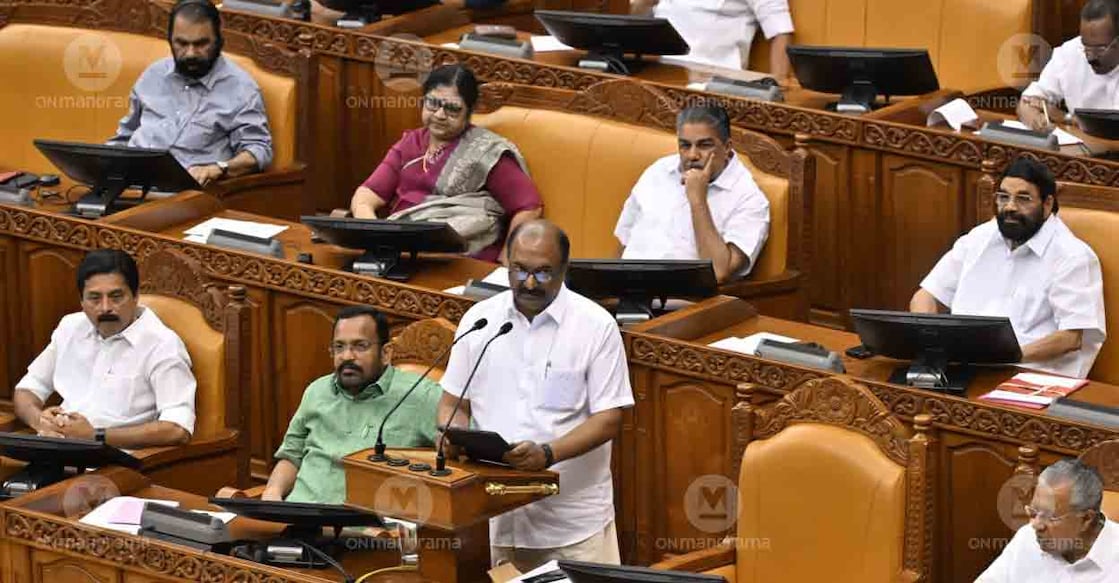
Balagopal proposes, Aravind Panagariya will ultimately dispose. Over nearly three hours, Kerala Finance Minister KN Balagopal delivered what felt like a swan song of a budget speech for 2026-27, generously sprinkling bounties across a wide spectrum — students, women, gig workers, auto drivers, and state government employees.
In essence, a little welfare for everyone. Against a current year’s revised budget size of ₹1.92 lakh crore, the 26-27 budget has been pegged at around ₹2.40 lakh crore — an increase of nearly ₹50,000 crore, or more than 25 per cent. This scale of expansion is unprecedented in the State’s fiscal history.
The inevitable question then arises: will the Treasury have the resources to fund this largesse, particularly in an election year? For those who raised this concern, the Finance Minister’s answer lay in the projected income breakup for the next financial year.
The LDF government, locked in a prolonged confrontation with the Union government over what it describes as attempts to stifle Kerala's growth ambitions — its plea for enhanced borrowing limits is currently before a Constitution Bench of the Supreme Court — is banking heavily on substantially higher transfers from the Centre. The budget assumes that central transfers will double, rising from ₹34,000 crore to ₹68,000 crore.
This expectation rests on two critical assumptions: first, that the 16th Finance Commission, chaired by Aravind Panagariya, will recommend a significantly higher allocation to States; and second, that the Union government will accept those recommendations in full. At present, both assumptions remain firmly in the realm of conjecture.
Thus, while the welfare priorities outlined in the budget are largely unexceptionable, the Finance Minister has, in effect, placed all his eggs in the Finance Commission’s basket. What happens if these assumptions fail to materialise? That question found no clear answer until budget night.
Compounding this uncertainty is the State’s struggle to meaningfully revive its own revenue streams. The Economic Survey, prepared by the State Planning Board, paints a sobering picture of Kerala’s fiscal health. It notes:
“The State’s total revenue receipts increased marginally from ₹1,24,486 crore in 2023–24 to ₹1,24,861.07 crore in 2024–25, registering a growth of just 0.3 per cent. However, transfers from the Centre declined sharply by 6.15 per cent in 2024–25 compared to the previous year. While the State’s own revenue receipts have generally shown an upward trend — barring the Covid-hit year of 2020–21 — growth in 2024–25 was modest at 2.7 per cent. During the same period, own tax revenue rose by 3.1 per cent, while non-tax revenue increased by only 0.9 per cent.”
In short, the fiscal tap that the Finance Minister expects to open wider to finance his ambitious welfare commitments remains firmly under the Centre’s control. If that tap does indeed open, Balagopal’s strategy may well appear prescient.
There has also been criticism that the Finance Minister ought to have limited himself to presenting an interim budget with a vote on account. Constitutionally, however, there is no bar on what the LDF government has chosen to do.
With Assembly elections looming, it remains to be seen how far these freebies help the ruling front. In the recent local body elections, the LDF lost ground to the UDF, while the BJP made a breakthrough by capturing the prestigious Thiruvananthapuram Corporation. Prime Minister Narendra Modi has alluded to the BJP’s first-ever municipal victory in Ahmedabad in 1987 as a signal of how the party intends to expand its footprint from here.
All things considered, there are at least five factors that merit close scrutiny.
First, Kerala’s growth rate over the last two years, as covered by the Economic Survey, has lagged behind the national average. In 2024–25, India grew at 6.5 per cent while Kerala managed 6.18 per cent. In 2023–24, the corresponding figures were 9.2 per cent for India and 6.75 per cent for Kerala. At the very least, future policy must focus on matching — if not exceeding — the national growth trajectory.
Second, the State Planning Board continues to rely on outdated datasets. Kerala is among the very few States — perhaps the only one — that still maintains a Planning Board and persists with the framework of Five-Year Plans, a relic of the Soviet era. The Board would do well to release documents grounded in up-to-date data. Even States like Odisha, which have dispensed with Planning Boards and rely solely on their Finance Departments, publish more current data ahead of their budgets. The Economic Survey produced by the Chief Economic Adviser offers a model worth emulating.
Third, GST mobilisation, particularly post-IGST settlement, must at least match the national average rather than trail it. The collections for 2024–25 and the cumulative figures up to December 2025 clearly demonstrate the urgency of corrective measures.
Fourth, according to government data, nearly one crore people out of Kerala’s population of around 3.25 crore receive some form of cash support from the State. If Kerala is indeed among the States with the lowest levels of poverty, how does one justify extending doles to nearly one in three residents?
Fifth and finally, there is an urgent need for rigorous follow-up to translate investment intent into actual inflows, particularly after the Industry Minister and his team’s visit to Davos. One major GCC-based US company has already expressed interest in investing in Kerala, and the Global Investor Meet held earlier in Kochi reportedly elicited encouraging responses.
There was also a very interesting suggestion to let municipal bodies borrow through bonds.Later, addressing the media, the FM said Mumbai municipal corporation had earlier built a trans-sea bridge through money from muni bonds.
With Assembly elections just weeks away, the stakes could scarcely be higher. Several surveys suggest that the UDF, led by the Congress, may wrest power from the LDF. Should that happen, changes in the composition of the government — and possibly a reworking of the budget itself — cannot be ruled out.