

Air India Express aircraft involved in Calicut crash reaches Palakkad scrap yard for dismantling, puts village in spotlight
Mail This Article


How long would it take to scrap the wreckage of a passenger aircraft? Palakkad-based scrap dealer Hamsa (name changed on request) says it can be done in less than a week.
The 53-year-old recently won the tender to dispose of the wreckage of Air India Express flight 1344, which crash-landed at Calicut International Airport in 2020. Yet Hamsa is in no hurry to finish the job. Instead, he plans to take nearly two months to dismantle the aircraft.
“I bought it out of curiosity. This is probably the first time in Kerala that a plane has been brought to a scrap yard,” says Hamsa, a native of Karakkad near Ongallur in Pattambi. “I may never get another opportunity to study an aircraft so closely — its mechanics, parts and materials.” Karakkad has long been associated with the scrap trade. “Our place is known as a hub for scrap dealers in Kerala. We have dismantled large machines and even ship parts, but this is the first time an aircraft has reached our yard,” he says.
The Air India Express flight — a Boeing 737-800 — was operating from Dubai to Calicut with 191 people on board when it overshot the tabletop runway at Calicut airport in August 2020. It plunged into a trench more than 25 feet deep and split into two. Twenty-one people, including both pilots, lost their lives.

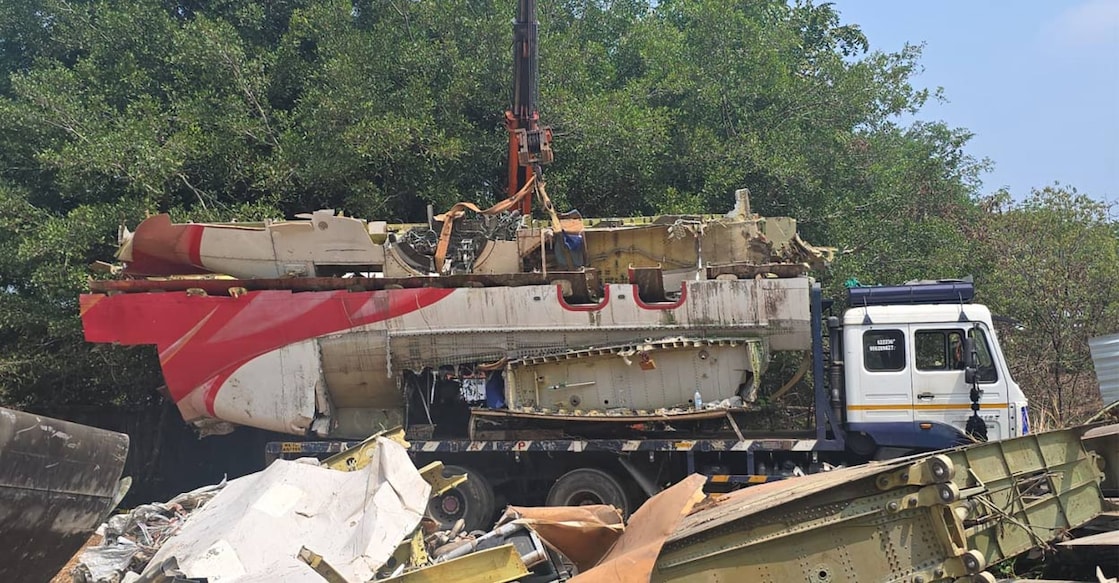
According to Hamsa, the airline floated the tender for disposing of the wreckage about four months ago. After inspecting the debris stored near the airport, he secured the contract. Last Friday, six loads of aircraft material were transported to his scrap yard in Pattambi using large trailers and heavy vehicles. On Wednesday, other parts, including the wings, arrived in four more vehicles.
“Since the wreckage reached here, many people have been visiting the yard just to see it. They take photos and videos, and suddenly our area has become quite famous,” Hamsa says. At the same time, he says the tragedy associated with the aircraft weighs on his mind. “There is always a sense of sorrow because the crash claimed 21 lives and left many injured,” he says.
The aircraft weighs about 45 tonnes, and the wreckage will occupy nearly 20 cents of his 50-cent yard. “A large part of our busy yard will now be taken up by the aircraft. Because of the space shortage, we may have to limit other scrap intake for some time,” he says. The dismantling will be carried out by his team of 12 workers using specialised machinery. “If we wanted, we could complete the scrapping within a week. But this time it is not just about finishing the work quickly,” Hamsa explains. “We want to examine the aircraft carefully, understand its components and sort the materials properly.”
He notes that intact aircraft wreckage rarely reaches scrap yards. “In many air crashes, the aircraft is destroyed by fire. In this case, that did not happen, which gives us the chance to study the components,” he says. Once the dismantling and sorting are completed, the materials will be sent to melting factories. “Most of the time we send scrap to factories in Kerala, though sometimes we depend on units in Tamil Nadu or Karnataka,” he adds.

Hamsa entered the scrap business at the age of 14, following his elder brother. “I used to go from house to house collecting scrap and carry it to the market. The business slowly grew in our area,” he recalls. Today, Karakkad has developed into one of Kerala’s major scrap trading centres, with dealers ranging from small operators to large-scale yards.
Despite decades in the trade and experience dismantling heavy vehicles and industrial machinery, handling an aircraft still feels unusual to him. “I have dismantled buses and large machines, but never imagined I would get an aeroplane,” he says. “Even when travelling by flight, that thought never came to my mind.”
He had heard of scrap dealers dismantling ship parts in the market but had never had the chance himself. “So when the tender came, I decided to take it. Even if it affects my regular business for a while, that’s fine,” he says. “It is a rare opportunity. I didn’t want to miss it.”
