

Analysis | More the murkier: Cong in Kerala must learn lessons from Karnataka & Rajasthan flop show
Mail This Article


Till May 4, when the Kerala assembly election results were announced, the Congress projected cohesion and stability. Now, chaos has unfolded over the Chief Minister's post.
Barely a week into the glorious win with 102 seats, street protests, backdoor jockeying, and ugly exchanges have pushed the Congress into an all-too-familiar terrain of factionalism. Ramesh Chennithala cites seniority, K C Venugopal banks on legislators' support, and V D Satheesan is fuelled by popular demand as they stake their claims for the Chief Minister’s post.
Traditionally, Congress in Kerala had two ways of arriving at the choice of Chief Minister. When groupism reigned, one leader would become the Chief Minister and another would head the party as the Kerala Pradesh Congress Committee chief.
In the late 1970s and late 90s, stalwarts K Karunakaran and A K Antony thus became natural choices. There had also been the much easier option of letting the Opposition leader progress to become the Chief Minister like in 2011 when Oommen Chandy was chosen as the Chief Minister.
Now, the state Congress leadership has to play by the rules of a national norm -- let Chief Minister probables marshal the majority support of the MLAs. The system, which had been calamitous for the Congress in Rajasthan, Madhya Pradesh, and Karnataka, is now unfurling in Kerala in all its dangerous shades.
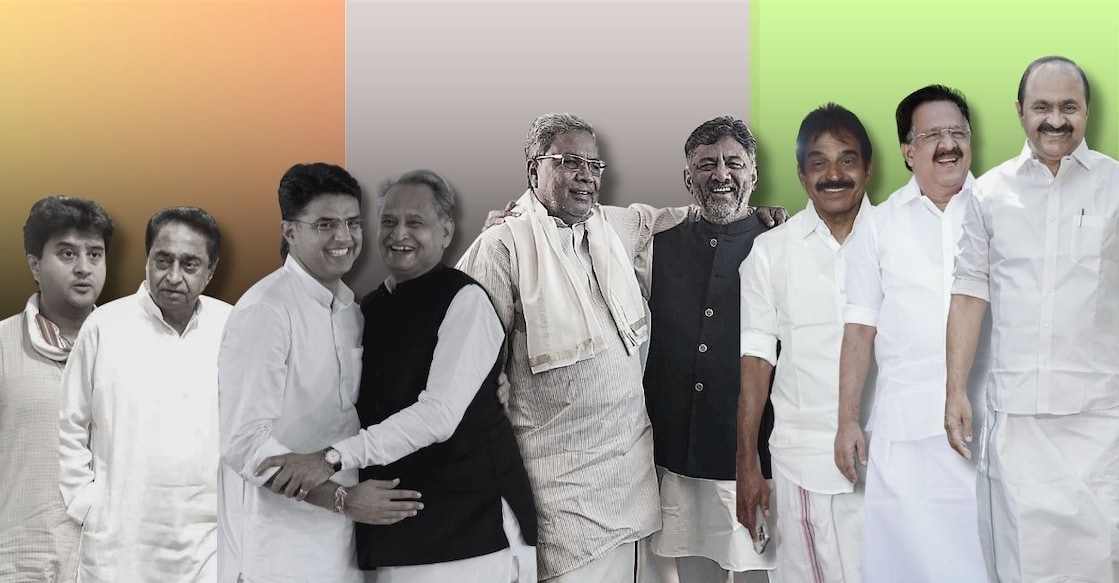
In Rajasthan, the Congress was undone by a power feud between Sachin Pilot and Ashok Gehlot over the Chief Minister’s post. The choice of the Chief Minister had spelt trouble for the party in Madhya Pradesh as well.
In 2018, the AICC picked Kamal Nath as the CM and a sulking Jyotiraditya Scindia quit the Congress and joined the BJP two years later in 2020. In spite of several breakfast meetings, the duel between Siddaramaiah and D K Shivakumar for the top post is still on in Karnataka.
Coming back to power after 10 years, the Congress in Kerala finds itself enmeshed in the very same divisive traits it wanted to dispel for good. If national lessons were not enough, the Congress should have looked at its own history to understand the need for unity more than ever before.
Historically, whenever Congress had been vested with a dominant majority in the assembly elections, trouble had followed, like a perennial curse. In 1977, even when an anti-Emergency sentiment swept the nation, the UDF was voted to power with 111 seats. K Karunakaran became the Chief Minister in March 1977. A month ago, T V Eachara Warrier had filed a writ of habeas corpus in the High Court after his son, Rajan, went missing during the Emergency.
K Karunakaran repeatedly asserted in the affidavit and in the assembly that Rajan was never taken into custody. In April, the High Court ruled that Rajan had been in police custody and that he should be presented in seven days. It became known that Karunakaran stated false facts in the affidavit and when the writ was disposed of, the court ordered that prosecution procedure shall be initiated against Karunakaran for submitting false affidavit. As protests swelled, Karunakaran resigned in April, exactly a month after he had become the Chief Minister.

A K Antony, hailed for his moralistic stance, became the next Chief Minister. It was said that Antony had shown no interest in being the Kerala Chief Minister. In December 1977, Indira Gandhi resigned from the Congress working committee - a result of deep-rooted factionalism within the party. The effect rippled through Kerala. Leaders like P C Chacko and Vayalar Ravi declared their stand against Indira Gandhi. Karunakaran exhorted workers to support Indira Gandhi. Antony said that Gandhi shall not dump the baggage of emergency on the Congress party.
Antony took a fierce stand against the Indira Congress. In 1978, Indira Gandhi contested for the Lok Sabha bypoll from Chikmagalur. Antony opposed any direct or indirect support for Indira Gandhi. The Congress opposed the Janata Party and supported Indira Gandhi, who won the election. Antony didn't wait for the official announcement of the results, and he quit as the Kerala CM. The tenure then saw two more Chief Ministers -- P K Vasudevan Nair and C H Mohammed Koya.
In 1991, the UDF rode a wave of sympathy following Rajiv Gandhi's demise to win 90 seats. K Karunakaran was elected the Chief Minister. The Congress was riven by intense factional rivalry. When the state was rocked by the ISRO espionage case, the High Court observed that there was strong evidence against the then South Zone IG Raman Srivastava. He was placed under suspension. Oommen Chandy called for group meetings in 14 districts. He openly declared that the espionage case was Karunakaran's sin alone and nobody else wished to carry that baggage.
The demand for action against Srivastava grew louder. Congress 'A' group demanded Karunakaran's resignation. In 1995, Karunakaran called a meeting at Gandhi Park and in an emotionally charged statement, he said, "In my entire political career, I haven't seen betrayers like this. They won't be forgiven". Karunakaran later quit as the Chief Minister, making way for A K Antony.
In a poetic twist of fate, Antony would fall prey to the evils of groupism a decade later. In 2001, the UDF soared to power with 99 seats, then suffered a humiliating defeat in the Lok Sabha elections of 2004. Antony assumed responsibility and quit as the CM. Then began another round of fight for the post. Vakkom Purushothaman staked his claim to the post. The matter was settled with Oommen Chandy being elected as the CM and Purushothaman allotted the Finance Minister’s portfolio. Chandy, the tactful politician that he was, even offered Cliff House for Purushothaman as a consolation.
"The irony is that whenever Congress had seats in excess, there were fights over the Chief Minister’s post. In 2011, they came to power with a slender majority, but Chandy managed to complete five years, bypassing all hurdles. The present confusion over the post will erode people's confidence," says G Gopakumar, political scientist. In 2011, the UDF came to power with just 72 seats. Chandy then steered the party to two bypoll wins, handled the Muslim League and its demand for the fifth ministerial post to complete the term.
