
From paddy fields to classrooms of nature: How three friends turned a Wayanad plot into an ecological haven
Mail This Article


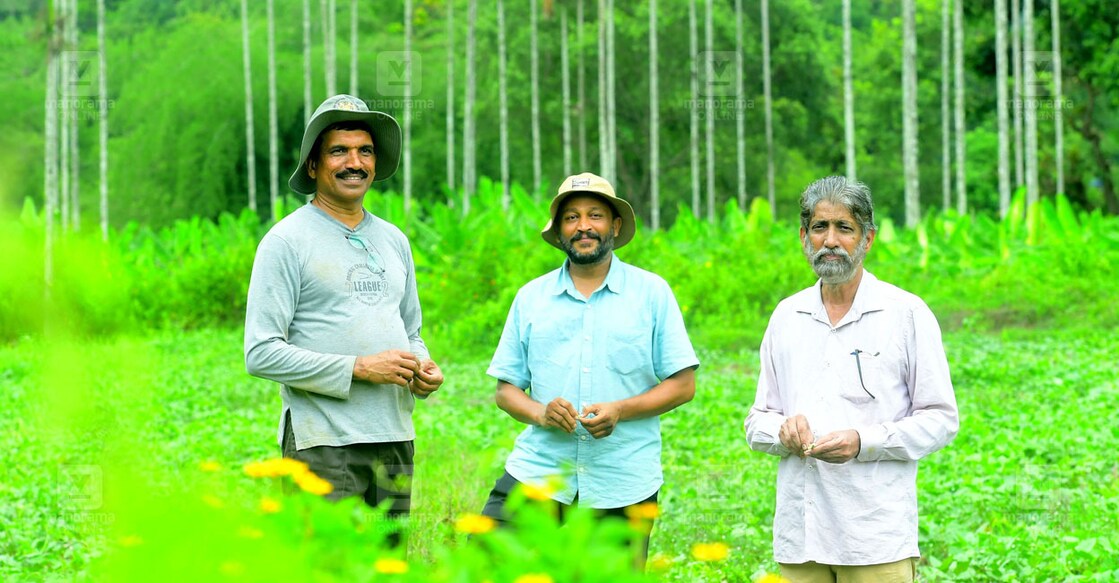
In an era where concrete is rapidly replacing clay and lush wetlands are being systematically leveled, three close friends chose a completely different path. They bought a patch of land, worked the soil with their own hands, and raised a paddy field from scratch. But this is more than just an agricultural venture; it has evolved into a living laboratory for environmental conservation. The visionaries behind this project are Dr Dineshan Cheruvat, the Idukki Collector; Dr Jafer Palot, a scientist with the Zoological Survey of India, Kozhikode Regional Centre; and Dr PK Asokan, who recently retired as the In-Charge of the Central Marine Fisheries Research Institute, Kozhikode Regional Centre. Their shared plot in Wayanad does more than just produce aromatic Gandhakasala rice—it tells the story of a deep, decades-long friendship committed to the planet.
A sanctuary built on coexistence
In 2016, the trio acquired around eight acres of land at Manikkolli, near Panavally in the Thirunelly panchayat of Wayanad. At a time when the prevailing trend across Kerala was to convert low-lying waterlogged paddy fields into dry, residential plots, these friends did the exact opposite. They broke the ground on three acres, enriched it with cow dung and organic compost, and carved out a traditional wetland. They shaped protective mud bunds, created a winding channel for water flow, and dug a pond on one side. They began their journey by cultivating rare, indigenous Wayanad rice varieties like Thondi, Paalthondi, Kullanthondi, Valichoori, and Gandhakasala.
Today, they focus primarily on Kullanthondi and Gandhakasala. Sown in July and harvested by mid-December, this single-crop-a-year cycle is followed by a clever ecological rotation. To naturally replenish the soil's nitrogen levels, they plant leguminous crops such as green gram, cowpea, and horse gram. These cover crops are rarely harvested; instead, they are ploughed back into the soil as green manure. Dr Dineshan Cheruvat explains that they yield about 1200 kg of Kullanthondi and 600 kg of Gandhakasala per acre. The lower yield of Gandhakasala is partly because local birds, including parakeets, peacocks, and weaver birds, love to feast on it. True to their principles, the trio refuses to use traps or chemical pesticides to deter these wild visitors.

Lessons from an environmental pioneer
Dr Jafer Palot fondly recalls a piece of wisdom shared by PN Subramanian, a relative of the land's previous owner and former vice president of Thirunelly panchayat, when they first bought the property: "An elephant will always collect its own tax." It was a rustic reminder that nature will claim its share, and humans must learn to share. However, Dineshan and Jafer had already imbibed this philosophy of coexistence years earlier from their mentor, the late Prof John C Jacob, who served as the Head of the Zoology Department at Payyannur College and was a pioneer of environmental education in Kerala. It was from him they learned that a blade of grass, a butterfly, and a human being hold equal rights to this Earth. The Manikkolli farm is a tribute to that very lesson.
The entire farm runs strictly on organic principles. Alongside the paddy, they cultivate areca palms on three acres and grow turmeric in smaller patches. Despite their demanding professional schedules, the three friends dedicate three to four days every month, especially during holidays, to oversee and participate in the farm work. Whenever Dr Dineshan gets a break from his busy schedule as the Idukki Collector, he heads straight to Manikkolli. During the peak transplanting and harvesting seasons, all three spend extended periods at the farm, staying in a small cottage on site. They do not just manage labourers; they actively descend into the muddy fields to till, plant, and harvest.
A thriving open-air school
The location of the farm is spectacular, flanked on two sides by the Begur reserve forest of the Wayanad Wildlife Sanctuary, with the Kalindi River—a tributary of the Kabani—flowing along another border. For the founders, this is not merely a sustainable farm, but a space to realise Prof John C Jacob's philosophy. The long-term goal is to establish an open-air school where children and adults can camp, observe wildlife, exchange ideas, and develop a deeply grounded ecological perspective. Dr Jafer Palot notes that many environmentalists, birdwatchers, butterflies enthusiasts, and researchers have already stayed here. To date, they have documented over 180 species of birds, including migratory species, 160 species of butterflies, five species of freshwater crabs, and numerous dragonfly species.
This nameless farm stands as a beautiful testament to mutual preservation. "A small species of crab found exclusively here actually helps us by feeding on paddy pests," says Dr Jafer Palot. "Elephants frequent the area, and we have spotted the footprints of tigers and leopards. King cobras, deer, hares, and monkeys are all part of this landscape, yet they have never posed a threat to us."
A bond forged over forty-five years
The roots of this joint farming initiative stretch back 45 years to the dusty schoolyard of Madayi Government Boys High School in Kannur, where Dineshan and Jafer first met in 1981. Though they went to different colleges, they remained inseparable study partners from pre-degree up to their post-graduation. Even as a schoolboy, Jafer spent his days observing birds on the Madayi rocks, eventually becoming a favoured student of Prof John C Jacob. Dineshan joined Prof Jacob's classes during his pre-degree days at Payyannur College, and their academic bond deepened over the years. In Prof Jacob’s final days, both Dineshan and Jafer were among the close circle that cared for him—a rare and deeply personal tribute to their teacher.
Remarkably, both of them joined the Zoological Survey of India at the same time. Two years later, Dineshan resigned to join the State Fisheries Department, but their paths crossed again in 2006 when both were posted in Kozhikode. It was there they met Dr PK Asokan, who was working with the CMFRI. Their professional acquaintance quickly blossomed into a lifelong friendship. All three have published numerous scientific papers and books. Dr Dineshan earned his PhD focusing on the ecological significance of Kaipad farming; Dr Jafer’s doctoral thesis explored the ecology of coastal birds; and Dr Asokan’s research was dedicated to cephalopods.
Dr Jafer Palot, a well-known ornithologist, was awarded the State Children’s Literature Institute Award in 2022 and the Kerala State Council for Science, Technology and Environment (KSCSTE) award for the best science book in 2021. Dr Dineshan Cheruvat has served in prestigious administrative positions, including Director of Fisheries and Director of the Local Self-Government Department. Dr PK Asokan is highly regarded for popularising brackish-water mussel farming on ropes across Malabar. Together, they also founded the Malabar Natural History Society in Kozhikode. This deep alignment of thoughts and values naturally led them to the organic fields of Manikkolli. Currently, the trio is preparing to introduce local cows to the farm, ensuring a steady supply of cow dung and urine for manure. For them, this land is a dream in progress, and they are now waiting for the perfect name—one as pure and flowing as the waters of the Kalindi—to dedicate to this beautiful sanctuary.

 Add as a preferred source on Google