






















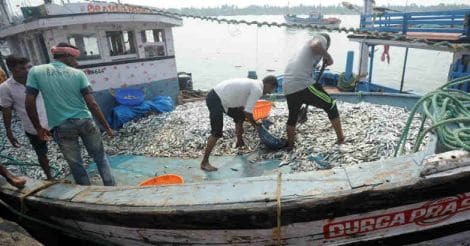
 Fishermen collecting fish from a boat in Mangalapuram fishing harbor. Photo: Fahad Muneer
(Fishy Platter is a series of articles that probes how unsafe/unhygienic is the seafood that Kerala consumes. This is part III of the series.)
Fish lovers, take note: there’s bad news. It has been found out that unscrupulous fishmongers are using formalin, a chemical used to preserve dead bodies in mortuaries, to prevent their catch from rotting away.
According to a coxswain from Vizhinjam, whenever costly fish are caught, fishermen would lift its gill cover and inject formalin into it to ensure that the fish remain ‘fresh’ for weeks.
Part I: A ‘fishy’ journey from deep seas to your steaming plates
Part II: Bringing home the catch without ice and hygiene
Worse still, devious men have discovered a pearl spot lookalike to fool unsuspecting customers who buy it regardless of the exorbitant prices they charge. Owing to the decline of pearl spot, the lookalike fish are brought here from Andhra Pradesh and Tamil Nadu. As the fish are preserved in toxic chemicals, no prize for guessing its 'freshness'.
 Fishing boats lined up at the Mangalapuram fishing harbor. Photo: Fahad Muneer
Recently, officials of the food department found traces of DDT in a stock of dried fish. Later, it was found that the traders had used the disinfectant to kill the ants in the fish. Apparently, the fish were stocked in unhygienic places, where ants and roaches were aplenty.
In India, 20 percent of the total fish caught are dried. In Kerala, about five to seven percent of the catch are dried. However, about 80 percent of the fish we consume are brought from Tuticorin, Mangaluru and so on.
The process of drying is unprofessional and chemicals are used along with salt to dry the fish. The fish that are dried is often infected with staphylococcus strains, which can cause skin diseases, bone infections and food poisoning. However, there are a few firms that ensure cleanliness when the fish is dried.
In addition to the unprofessional means of preservation, another factor that leads to the quick deterioration of dried fish is that they are often procured after they are no more good to be sold raw. Such fish can be obtained at low costs.
 Crates filled with fish are piled at a market in Magalapuram. Photo: Fahad Muneer
The drying facilities at Nagapattinam and Tuticorin are often frequented by stray dogs and flies. Most of the time, the fish is laid on open floor and it increases their bacterial load. The dried fish are then stocked in gunny bags, which get infected with bacteria and fungus in humid conditions. The salt that is used for pickling the fish is also found to be of very low quality.
