

















 A combination of pictures shows the gutted Hiroshima Prefectural Industrial Promotion Hall (C), which is currently called the Atomic Bomb Dome or A-Bomb Dome, after the atomic bombing of Hiroshima on August 6, 1945. Photo: Reuters/AFP
Hiroshima: With a blinding flash of light and an ear-splitting roar, the age of nuclear conflict arrived with terrifying and awe-inspiring force on August 6, 1945, changing the course of history, and killing 140,000 people.
The morning was a run-of-the-mill one for most Hiroshima residents. Housewives made breakfast for their families, children played in the sticky summer heat, and men hurried to get ready for work.
 The ground crew of the Enola Gay B29 bomber which bombed Hiroshima, Japan on Aug. 6, 1945 with the "Little Boy" atomic bomb, stands with pilot Col. Paul W. Tibbets, center, in the Marianas Islands. Photo: AP
Few could have known the dangers above them as a US B-29 bomber, the Enola Gay pierced the sky, loaded with deadly cargo in its belly, the single most fearsome weapon the world had ever seen.
At 8:15 am, the pilot released Little Boy, a uranium bomb with a destructive force equivalent to 16 kilotons of TNT.
After the initial searing fireball, gusts of around 1.5 kilometres (one mile) a second roared outwards, carrying with them shattered debris, and packing enough force to rip limbs from bodies.
 Skulls of victims who were killed in Hiroshima Atomic Bombing On August 6, 1945. Photo: Onmanorama
The air pressure suddenly dropped, crushing those on the ground, and an ominous mushroom cloud rose, towering 16 kilometres above the city.
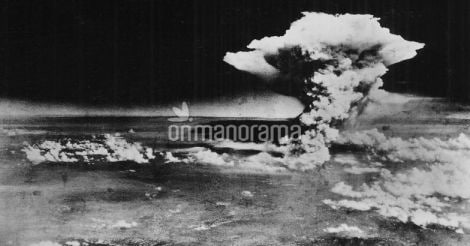 The plume of smoke from a mushroom cloud billow, about one hour after the nuclear bomb was detonated above Hiroshima, Japan. Photo: AP
The smell of burning flesh filled the air as scores of badly injured survivors tried to escape the inferno by diving into the rivers that criss-crossed Hiroshima.
Countless hundreds never emerged, pushed under the surface by the mass of desperate humanity; their charred bodies left bobbing in the brackish water.
 A correspondent looks over the expanse of ruins left the explosion of the atomic bomb on August 6, 1945 in Hiroshima, Japan. Some 140,000 people died here immediately. Photo: AP
Many died of their terrible injuries over the following hours and days; lying where they fell, desperate for help that would never come, or even just for a sip of water.
 Nuclear bomb victims are sheltered at the Hiroshima Second Military Hospital's tent relief center at the banks of the Ota River in Hiroshima, Japan, 1,150-meters (1,258-yards) from the epicenter on Aug. 7, 1945, one day after the world's first nuclear bombing by the United States. Photo: AP
For those who survived, there was the terrifying unknown of radiation sickness still to come.
Gums bled, teeth fell out, hair came off in clumps; there were cancers, premature births, malformed babies and sudden deaths.
 The devastated city of Hiroshima in days after the first atomic bomb was dropped by a US Air Force B-29 on August 6, 1945. Photo: AFP
Seven decades later, some stone buildings that survived the supersonic blast still bear the shadows of anything -- or anyone -- that was incinerated in front of them.
The mangled skeleton of a domed exhibition hall -- the only structure left standing near the epicentre -- stands as a grim reminder of the power of the world's first atomic bombing, a sight that Barack Obama will see Friday when he becomes the first sitting US president to visit the city.
The Hiroshima attack was followed three days later by the Nagasaki bombing. In the wake of the overpowering twin bombs, Japan surrendered less than a week later, ending World War II.
 This combo shows black and white portraits taken on May 25 and 26, 2016 of survivors of the 1945 atomic bombing of Hiroshima, (top L to R) Keiko Ogura, Park Nam-Joo, Sunao Tsuboi, and (bottom row L to R) Shigeaki Mori, Misako Katani and Emiko Okada in Hiroshima. Photo: AFP
(With inputs from agencies)
