

When the crowns come off: Inside Thampanoor Indian Coffee House

Mail This Article


There is a silence that settles inside an Indian Coffee House between two waves of customers, after the tumblers have stopped ringing against saucers for a brief spell, after the last order from a crowded table has been carried across the hall, after the urgency of movement loosens its grip for a few precious minutes, and in that hush, the men dressed in ceremonial turbans ease their shoulders, lift the weight from their heads, drink water in slow gulps, look toward nothing visible, or sink into thoughts no customer will ever hear.

That is the silence, the kind we call loud, which photographer Aakash Kannan heard at the Indian Coffee House in Thampanoor, Thiruvananthapuram, and that is the silence he has transformed into a deeply felt series of photographs that understands labour not as performance, but as a human condition lived hour after hour.
The rhythm of unseen work
His images do not chase drama through exaggeration, nor do they search for easy nostalgia through props and familiar décor. What they pursue, instead, is far more intimate and far more difficult to capture.
A bearer bends to pour tea with the grace of repetition refined over years, another strides forward balancing plates, a worker clears leftovers from a table that only moments earlier held laughter and appetite, another leans back to drink water with the exhaustion of a long shift written plainly across his face, while elsewhere smiles break through fatigue and camaraderie survives routine.
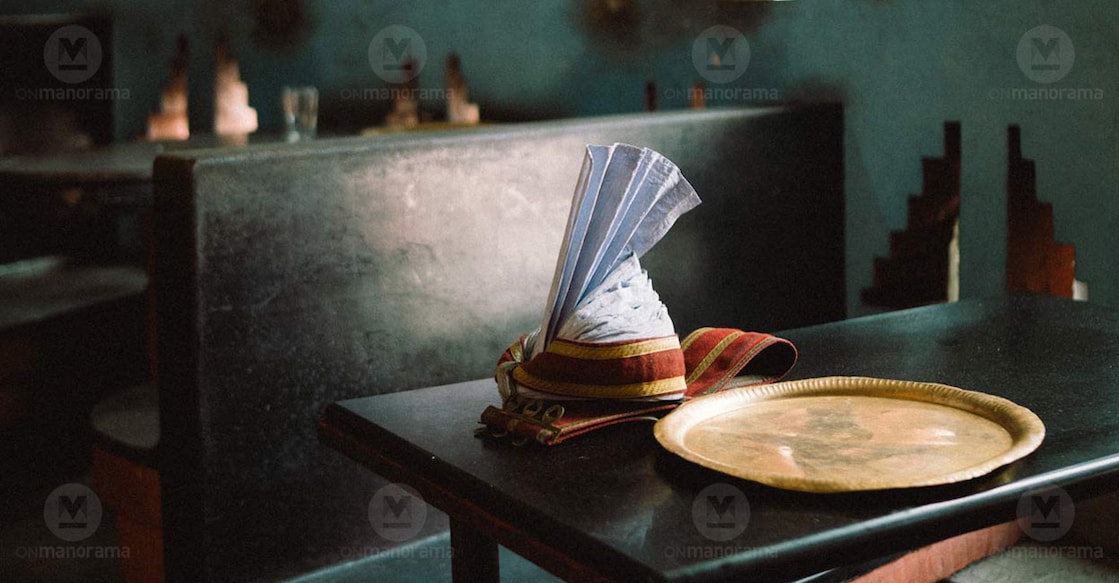
The final photograph in the series speaks with the strongest voice despite the absence of any person in the frame, because the crown-like cap worn by the servers has been placed upon a table beside a golden serving plate, as though the uniform itself has exhaled after a day spent standing upright for others.
The weight of a crown
Aakash, who comes from Thanjavur and works as a wedding documentary photographer, says he was drawn first by affection for tea and then by what the place revealed once he stayed long enough to look closely, for although this was only his second visit, the architecture and the workers’ attire immediately held his attention, and what moved him most was the contrast between their relentless composure during crowded hours and their inward-looking expressions during the slower intervals when caps came off and private selves returned.
His artistic philosophy is expressed in one line: “True beauty lies in our good deeds”.
That belief runs quietly through the series. These are not photographs trying to make poverty picturesque or labour dramatic for effect. They are photographs about presence. About people whose work forms the background of countless meals, reunions, political arguments, train-stop breakfasts and late-evening teas, yet who are often remembered only as uniforms moving past tables.
And what uniforms they are.
The Indian Coffee House bearer’s attire remains among the most recognisable workwear in India: white tunic, sash, elaborate headgear, touches of colour denoting hierarchy and service roles in many branches. The costume carries theatre, discipline and history at once. It can look regal to the customer and burdensome to the worker, especially in the southern heat. Aakash’s frames understand both truths.
House of voice
The setting deepens the emotional force of the series, because the Thampanoor Indian Coffee House in Thiruvananthapuram is not merely a restaurant but one of the city’s most beloved landmarks, designed by celebrated architect Laurie Baker as a cylindrical spiral structure in exposed red brick where light enters through patterned jaali walls and circulates through interiors built with uncommon sensitivity to climate, movement and human comfort.
Generations have entered that building for reasons far larger than hunger, since the Indian Coffee House across India has long functioned as an open room for democracy in everyday form, where politicians argued, students dreamed, writers observed, trade unionists organised, lovers lingered, journalists listened, pensioners read newspapers, and strangers briefly shared space over cups priced for ordinary people.
Its history also carries struggle that is inseparable from its identity, because when government-run coffee houses were closed in the 1950s, worker cooperative societies stepped forward with encouragement from leaders including A K Gopalan, ensuring that what survived was not only a restaurant chain but a living institution shaped by labour, collective ownership and dignity earned through resistance.
The larger story stretches back centuries. India’s earliest coffee house is recorded in Kolkata in 1780, followed by another in Madras in 1792. In the twentieth century, the modern Coffee House chapter began in Bengaluru in 1909, laying the foundation for what would later become a national institution.
Kerala’s own chapter
Kerala entered that story in 1958. The first worker-run Indian Coffee House in the state opened in Thrissur on March 8, 1958, in the Mangalodayam building on Swaraj Round with 13 workers, and coffee was priced at just ten paise. The first day’s sales reportedly came to ₹60.99.
The same year, another branch opened in Thalassery, and over the decades Indian Coffee House would become woven into Malayali life, with branches spreading across towns, bus stands, railway junctions and city centres.
Rooms where India spoke
In Delhi’s Connaught Place, the Indian Coffee House became famous as a meeting point for politicians, writers, artists and journalists. Names such as M F Husain, I K Gujral and Atal Bihari Vajpayee are tied in memory to its tables, where coffee often accompanied argument, dissent and friendship.
Aakash’s photo story honours that hidden archive of memory by returning the gaze toward those who make comfort possible for others, showing men who laugh, sweat, bend, carry, pause, endure and continue.
And when the cap is finally placed on the table beside that gleaming plate, the image lands heavy. It reminds us that every institution people romanticise is held up by invisible human effort. The meal ends, the conversation fades, the crowd leaves.
Someone still has to clear the table.
 Add as a preferred source on Google