Manjeshwar: Ashraf edges ahead in a constituency where margins barely breathe
Mail This Article


Onmanorama tracks the battle in 12 closely fought constituencies where stakes are high and margins razor-thin: Nemom, Manjeshwar, Palakkad, Kunnathunad, Pala, Kottarakkara, Peravoor, Thripunithura, Ambalappuzha, Taliparamba, Payyanur and Nattika. Our team will capture the ground-level pulse and update the poll-meter.
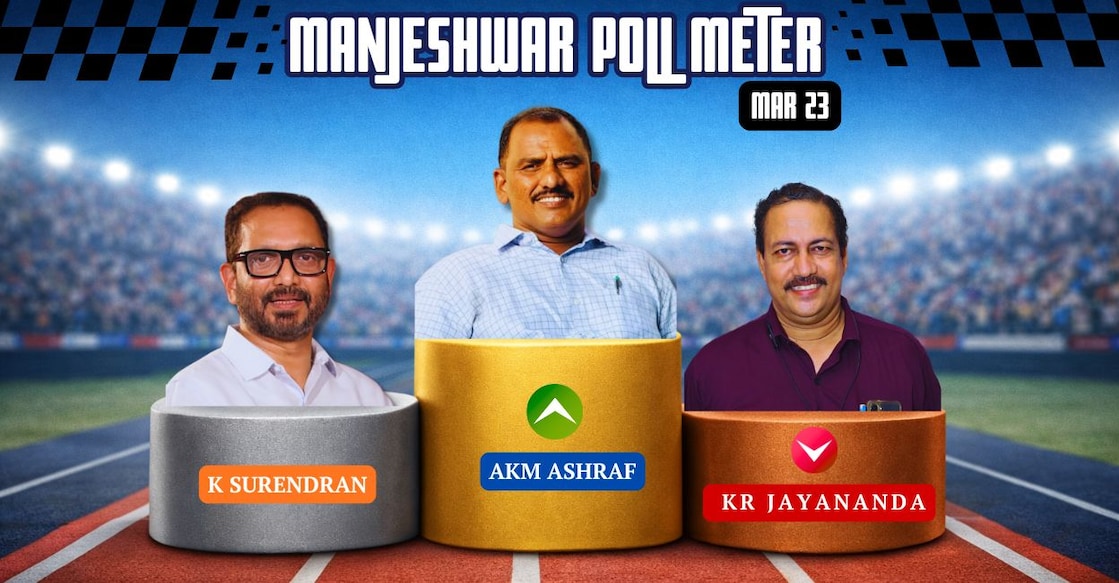
Kasaragod: In a constituency where the last two victories came by 89 votes and 745 votes, calling the race is an act of risk. Yet this time, a discernible drift is visible. Several factors tilt the field towards the United Democratic Front’s A K M Ashraf. Even before formally opening his election office, he appears to hold the early edge.
In the local body polls, the UDF swept all eight panchayats and all four district panchayat divisions that make up the Manjeshwar Assembly constituency, an outcome that has reset the baseline ahead of the Assembly contest.
Against this, K Surendran, the BJP’s former state president, is attempting to reframe the contest in his fourth outing here. Manjeshwar and neighbouring Kasaragod are the only two constituencies in Kerala’s 140 arenas where the BJP is in a direct fight with the Indian Union Muslim League (IUML). The pattern has held since 1982 in Kasaragod and 1987 in Manjeshwar.
This time, the BJP is consciously shifting the frame, from a religious binary to a linguistic question. When Surendran filed his nomination on Saturday, March 21, his party’s saffron-and-green stole was almost covered by a maroon one bearing the symbols of Tulunadu -- a sun and crescent on one side and the words Jai Tulu on the other.
Against the backdrop of the Malayalam Language Bill, his campaign foregrounds the grievances of Kannada and Tulu speakers.
The pitch is calibrated: linguistic identity cuts across religion, potentially offering the BJP a wider coalition in a constituency where Muslims form the larger share of the electorate.
He couples this with a familiar development critique -- neglect, weak infrastructure and administrative indifference. Yet, beneath the language-and-development plank runs a quieter current. Publicly, the BJP avoids overt polarisation; privately, Hindu consolidation remains central. The RSS's ‘Hindu Ekta Sammelanam’, organised without overt RSS branding, drew participation cutting across party lines.
In Meenja panchayat, the event saw CPI leader Sundari R Shetty share the stage with Hindutva leaders. A five-time panchayat member and two-time president, Shetty said she attended what she believed was a Hindu community event. But the messaging carried political undertones. Speaking in Kannada and sitting next to Shetty, Nityananda Yoga Ashrama’s Yoganandan Saraswati invoked national anxieties and called on Hindus to remain vigilant. The BJP’s booth-level and door-to-door campaigns appear to extend this persistent narrative.
Numbers behind the narratives
The BJP cannot foreground this dogwhistling in Manjeshwar for a reason.
In 2021, roughly 83,000 Hindus and 83,000 Muslims, and nearly 6,000 Christians voted in Manjeshwar. The BJP’s path depends on near-total consolidation of Hindu votes, now estimated at 80%. The IUML, by contrast, typically draws only 65% of Muslim votes.
The Special Intensive Revision of the electoral rolls adds uncertainty. Both sides acknowledge deletions, but differ on impact. Of around 17,000 names removed, the IUML claims nearly 11,000 were traditional BJP voters. BJP leaders peg their loss at around 8,000, against roughly 3,000 UDF voters. The IUML also claims to have added about 14,000 new voters, compared to the BJP’s 3,400.
Both parties, however, concede that many deletions involved voters no longer residing in the constituency.
The revised rolls place the electorate at about 2.27 lakh: 1.3 lakh Muslims, 90,000 Hindus and around 7,000 Christians. On paper, this gives UDF's Ashraf the definite edge. The local body results reinforce that advantage.
Local body momentum & Ashraf's emotional connect
UDF put on a good show in the local body elections, which will give thrust to the campaign in the assembly elections.
What strengthens Ashraf further is his personal acceptability. In the 2019 by-election, his supporters travelled to Panakkad and openly protested after IUML gave the ticket to the then District President M C Kamaruddin. By 2021, with Kamaruddin sidelined following the deposit scam, the party turned to Ashraf. Since then, he has entrenched himself as a grassroots leader who cannot be easily sidelined.
A polyglot in a linguistically layered constituency, he moves across communities with ease. His politics is also instinctive as much as it is calculative. He openly condemned the BJP and the Union government for not inviting PWD Minister P A Mohamed Riyas for the inauguration of Kasaragod's Talapady-Chengala stretch of NH66.
On the Kumbla toll plaza issue, while Surendran and the BJP may have secured its eventual removal, it was the sustained public protest, led by Ashraf, that etched the issue into public memory and tied his image to the outcome.
He had done that before during the 72-day search for Kozhikode truck driver Arjun, killed in a landslide at Shirur. Ashraf stayed on the ground, pressing the Karnataka government not to call off the search, building an emotional connect that travelled beyond party lines.
On Saturday, March 21, he wrote on Facebook: “Last Eid, I received a gift… a letter from Arjun’s mother… This Eid, she has given me the amount needed to file my nomination.”
The Left Democratic Front (LDF) enters on a weaker footing. The CPM bypassed its younger face, Shanavas Padhur, and fielded veteran K R Jayananda , with a clear mandate: not to split minority votes. The SDPI and sections of the Church, both of which could eat into Ashraf’s vote base, are still weighing their options, but are likely to stay out to avoid aiding the BJP.
Jayananda also carries a structural disadvantage. Manjeshwar has often preferred “outsiders” -- from Cherkalam Abdulla to CPM’s C H Kunhambu. Even when they lost, candidates like K Surendran and CPM’s V V Rameshan managed to increase their vote share. Ashraf, despite winning in 2021, saw his vote share dip by around two percentage points. If that trend holds, the LDF could see its vote share slip below 23%.
For now, the lines are clear. The BJP is pushing a linguistic pivot backed by consolidation. The LDF is in the assist role. The UDF holds both an arithmetic advantage and organisational momentum.