BJP’s Sobha Surendran gains early edge as Palakkad sees triangular churn
Mail This Article


Onmanorama tracks the battle in 12 closely fought constituencies where stakes are high and margins razor-thin: Nemom, Manjeshwar, Palakkad, Kunnathunad, Pala, Kottarakkara, Peravoor, Thripunithura, Ambalappuzha, Taliparamba, Payyanur and Nattika. Our team will capture the ground-level pulse and update the poll-meter.
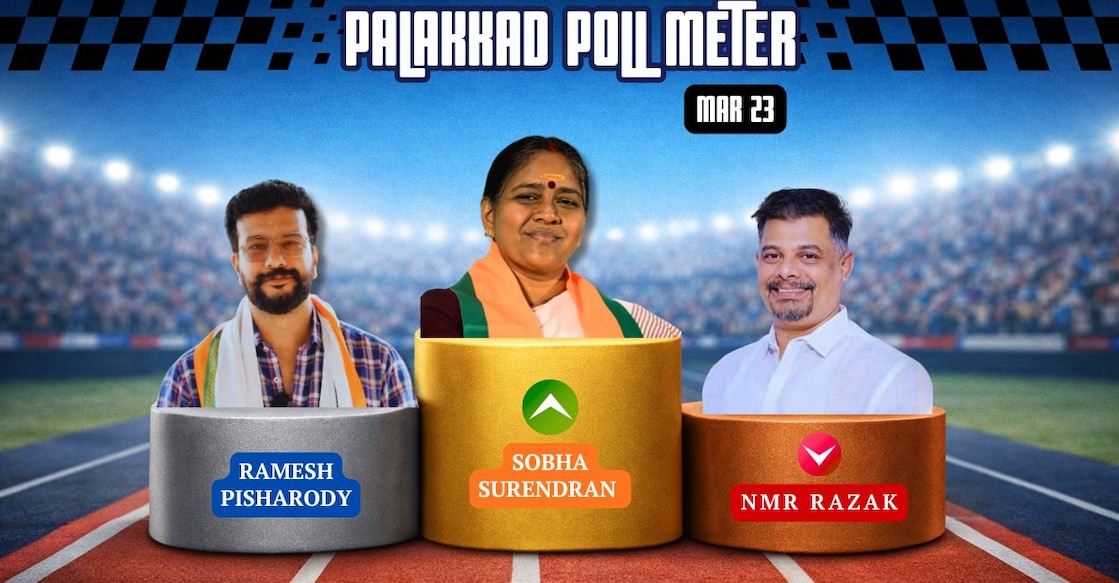
The electoral battle for the Palakkad assembly constituency looks to be an intense triangular contest. Early momentum appears to favour the BJP, and its candidate, Sobha Surendran, is setting the tone through sustained and visible outreach. In contrast, both the UDF and the LDF are yet to match that tempo as the candidates are still working to establish early traction.
Sobha Surendran, known for her combative style and repeated electoral presence, has emerged as the most visible campaigner.
The Congress has fielded actor Ramesh Pisharody and it appears to be more of a gamble than a calibrated choice. The CPM-backed independent candidate, businessman NMR Rasakh, adds a new dynamic but also raises questions about organisational depth.
Congress’s setback
The recent by-election in Palakkad, triggered by Shafi Parambil’s resignation, had delivered a clear mandate to the Congress. (Shafi Parambil had to resign following his election to Lok Sabha in June 2024 from Vadakara). In the ensuing Assembly by-election, Rahul Mamkootathil of the Congress had won the seat with over 58,000 votes (42.27%), while the BJP’s C Krishnakumar polled around 39,500 votes (28.63%). However, the political landscape has since shifted. Sexual harassment allegations against Rahul Mamkootathil, which led to his expulsion, placed the Congress on the defensive.
In this context, the choice of Pisharody has raised concerns within sections of the party, especially at a time when it needed a politically seasoned candidate to stabilise voter confidence. The burden of regaining momentum now rests more on the party machinery than on individual appeal.
The campaign has also acquired a gender dimension. With Sobha Surendran as the only prominent woman candidate, the BJP is attempting to expand its appeal among women voters beyond its traditional base.
Open to shifts
Past electoral data reflect the constituency’s fluidity. In the 2021 Assembly election, BJP’s E Sreedharan secured over 50,000 votes (around 35%) and indicated a strong base despite losing to Shafi Parambil. This suggests that while the BJP has not converted its vote share into victory, the electorate has shown openness to shifts.
The BJP’s internal factionalism, which affected its by-election performance, appears to have eased. The party now presents a more coordinated campaign structure, which could be decisive in a close contest.
Sobha Surendran’s strength
Sobha Surendran’s role in expanding the party’s vote base is notable. In 2011, the BJP secured 22,317 votes (19.86%) with C Udayabhaskar. In 2016, with Sobha in the fray, the vote share rose sharply to 40,076 votes (29.08%). This underlines her effectiveness as a mobiliser.
LDF’s show
For the LDF, the trajectory has been one of gradual decline. Once considered a stronghold, A K Gopalan, considering this a safe seat, contested in the Lok Sabha and won from here in 1971. The constituency now reflects reduced organisational depth. The decision to field NMR Rasakh as an LDF-backed independent, rather than a party candidate, may also affect cadre morale.
Geographically, Palakkad presents a mixed terrain. It comprises the municipality and the panchayats of Pirayiri, Mathur, and Kannadi. The BJP retains a steady urban foothold and the UDF and the LDF remain competitive in rural segments.
Recent local body trends, however, indicate that the BJP is making incremental gains in panchayats like Pirayiri and Mathur. This expansion beyond urban centres strengthens its position in a fragmented contest.
Minority consolidation
Minority vote consolidation remains a critical variable. Traditionally aligned with the UDF, Muslim voters have played a decisive role. The presence of Rasakh as an LDF-backed candidate could disrupt this pattern and may potentially split votes. Strategic consolidation against the BJP cannot be ruled out but its intensity may weaken.
Shafi Parambil’s personal influence continues to hold sway in certain pockets and could help the Congress retain parts of its base. However, this effect may be moderated by the broader controversy surrounding Rahul Mamkootathil.
Campaign momentum also appears uneven. Sobha Surendran has already completed multiple rounds of outreach and established an early connect. The UDF and the LDF campaigns are gathering pace but they have conceded early ground to the BJP.
Senior Congress leaders, including K C Venugopal and V D Satheesan, have alleged a tacit understanding between the CPM and the BJP, citing candidate selection. The BJP has dismissed these claims and Sobha Surendran framed it as a reflection of opposition anxiety.
Three factors
In a constituency where outcomes are shaped by vote consolidation and campaign energy, three factors may prove decisive: the BJP’s organisational push, the Congress’s ability to recover from reputational setbacks, and the extent of opposition vote fragmentation. Early indicators may favour the BJP, but, as always, the contest remains open.