























New Delhi: Gulf carrier Oman Air's CEO Paul Gregorowitsch said Friday the airline had no intention to bid for Air India or any of its wings.
He said that as the Gulf economies were in "crosswinds", the Muscat-based airline would prefer to focus on a strategy different from other Gulf carriers that had invested in other airlines either in India, Asia or Europe, and had "not been successful".
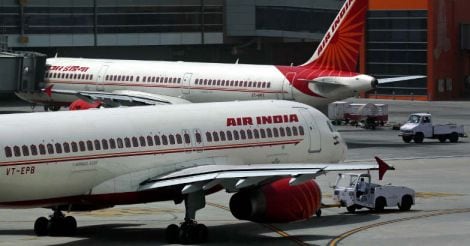
The union cabinet has given its in-principle approval for disinvestment of Air India, after the government's think tank NITI Aayog proposed complete privatization of the national carrier, which is saddled with a debt of Rs 52,000 crore.
"You never say no but if you ask me today if I would write a cheque to participate in (the bidding for) Air India, (I would say) we leave this to the priority of other Indian carriers," Gregorowitsch said at a press meet here.
Indian low-cost carrier IndiGo wrote to the government with an expression of interest in buying out the international arm of Air India and if that was not possible, it said it would like to buyout the entire Air India flight operations as well.
Oman Air currently has 47 aircraft in its fleet, which comprises Boeing 787S, Boeing 737s, Airbus 330s and Embraer 175s. It plans to expand its fleet to 70 aircraft and serve 75 destinations by 2023.
Sky pact
Gregorowitsch said that India has plans to have open sky agreements with countries within a radius of 5,000 kilometres.
An open sky air service agreement allows for airlines from the two countries to have an unlimited number of flights as well as seats to each other's jurisdictions.
"If the current policy of the Indian government to also consider an open sky (agreement) for those destinations which are within 5,000 kilometres materialises in the next two years, then it will automatically (provide us) a more level environment," Gregorowitsch said at a media round table here.
The move could be implemented by 2020, the Oman Air CEO claimed.
"From (the) information I have received in Oman, Indian government has said it will consider it (open sky agreement) by 2020," he said.
He also said that such a move would be a "win-win" for both India as well as the Oman carrier, as the latter is planning to add more aircraft and more destinations.
However, the move should be complemented with more airports being made available in the country by permitting military airports to be used for civil purposes, he added.
As per the National Civil Aviation Policy 2016, the government will enter into an open sky air service agreement on a reciprocal basis with SAARC countries and countries with territory located entirely beyond a 5,000-kilometre radius from New Delhi.
"For countries partly or fully within the 5,000-kilometre radius, where the designated carriers of India have not fully utilised 80 per cent of their capacity entitlements, but foreign carriers/countries have utilised their bilateral rights and are pressing for increase in capacity, a method will be recommended...," according to the policy.
Oman Air has been able to add 5,067 seats in summer this year. In the winter schedule too, it will add 1,821 seats after the bilateral agreement between the two countries was revised to permit the carrier to operate additional seats.
The total weekly flights have now gone up from 128 to 161.
"This has allowed us to move to a total 27,405 seats, while we are allowed to have 28,000 seats between Oman and India," Gregorowitsch said.
He also touched upon the challenges facing the airline because of infrastructural shortcomings at airports in India.
"In Mumbai, we are moving from double (flights) daily to triple (flights) daily. While we have bilaterals, the infrastructure is quite difficult as there is only one runway," Gregorowitsch added.
While speaking about diplomatic tensions facing Qatar, he said the thaw in relations affected all countries in the region.
"If you look at markets, they look at the middle east as one big entity and unrest in Qatar reflects on all the nations. There are no winners, there are only losers. People could have second thoughts because they sense a kind of instability in parts of middle-east," he said.
Currently, the airline has 47 aircraft in its fleet, which comprises Boeing 787S, Boeing 737s, Airbus 330s and Embraer 175s.
Its plan to expand the fleet size to a total 70 aircraft and serve 75 destinations by the end of 2020 has been postponed to 2023.
