





















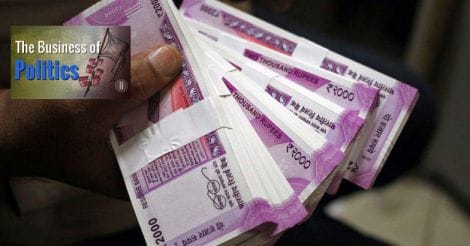
 Representational image
The BJP’s Kerala unit was energized by the party’s ascent to power at the center. There was a mad rush to the party and for good reason. Power provided avenues to get rich quick. Here’s how.
An imaginative way to form special cells within the party. No one wanted the dirty work. Everyone wanted to be in charge of something special.
BJP president Amit Shah was peeved by the tendency. He lashed out at a leader at a review meeting for harping on job fairs, medicine distributions and water conservation plans. Shah gave him a piece of his mind: “We don’t need any extraordinary work. We need party work.”
The outburst was well-founded. BJP leaders in Kerala had been busy collecting donations in the name of implementing the welfare measures rolled out by the central government. They went about organizing job fairs and forcing central government institutions to sponsor the events.
The party headquarters was flooded by complaints about the forced fund raising.
The Jan Oushadhi scheme threw open another opportunity for the unscrupulous elements within the party that ruled at the center. A Jan Oushadhi center could be allotted to anyone who deposits a nominal fee of Rs 100. In practice, a “service charge” is due to some parties. Moreover, anyone who wants to operate a center will have to agree to hire specific firms to do the interior works. Needless to say, those agencies have connections with some party leaders.
The same strategy was employed in the computer service centers.
Two middlemen from Kochi were at the center of all these deals. They even misled two Union ministers to a particular luxury hotel. They have interests in everything from the cleaning ops in the airport to the catering services in the railway. The party has received a complaint that the two leaders had asked for Rs 25 lakh from a water distribution firm in the Naval Base in Kochi.
The BJP had planned a month-long house visit and fund raising ahead of the 2019 general election. The workers were asked to go to every house they were assigned to and receive a token amount as donation during the campaign drive. The aim was to activate the booth-level work.
The district units of the party, however, took a short cut. The committees met their fundraising targets by going to the merchants and establishments, doing away with the hard work of going from house to house.
Some local leaders were even accused of intimidating merchants into paying up.
A leader in Kottayam and the leader disgraced by the recent scam went directly to a private establishment in Kottayam to ask for Rs 25 lakh. The factory owner said he had already given Rs 1 lakh to another leader who was in charge of the area. He even showed them a receipt.
The leaders refused to back out. They said they were on a different mission. They even gave the entrepreneur an option to pay in installments!
The district leader later sent a letter to the businessman in an intimidating tone. He said the businessman refused to oblige even after the state-level leader met him personally, whereas all other establishments had paid up.
Shockingly, the party leaders ask for an arbitrarily set amount. If anyone protests, they are subtly reminded of a possible income-tax raid.
In note we trust
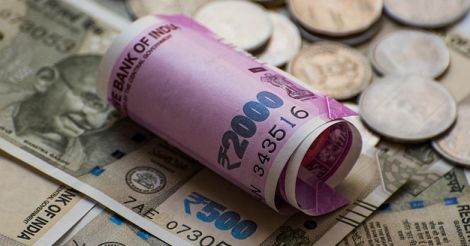 Representational image
Some BJP leaders in Kerala think it is below their dignity to collect donations from the common man. The matter came up for discussion in a top-level meeting attended by Amit Shah. Why would we want receipts for as low as Rs 20, some of them asked.
They complained that their activities were being hampered by a shortage of receipts for Rs 1,000 and above. They said they were tired of going around for small change when industrialists were ready to contribute huge amounts.
Shah did a quick math and presented his arguments. He said the party unit in Kerala has distributed only 30 percent of the Rs 20 receipts, which means that the workers have not gone to every doorstep as required.
The BJP did not have any dearth of funds. The party wanted its foot soldiers to go on a modest fundraising drive because that offered them a chance to mingle with the crowd, Shah said.
Still individuals and establishments across Kerala keep getting requests for donations in the party’s official letterheads. The requirements -- ranging from Rs 1 lakh to Rs 10 lakh -- have unleashed a plethora of complaints and disputes.
Shah was put up in a government guest house when he visited Kochi. The party’s state leaders, however, chose luxury hotels.
Shah hosted business leaders from his guest house room. The BJP business cell had put up huge cutouts of the party president along the city, some larger than the ones erected by the party. The business lobby was there to prove its presence when prime minister Narendra Modi visited Kochi to inaugurate Kochi Metro.
The BJP has only barred its workers from getting involved in matters of administration. They are free to exploit the situation wherever possible. When Modi visited Kozhikode to address a huge gathering, a state leader ensured that he bagged the contract to put up the makeshift marquee. Others made sure that they too got a piece of the pie by getting contracts to put up cutouts and paste posters.
Systemic rot
A BJP leader in Kochi is accused of receiving bribes to grant licenses to run the central government’s Jan Oushadhi drug outlets. He is also accused of receiving bribes from pharmaceutical companies to create an artificial shortage of certain top-selling medicines.
The Jan Oushadhi franchise owner decided to take up the issue with the BJP leadership but he was intimidated by the goons hired by the leader.
Jan Oushadhi was most popular in Kerala because of the availability of cheap medicine. The popularity of the scheme launched a tide of applications for operating franchises in the state. The leader saw an opportunity in the scheme and offered a franchisee to anyone willing to pay him Rs 3 lakh to Rs 4 lakh. A society was formed based in Kochi with an intention to start stores that sold medicines at cheap rates. The money was to be deposited to an account in favor of “Government Jan Oushadhi”.
BJP leaders have received complaints against a gang of middlemen led by the controversial leader. The coterie had facilitated the setting up of Jan Oushadhi stores close to existing shops under the scheme in Kollam, Vaikom, Angamaly and Kodungallur areas.
The leader even asked for a bribe of Rs 4 lakh from another party leader in Malappuram for granting a franchise. The leader in Malappuram, however, got a taste of his own medicine. He himself is facing allegations of asking for Rs 10 lakh as bribe for ensuring someone a job in a bank.
The Jan Oushadhi scheme had only one nodal officer in Thiruvananthapuram. With the increase in the number of applicants, three nodal officers had to be appointed. One of them landed in soup when his behind-the-scene deal-making was secretly recorded and the audio clip sent to all BJP leaders before a key meeting. He was heard talking to the applicants with a fixed rate in mind. A couple of officials from Delhi had come to Thiruvananthapuram to enquire the matter.
As many as 200 Jan Oushadhi stores had been opened in Kerala, compared to just 10 in Tamil Nadu. As many as 12,000 applications are pending perusal.
Drugs for lifestyle diseases such as diabetes and thyroid imbalance sell at almost 80 percent lower rates at the Jan Oushadhi stores. The pharma companies saw a decline in sales of these drugs after the launch of the scheme.
They found a conspirator in the BJP leader who offered to create a shortage of these drugs in the Jan Oushadhi stores. He received a bribe after meeting with the representatives of the companies.
The Jan Oushadhi franchisee, who is also a BJP sympathizer complained to party bodies about the leader’s role in the conspiracy, but the leadership is yet to take any action on it.


Fence eating the crop
The appointment of a tainted officer as the managing director of a public sector undertaking raised many eyebrows. He was already under the scanner of the Central Bureau of Investigation and the Vigilance and Anti-Corruption Bureau for irregularities conducted during his stint as the managing director of another public sector undertaking in Kollam.
Though he was appointed as the managing director of the PSU in Kollam in 2005 during the tenure of the United Democratic Front government, he survived the regime change a year later. He had an impressive unbroken innings even after the United Democratic Front came back to power in 2011. Moreover, his close relative, a trade union leader, was appointed as chairman of the PSU.
Both the managing director and the chairman came under the lens of the CBI along with a CPM leader. Shown the door from the PSU, the official started lobbying for another position. He found surprising support from a CITU leader and a state committee member of the CPM.
The accused official sent an application to helm the Thiruvananthapuram-based PSU along with the recommendation letters of the CITU and CPM leaders. His application was forwarded with uncharacteristic speed to the minister concerned, who ordered his appointment.
But that was not the end of the story. The department head raised an objection and wrote a note demanding clearance from the Vigilance and Anti-Corruption Bureau before appointing a person facing a corruption probe.

Memorial to corruption
Congress workers in Kannur wanted to build a memorial for a deceased leader. A charitable trust formed for the purpose collected more than Rs 16 crore, mainly from expatriates. The plan was to buy the leader’s alma mater and make the school into a memorial. Four years down the line, the plan remains a not-starter and the school has come under the control of the CPM.
Many non-resident businessmen had contributed to the project. Some of them had even donated Rs 50 lakh. They were told that the school would be developed into a deemed university within 15 years.
The Congress leaders now say that they could not agree on a price for the school. They, however, remain silent on how to repay the investors.
A Congress minister in the Oommen Chandy government is still ruing the day he trusted his party colleague.
The minister had mediated a high-profile dispute when he was in power. The company rewarded the minister with an apartment near the museum in Thiruvananthapuram. The leader, being cautious, asked the company to register the apartment in the name of a former DCC member’s wife. After all, the government was being rocked by allegations of corruption related to the bar issue.
The transaction was completed and the former DCC member shifted to the flat along with his family.
Out of power, the Congress leader asked his benami to vacate the flat. He was in for a shock. The former DCC member simply refused to pack up. He is happy in his new adobe and he has almost quit the party.
The former minister even thought of extreme measures to get the flat vacated but his friends restrained him.
(To be continued)
(Reported by Jiji Paul, Anil Kurudath, Jayachandran Ilankath, R Krishna Raj, V R Prathap, Mintu P Jacob, A S Ullas and T B Lal)
Read more: Latest Kerala news | As soon as I heard about the actress attack, I called up Kavya Madhavan: Rimi Tomy
