























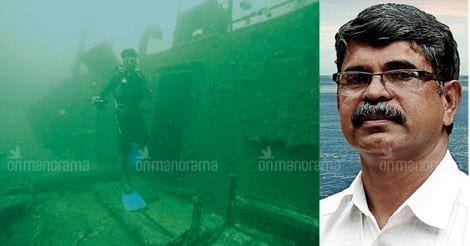
 A Pakistani ship that sunk off the coast of Kanyakumari.(L) Robert Panipilla
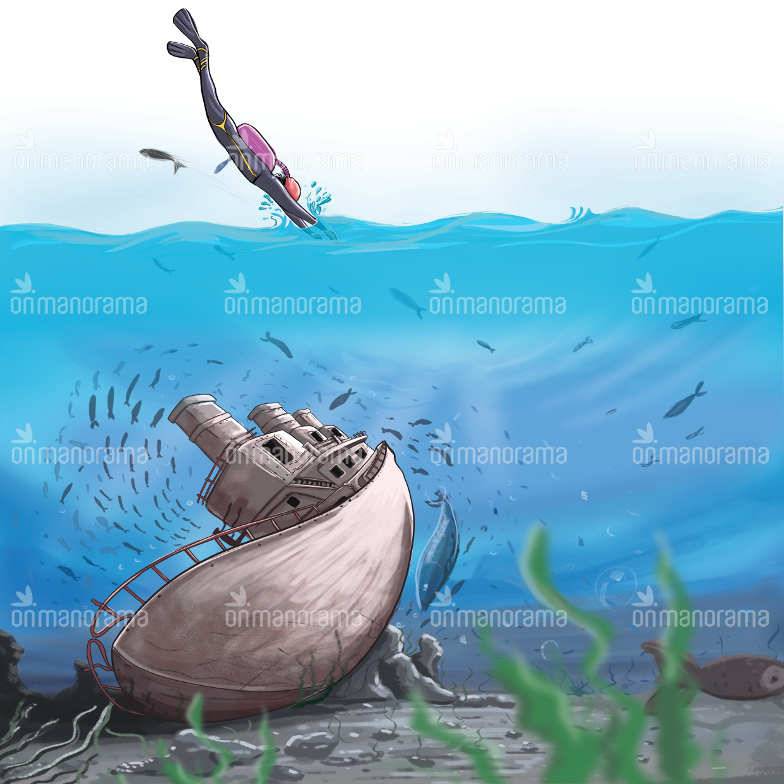
Thomas and Jose had cast their fishing nets in the bay off Shamkhumugham around midnight when they spotted a red light in the deep sea. The fishermen watched the light slowly sinking into the water. That was not the only strange sight that awaited them on that distant August in 1968.
Moments later they saw another light fast approaching the same spot. The first light had almost snuffed out by then.
The next day, they learned that they had witnessed the sinking of an oil tanker. The second light was a rescue boat called in to save the sailors. The fishermen hauled the timber from the sunken ship and presented them to the local church.
Thomas and Jose searched for four years to identify the exact location of the shipwreck until they succeeded in July 1972. They relied on stars and other navigation techniques to pinpoint the location.
The discovery was significant for the fishermen. A sunken ship gradually transforms into a shelter for schools of fish, a guaranteed spot for fishing. The artificial reef turned 50 years old this year.
Fishermen’s lore such as this gradually fades from the community’s memory, unless someone like Robert Panipilla materialises.
The marine life enthusiast from Valiyathura near Thiruvananthapuram has been documenting the hidden wonders of the seabed. The fisherman started out by interviewing the veterans of the community, including his father and brothers.
He compiled the experience of generations into a Malayalam book titled ‘Kadalarivukalum Neranubhavangalum’ and got it translated into English. He said that he had documented about 30 ecosystems off the coast of southern Kerala. He has photographed about 20 sunken vessels that have turned into artificial reefs.
There are 100 such marine ecosystems off southern Kerala that are instrumental in finding a steady livelihood for fishermen.
One of Panipilla’s finds was a massive Dutch vessel that sunk near Anjuthengu between Thiruvananthapuram and Varkala about 250 years ago. The fishermen in the area have been fishing over the ship for about a century since it was discovered by one Sebastian aka Sukkoorachan. The high concentration of fish has even drawn fishermen from as far as Kanyakumari, according to the folk songs still in currency.
Determined to photograph the ships and collect more details on the wreck, Panipilla got in touch with the ports department and the archaeology department but none of the officers had any clue about the wreck.
Panipilla neither possessed the diving apparatus to go below 40 metres nor any background in marine science. However, he was armed with knowledge passed on through generations and a steely will to succeed.
The man who had studied only up to 10th grade formed a voluntary association named the Friends of Marine Life (FML) 18 years ago and taught himself English to access a wider world.
He tapped into the local communities of fishermen to form a collective of deep-sea divers. He brought in licensed divers from Tamil Nadu and bought underwater cameras.
He funded his passion with the little money he earned from landscaping business and the modest apparel shop run by his wife Naina and daughter Roshni. He also received liberal help from his friends.
Ultimately, he managed to reach the Dutch ship and take photographs of its still visible cannons and cranes. 43 metres below the sea level, the wreck is home to a variety of big fish.
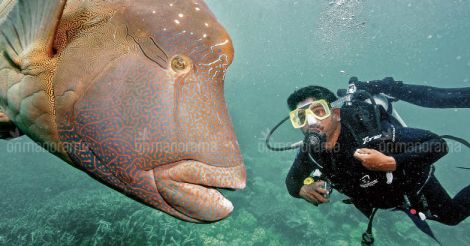 Robert Panipilla diving in the Great Barrier Reef in Australia.
The discovery only fuelled Panipilla’s curiosity. He studied the ship’s history. He learned about a bell gifted by Dutch sailors to a local temple in Varkala. He followed the Dutch names inscribed on the bell. After rifling through old Dutch records, he found out that the ship was manufactured in the Amsterdam wharf in 1752. The ship came under attack during one of its voyages to the then Travancore in 1754. The locals had burnt down the ship, Panipilla said.
Diving to the top
Two years of indigenous marine research has transformed the founder of the Friends of Marine Life. He received training in deep sea diving. He has dived to most exotic locations including the Great Barrier Reef in Australia to learn about coral reefs.
He formed a team of expert Scuba divers and helped many children from the fishing communities to pursue higher education in marine studies.
The underwater team of the Friends of Marine Life has even photographed a Pakistani ship sunken off the coast of Muttam near Kanyakumari.
Panipilla focused his works to establish the connection between marine research and indigenous knowledge of the fishermen community. His efforts paid off when he was made the coordinator of the newly formed marine bio register by the biodiveristy board in Thiruvananthapuram.
He attended the United Nations marine conference in New York last year. He just travelled to London as a special invitee of the Ditchley Foundation to draw the framework of the talks in the G7 summit in June. The next stop is a conference of marine researchers in the Netherlands.
Panipilla said that he was just adding traditional wisdom to the academic body of work.
The Friends of Marine Life team has recently fished out tons of fishing nets strewn all over the seabed by the devastating Cyclone Ockhi. These “ghost nets” are environmentally disastrous as they keep netting unsuspecting marine life.
Panipilla’s next mission is to photograph the sunken oil tanker discovered by Thomas and Jose.
That would add to a gallery of pictures that includes an underwater rail track!
Not long ago, a rail track divided the Shankhumukham beach in Thiruvananthapuram. Goods trains from Veli carried cargo to the Valiyathura sea bridge, where the boats lay in wait to transport the cargo to the ships anchored beyond.
In 1947, a crashing sound alarmed the flock gathered at the Valiyathura church in the evening. They rushed out of the church to see the sea bridge swaying violently. S S Pandit had veered off its course and crashed into the sea bridge. Eventually, the bridge went under water.
The owner of the ship paid up and the government rebuilt the sea bridge in 1956.
Panipilla’s team has photographed the rail track that fell into the sea in 1947. The divers are waiting for the next catch.
