























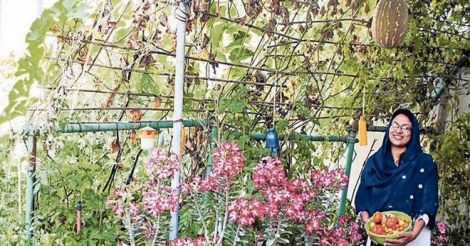
Najma Nazir’s villa in Hilal, Doha, is in reality a vegetable garden, with almost everything growing out of the desert. It’s been 15 years now since Thrissur-native Najma started her home farm in Qatar. Though she had to move house many a time, her farm was left intact and went along with her. With the Hilal villa being her present set up for the past three years, the farm output has only multiplied and the yield is there all round the year.
This is no random hobby farming for Najma. A lot of homework goes into her work. It’s a deliberate exercise, executed scientifically and in structured phases. The farming is a three-phased exercise, beginning from September. Najma has a clear idea of what’s to be planted in each phase. Her experiments have been culled from her years of experience as an expatriate.
The three phases
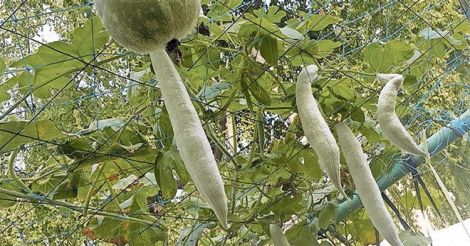
Vegetables planted in September include: Ash gourd, okra, snake gourd, pumpkin, ridge gourd, peas, beans, bottle gourd, yellow cucumber and several varieties of brinjal.
The second phase in November sees cabbage, tomato, green chillies, broccoli, cauliflower, asparagus and molokhia being planted. This also happens to be the best time to farm small and big onions.
What’s planted during the third phase in February are spinach, ladies finger, water melon and cucumber. By this time the drumstick will start flowering.
Najma uses nothing other than organic manure on her farm. She has her own manure mix which she shares with Onmanorama Women. One trick is to pour rice gruel into powdered cow dung. This is set aside for three days. When diluted with water, it’s a fine source of manure. Fish amino acid, egg amino acid, groundnut waste (kadala pinnakku) and curdled gruel are other sources of natural manure. Once in 10 days, all the plants are fed powdered cow dung. All waste from the kitchen too is turned into plant food.
From jarjeer to aniseed
The salad favourite jarjeer (aragula) leaves, mustard and aniseed can also be sourced from Najma’s farm. Several varieties of tomato, especially, the yellow ones are in plenty here. During peak seasons, Najma has collected over 2 kg of tomatoes a day. She has up to 30 kg of tomatoes saved in her freezer from which she takes whatever she needs for her dishes. She has also exotic and varied varieties of spinach. With each harvest comes the job of preserving the best seeds for the next year’s crop. The sand needed for her pots and bags is bought from nurseries.
The best mix for plants is a right combination of sand, cow dung and coir pith, says Najma.
Not all tubers grow
Though carrots and beetroots were a success, the farming genius is quite sad that her experiments with ginger, yam, colocasia and Chinese potato (koorka) have not borne fruit. They just refuse to come up with the desired yield. She has therefore decided not to waste her time over such produce.
On an average Najma spends close to three hours on her farm. She is gratified by the fact that the family eats only fresh-from-the farm veggies, though her farm produce does not exactly see her cash box ringing. Since the vegetables are planted on a phased basis, the family has almost all it needs to keep it going for 10 months in a year. She seldom shops for vegetables from outside except on very rare occasions and that too for special needs.
Najma, a member of Doha’s Nammude Adukkalathottam group, often engages classes for friends and others interested in farming. She believes that an exchange of ideas and farming tips is the best learning experience.
Pest-busting tips from Najma
The best way to keep pests away is to be with your plants daily, to check on them and find signs of pest attacks. The minute you spot an attack, curative measures can be taken.
Here’s a medicinal concoction from Najma. Extract juice from tulsi and mix it with jaggery. Powder two Paracetamol tablets and add this to the mixture which can be sprinkled over the leaves and stem.
Yellow is an insect-luring colour, says Najma. To ward off pests, she has planted tagetes or marigold (chendumalli) and placed them in vital corners. She believes that these yellow flowers will attract pets away from her vegetables. A mix of neem cake and turmeric are also natural pesticides. Turmeric is an ideal anti-pest remedy, says Najma. This works best for cabbage. Turmeric powder is to be sprinkled at least once in 10 days and neem cake can be mixed with the soil. An additional quantity of neem can be mixed with the soil every two weeks.
Talking about her experience as a Gulf expatriate, Najma says, one has to live in the Gulf to learn how to maximize output from the minimum resources available, space being the main factor. So use, whatever you can to the best of your advantage is her advice. Never plant climbers or creepers at the centre of the garden. Leave them by the boundaries and allow them to grow freely. Plants in grow bags or pots work best in Gulf countries, says Najma, aglow with the joy of her success in farming.
Read: On a Roll | When a Dalit girl soared on the wings of her ambition
